Highlights
- Significant improvements were observed in children’s overall developmental quotient (ES, 0.17 SD) and fine motor abilities (ES, 0.19 SD) following an 8-month blended parenting intervention.
- The intervention significantly enhanced parenting behaviors, as measured by the HOME score (ES, 0.25 SD), indicating improved responsivity and learning environments.
- The study demonstrates the feasibility of integrating child development programs into existing primary health care services using a cost-effective blended delivery model (alternating in-person and remote contact).
- Findings suggest that hybrid delivery can maintain the effectiveness of traditional home-visiting programs while potentially increasing reach and scalability in resource-limited settings.
Background: The Challenge of Global Child Development
Early childhood development (ECD) is a critical determinant of lifelong health, educational attainment, and economic productivity. Despite its importance, an estimated 250 million children under the age of five in low- and middle-income countries (LMICs) are at risk of not reaching their developmental potential due to poverty and lack of stimulation. While evidence-based parenting programs have shown success in mitigating these risks, the primary challenge remains the identification of scalable, sustainable delivery models within government services.
Traditional home-visiting programs, such as the widely recognized Jamaican Reach Up model, are effective but resource-intensive. They require significant personnel time and travel costs, which often hinder large-scale implementation. Primary health care (PHC) systems offer a logical platform for these interventions; however, the heavy workload of clinic staff necessitates more flexible delivery strategies. The integration of remote delivery—via telephone or digital platforms—combined with occasional in-person visits (a blended approach) has emerged as a potential solution to bridge the gap between efficacy and scalability.
Study Design and Methodology
This single-blind randomized clinical trial (RCT) was conducted in Jamaica, involving primary health care centers across multiple communities. The primary objective was to evaluate whether a parenting program delivered through the government health system, utilizing a blended approach of in-person home visits and remote telephone calls, could benefit child development and parenting practices.
Participants and Setting
Enrollment took place between July 2022 and August 2023. Families with children aged 3 to 28 months were identified by health staff at participating PHC centers. A total of 627 children were enrolled and randomly assigned to either the intervention group (n=311) or a waiting list control group (n=316). The sample was relatively balanced by gender, with 322 (51.4%) male children.
The Intervention
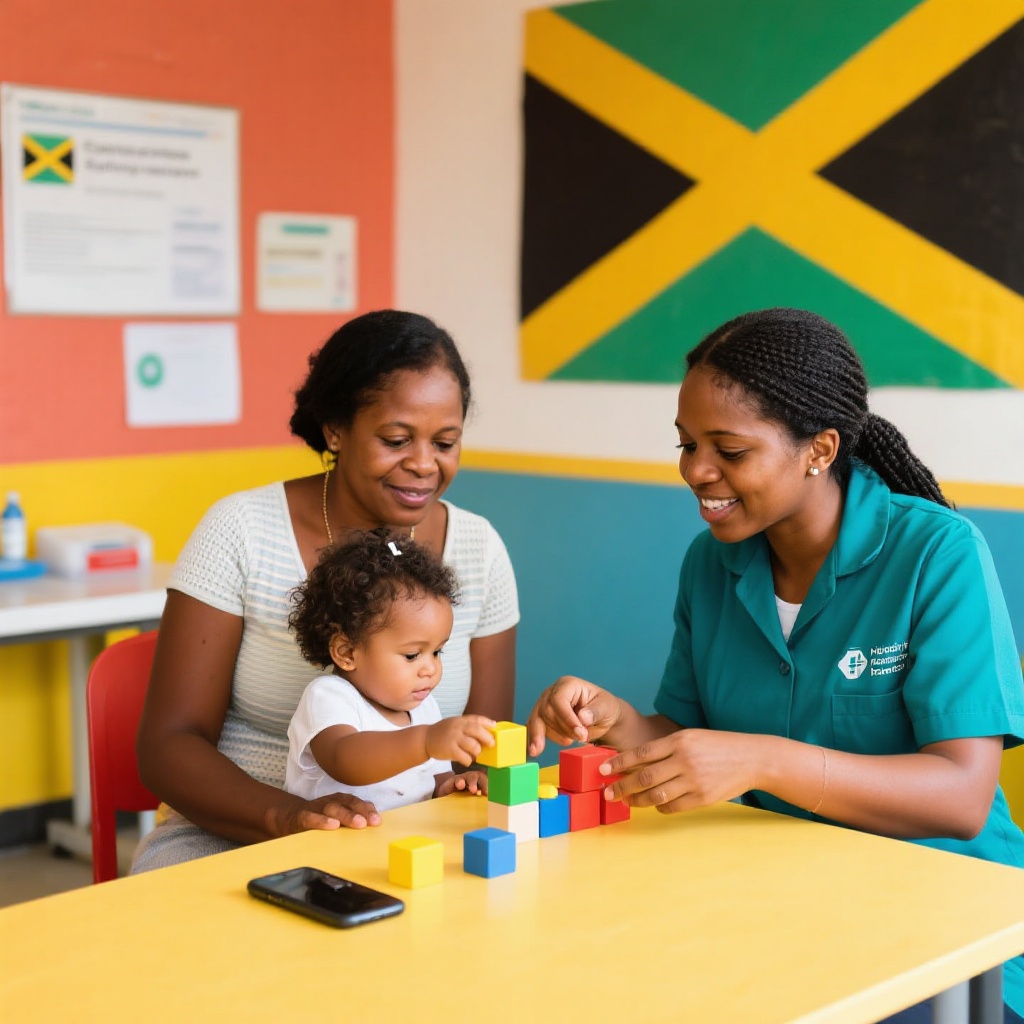
The intervention lasted eight months and was delivered by community health workers (CHWs). The curriculum focused on strengthening parents’ abilities to support their child’s learning through responsive interactions and play. The delivery was unique in its blended format: CHWs made fortnightly contacts with families, alternating between one in-person home visit and one telephone call every month. This structure was designed to maintain the personal connection and hands-on coaching of home visits while reducing the logistical burden through remote check-ins.
Outcome Measures
The primary outcomes were children’s developmental progress and the quality of the home environment. Child development was assessed using the Griffiths Mental Development Scales (GMDS), which provide a developmental quotient (DQ) and subscale scores for domains such as fine motor skills, language, and personal-social development. Parenting behaviors and the home learning environment were measured using the Home Observation for Measurement of the Environment (HOME) inventory, which evaluates parental involvement, responsivity, and the provision of learning materials. Effect sizes (ES) were calculated to provide a standardized measure of the intervention’s impact.
Key Findings: Significant Gains in Development and Parenting
The study reported follow-up data for 491 children (78.3% of the original sample) at an average age of 27 months. The results, analyzed via intention-to-treat multivariate regression with inverse probability weights, demonstrated clear benefits across several domains.
Child Developmental Outcomes
Children in the intervention group showed a significantly higher overall developmental quotient compared to the control group, with an effect size of 0.17 SD (95% CI, 0.01-0.33 SD). When examining specific developmental domains, the most pronounced benefit was observed in fine motor abilities, which yielded an effect size of 0.19 SD (95% CI, 0.03-0.36 SD). These results indicate that even with a reduced frequency of in-person contact, the program successfully stimulated cognitive and physical milestones.
Parenting and Home Environment
Perhaps the most robust finding was the impact on parenting behaviors. The total HOME score improved significantly in the intervention group (ES, 0.25 SD; 95% CI, 0.08-0.41 SD). This suggests that the blended delivery model was effective in changing how parents interact with their children, fostering more responsive caregiving and better utilization of play materials. This is a crucial finding, as improvements in the home environment are often the mechanism through which child developmental gains are sustained over time.
Consistency and Scalability
The study found no significant differences in follow-up rates or baseline characteristics between the intervention and control groups, suggesting that the blended model did not adversely affect family retention. The use of existing community health workers within the government primary care framework further highlights the potential for this model to be integrated into national health policies without requiring an entirely new workforce.
Expert Commentary: Bridging the Implementation Gap
The findings of this trial, published by Chang et al. in JAMA Network Open, represent a significant step forward in the field of global child health. For years, the scientific community has known “what” works—responsive parenting and early stimulation. The lingering question has been “how” to deliver these interventions at scale within constrained public health budgets.
This study provides strong evidence that the “how” may involve hybrid or blended delivery. By alternating phone calls with home visits, the program reduces travel time for CHWs and allows for more flexible scheduling for parents, particularly those who may be working. The significant effect size for the HOME score (0.25 SD) is particularly encouraging, as it confirms that remote contact can successfully reinforce behavioral changes in parents that were initiated during in-person visits.
However, some limitations must be considered. While the overall DQ and fine motor scores showed significant improvement, other subscales did not reach statistical significance. This may suggest that certain domains, such as language development, might require more intensive or specific in-person coaching than the blended model provided in this eight-month window. Furthermore, while the study demonstrates efficacy in the Jamaican context, further research is needed to determine if this model can be adapted to regions with lower telephone penetration or different cultural attitudes toward remote health services.
Conclusion: A Blueprint for the Future
The Jamaican trial of blended parenting delivery offers a promising blueprint for scaling early childhood interventions. By leveraging the existing primary health care infrastructure and utilizing a mix of in-person and remote delivery, the program achieved meaningful improvements in both child development and parenting practices. As governments worldwide strive to meet the Sustainable Development Goals related to early childhood, this model provides a pragmatic, evidence-based strategy for ensuring that the most vulnerable children receive the support they need to thrive.
Funding and Trial Registration
This study was supported by grants from the Inter-American Development Bank and other international development partners. The trial is registered in the ISRCTN Registry (Identifier: ISRCTN11059214).
References
- Chang SM, Smith JA, Wright AS, et al. Blended Delivery of a Primary Care Parenting Program for Child Development: A Randomized Clinical Trial. JAMA Netw Open. 2026;9(2):e2556024. doi:10.1001/jamanetworkopen.2025.56024
- Walker SP, Wachs TD, Grantham-McGregor S, et al. Inequality in early childhood: risk and protective factors for early child development. Lancet. 2011;378(9799):1325-1338.
- Grantham-McGregor SM, Powell CA, Walker SP, Himes JH. Nutritional supplementation, psychosocial stimulation, and mental development of stunted children: the Jamaican Study. Lancet. 1991;338(8758):1-5.