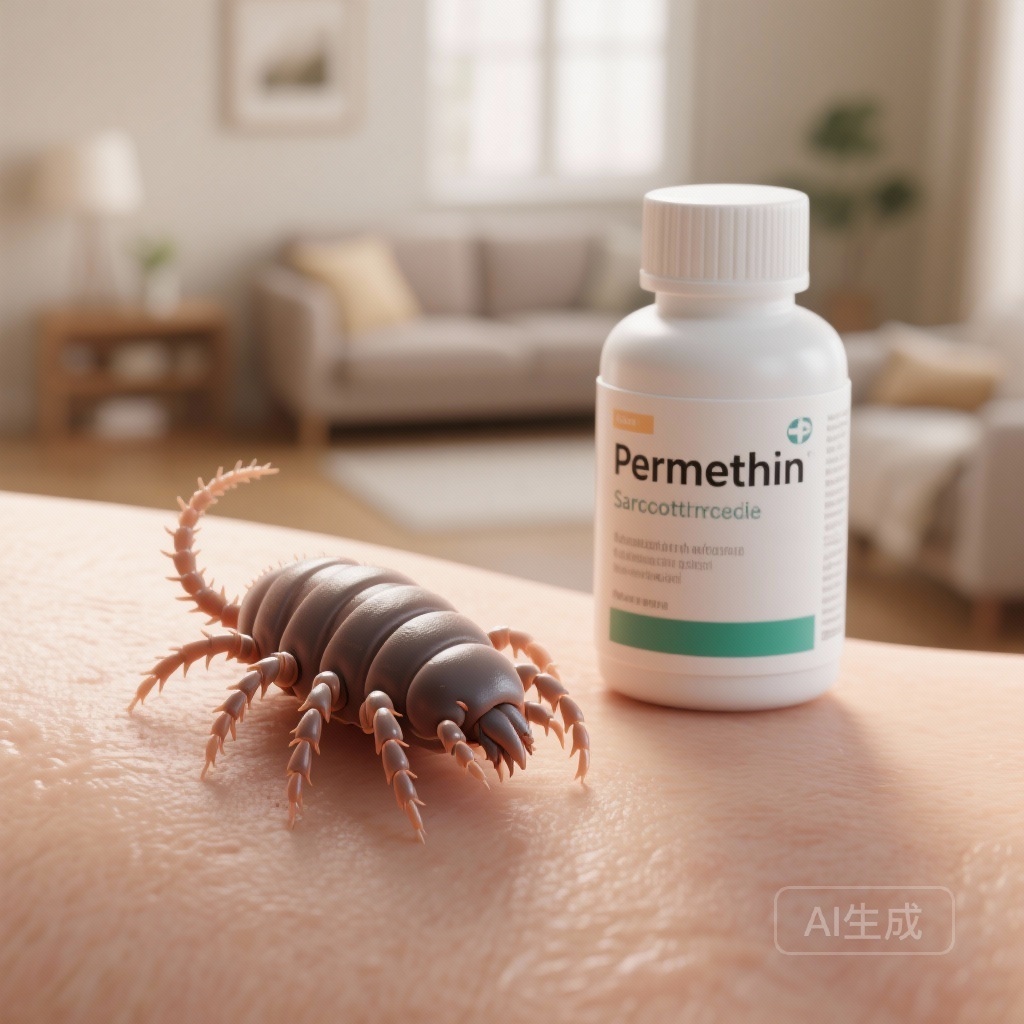
The Persistent Problem of the Seven-Year Itch
Scabies is more than just a minor skin irritation; it is a neglected tropical disease that affects millions worldwide, regardless of age, socioeconomic status, or hygiene levels. Caused by the microscopic mite Sarcoptes scabiei var. hominis, this condition triggers an intense, relentless itch that often worsens at night, severely impacting the quality of life, sleep, and mental well-being of those affected. For years, clinicians have debated the best way to tackle this highly contagious infestation, often choosing between the convenience of an oral pill, ivermectin, and the traditional topical application of 5% permethrin cream. While the oral route is often perceived as easier for patients to comply with, a major new clinical trial published in the BMJ suggests that we may need to reconsider our preference for the pill.
Scabies is fundamentally a family or household disease. Because the mites are transmitted through close skin-to-skin contact, treating only the individual with visible symptoms—the index case—is rarely enough. Entire households must be treated simultaneously to prevent the dreaded cycle of re-infestation. This communal aspect of the disease was the central focus of a recent multicentre, cluster-randomised trial conducted across 28 hospitals in France, providing some of the most robust evidence to date on how we should approach treatment today.
The Case of the Thompson Family
To understand the practical implications of this research, consider the Thompsons, a family of four living in a quiet suburban neighborhood in Ohio. Mark, a 34-year-old high school teacher, began noticing small, red bumps between his fingers and around his wrists. Within a week, the itch became unbearable, especially after he went to bed. Soon, his wife, Sarah, and their two young children, six-year-old Leo and three-year-old Mia, began scratching as well.
When the family visited a dermatologist, they were diagnosed with classic scabies. The doctor explained that the mites had likely spread through their daily close interactions. In a scenario like this, a clinician faces a choice: prescribe a round of ivermectin pills for the adults and older children, or ask everyone to apply a thick layer of permethrin cream from head to toe. Many families, like the Thompsons, might initially prefer the pill, thinking it is less messy and easier to manage than a full-body cream application. However, as the latest scientific evidence shows, the ‘easier’ path might not be the most effective.
What the Data Tell Us: Oral Ivermectin vs. Permethrin Cream
The French study, led by Boralevi and colleagues, was a rigorous investigation involving 1,075 participants across 289 households. The researchers used a cluster-randomised design, meaning entire households were assigned to either oral ivermectin (200 µg/kg) or 5% permethrin cream. Crucially, all participants received two doses of their assigned treatment: one on Day 0 and a second on Day 10. This two-dose regimen is essential because most scabies treatments kill the mites but not the eggs; the second dose is timed to kill any mites that have hatched since the first application.
The results were striking. When looking at the primary outcome—the clinical cure of the entire household by Day 28—permethrin cream significantly outperformed oral ivermectin. In the permethrin group, 88.5% of households were completely cured, compared to only 71.8% in the ivermectin group. This represents a difference of nearly 17 percentage points, firmly establishing the superiority of the topical treatment in this trial.
Comparison of Cure Rates at Day 28
| Analysis Level | Oral Ivermectin Cure Rate | Permethrin Cream Cure Rate | Difference (Percentage Points) |
|---|---|---|---|
| Household (Cluster) Level | 71.8% | 88.5% | -16.7% |
| Index Case Level | 76.6% | 91.5% | -14.9% |
| Individual Participant Level | 85.3% | 94.2% | -9.2% |
Why Does Permethrin Work Better?
The biological reason for this difference likely lies in how these medications reach the mites. Permethrin is applied directly to the skin, creating a high local concentration of the neurotoxic agent that targets the mites where they live, in the stratum corneum (the outermost layer of the skin). It stays on the skin for 8 to 12 hours, ensuring prolonged exposure for the parasites.
In contrast, oral ivermectin must be absorbed by the gut, enter the bloodstream, and eventually reach the skin through the capillaries and sweat glands. While ivermectin is highly effective at killing many parasites, its concentration in the skin may vary depending on an individual’s metabolism, body fat, or even what they ate that day. Furthermore, ivermectin might not reach the very surface of the skin where some mites reside as effectively as a topical cream does.
Correct Health Practices: The Secret to Success
One of the biggest challenges with permethrin is the application process. For the treatment to work, it must be applied correctly. This means applying the cream to the entire body, from the jawline down to the soles of the feet, including between the toes, under the fingernails, and in the genital area. For children and the elderly, the scalp and face should also be included, avoiding the eyes and mouth.
Many ‘treatment failures’ are actually application failures. If a patient misses a small patch of skin—for example, the middle of the back or the skin under a wedding ring—a female mite could survive there and continue to lay eggs. The BMJ study underscores that when permethrin is applied diligently on Day 0 and Day 10, the success rate is exceptionally high.
Common Misconceptions and Harmful Behaviors
A common misconception is that if you don’t itch, you don’t have scabies. In reality, it can take up to six weeks for a newly infested person to develop the allergic reaction that causes itching. This is why the ‘cluster’ approach is so vital. If Mark Thompson is the only one scratching, but Sarah and the kids are not yet symptomatic, they likely still harbor mites. Treating only Mark would almost certainly lead to him being re-infested by his family members a few weeks later.
Another harmful behavior is the overuse of corticosteroid creams. While these can temporarily soothe the itch, they do not kill the mites. In fact, they can mask the symptoms and lead to ‘scabies incognito,’ making the condition harder to diagnose while the mites continue to spread. The itch of scabies can persist for several weeks even after the mites are dead; this ‘post-scabietic itch’ is a result of the body’s ongoing immune response to the mite debris and does not necessarily mean the treatment failed.
Expert Insights and Commentary
Dr. Sarah Jenkins, a leading dermatologist with expertise in tropical medicine, notes that these results are a wake-up call for the medical community. For a while, there was a shift toward ivermectin because it felt more modern and avoided the messy nature of creams, Dr. Jenkins explains. But this data reminds us that topical permethrin is the gold standard for a reason. It is safer for very small infants (weighing less than 15kg, where ivermectin is often avoided) and, as we now see, more effective at clearing the infestation from a household.
She also emphasizes the importance of the Day 10 dose. In many clinical settings, a single dose is prescribed, but the second dose is non-negotiable for breaking the life cycle of the mite. If we want to eradicate scabies in a community, we have to get the household treatment right the first time.
Conclusion
The battle against scabies requires both the right medication and the right strategy. The cluster-randomised trial by Boralevi et al. provides clear evidence that 5% permethrin cream remains the superior choice over oral ivermectin for both individual and household cures. While ivermectin remains a valuable tool—especially in mass drug administration programs or for patients who cannot tolerate topicals—clinicians and patients should lean toward permethrin for the management of classic scabies in the home.
For families like the Thompsons, the message is clear: the effort of a thorough, two-step cream application is well worth it to ensure a future free from the itch. By understanding the data and committing to the full treatment protocol, we can stop the spread of this ancient parasite and improve public health outcomes.
Funding and Trial Registration
The study was supported by various French institutional grants and was registered at ClinicalTrials.gov under the identifier NCT02407782.
References
Boralevi F, Simon G, Bernigaud C, Brun J, Goujon E, Perrot JL, Phan A, Hérissé AL, Maruani A, Vanhaecke C, Couty E, Abasq-Thomas C, Fournet M, Mallet S, Brenaut E, Hubiche T, Balguerie X, Caux F, Beneton N, Dutkiewicz AS, Adamski H, Aubert H, Bourrat E, Couzan C, Eyraud A, Janela-Lapert R, Marti A, Miquel J, Richard M, Barbarot S, Bonniaud B, Chabbert C, Delion F, Dinulescu M, Duong TA, Etienne M, Hirsch G, Isnard C, Huet F, Le Bidre E, Leducq S, Legrand A, Monestier S, Morice-Picard F, Seneschal J, Capelli A, Lacoste C, Labrèze C, Miraglia G, Do-Pham G, Giraudeau B, Chosidow O. Oral ivermectin versus 5% permethrin cream to treat children and adults with classic scabies: multicentre, assessor blinded, cluster randomised clinical trial. BMJ. 2026 Jan 6;392:e086277. doi: 10.1136/bmj-2025-086277. PMID: 41494769; PMCID: PMC12771274.