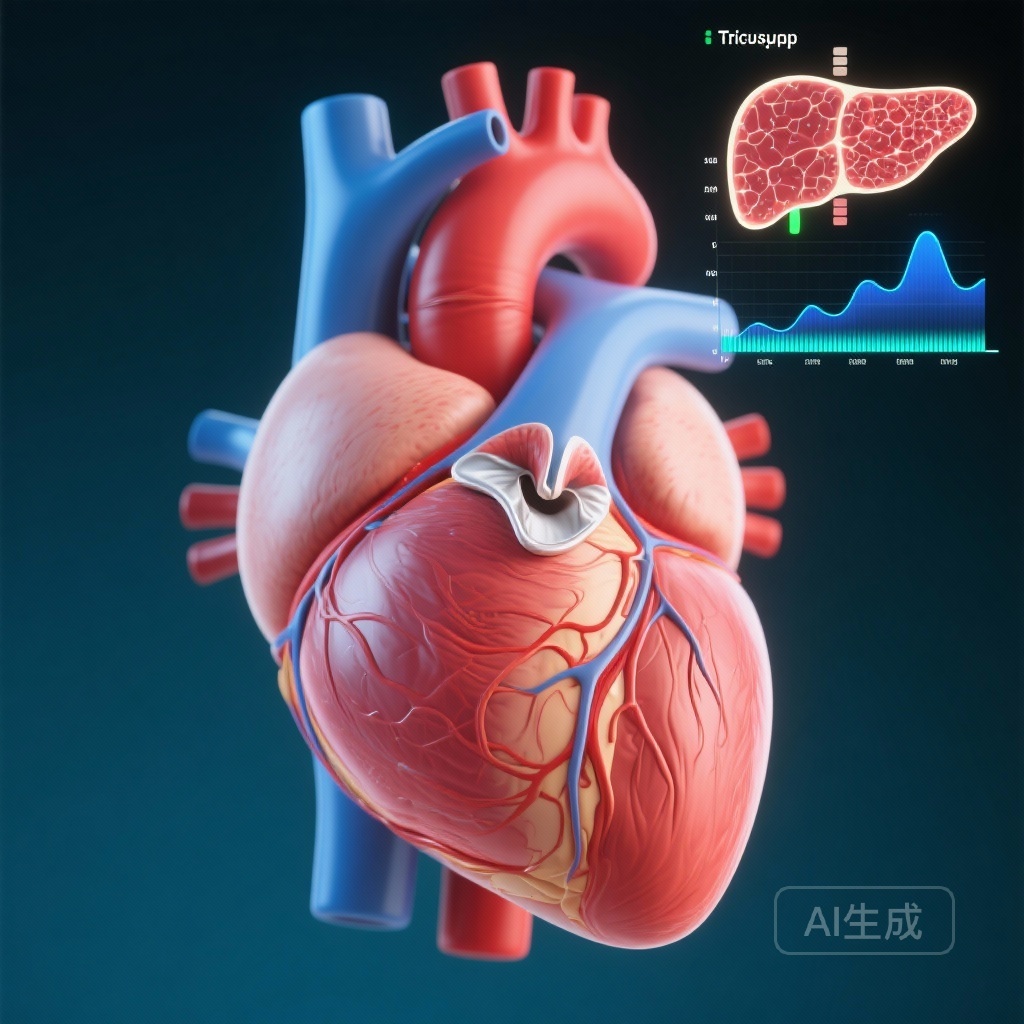
High-Risk Tricuspid Regurgitation: The Case for CMR-Based Precision
For decades, tricuspid regurgitation (TR) was often dismissed as a secondary consequence of left-sided heart disease—the so-called ‘forgotten valve.’ However, the emergence of transcatheter tricuspid valve interventions (TTVIs) has catalyzed a paradigm shift, necessitating more precise diagnostic and prognostic tools. While transthoracic echocardiography (TTE) remains the first-line screening modality, its limitations in quantifying TR—particularly due to the complex, non-planar geometry of the tricuspid annulus and the challenges of acoustic windows—are well-documented.
Recent evidence published in Circulation by Margonato et al. (2025) suggests that Cardiac Magnetic Resonance (CMR) imaging may offer the definitive solution for identifying high-risk patients. By utilizing tricuspid regurgitant fraction (TRF) and parametric mapping of the liver, clinicians can now move beyond qualitative ‘mild-to-severe’ labels toward a quantitative, data-driven risk stratification model that correlates directly with patient survival and hospitalization rates.
The Clinical Challenge: Why Echo Often Falls Short
In clinical practice, TR severity is typically graded using proximal isovelocity surface area (PISA) or vena contracta width on echocardiography. However, these methods rely on geometric assumptions that frequently do not hold true for the crescent-shaped tricuspid orifice. Furthermore, the assessment of right ventricular (RV) function, which is intrinsically linked to TR prognosis, is often limited by the RV’s complex shape when viewed in 2D.
CMR provides a unique advantage by allowing for direct volumetric measurements of both the right ventricle and the regurgitant volume without relying on geometric modeling. By subtracting the forward pulmonary flow (measured via phase-contrast imaging) from the RV stroke volume, CMR can calculate the TRF with high precision. Despite these advantages, the specific thresholds for TRF that define ‘high-risk’ patients have remained elusive until now.
Study Design: A Comprehensive Prognostic Analysis
This retrospective observational study analyzed 489 patients referred for clinical CMR between 2019 and 2024. The cohort represented a ‘real-world’ clinical population with varying degrees of TR. The researchers focused on two primary CMR-derived metrics:
1. Tricuspid Regurgitant Fraction (TRF): The percentage of the RV stroke volume that regurgitates into the right atrium.
2. Liver Extracellular Volume (L-ECV): A parametric mapping technique used to quantify interstitial expansion in the liver, serving as a surrogate for chronic systemic venous congestion.
The primary endpoint was a composite of all-cause mortality and heart failure (HF) hospitalization. The study design was particularly robust, accounting for the timing of tricuspid interventions to ensure that the natural history of the disease under medical management was accurately captured.
Key Findings: Redefining ‘Moderate’ as ‘High-Risk’
The median TRF in the study population was 21%. Perhaps the most striking finding was the relationship between TRF thresholds and clinical outcomes. The analysis identified that a TRF of ≥20% was associated with a hazard ratio (HR) greater than 1, while a TRF of ≥40% was associated with a hazard ratio greater than 2 for the primary composite outcome.
This is clinically significant because current guidelines often categorize TR based on echocardiographic parameters that may understate the risk at lower volumes. The study demonstrated that patients previously considered to have ‘moderate’ TR (TRF 20-30%) already faced a significantly worse long-term prognosis than those with TRF <20%.
During a median follow-up of 2.3 years, the survival curves diverged sharply. TRF ≥40% emerged as an independent predictor of both mortality and heart failure hospitalization, even after adjusting for age, sex, and other comorbidities. This suggests that a TRF of 40% should perhaps be the new definitive threshold for 'severe' TR when using CMR.
L-ECV: A Novel Window into Systemic Congestion
One of the most innovative aspects of this research was the inclusion of liver mapping. In the context of TR, the right heart’s failure to maintain forward flow leads to backward pressure into the vena cava and the hepatic veins. This chronic congestion results in liver fibrosis and interstitial expansion, which can be measured via L-ECV.
Among the 371 patients with available liver mapping data, an L-ECV ≥32% was strongly associated with clinical manifestations of right-sided heart failure (e.g., peripheral edema, ascites) and adverse long-term outcomes. Most importantly, L-ECV provided incremental prognostic value. Patients who had both a high TRF (≥20%) and a high L-ECV (≥32%) experienced the highest rates of adverse events. This indicates that L-ECV can identify ‘congestive hepatopathy’ before it becomes clinically obvious, providing a window for earlier intervention.
Expert Commentary: Shifting the Treatment Window
The findings from Margonato et al. suggest that we may be waiting too long to intervene in tricuspid disease. If a TRF of 20%—which many might currently view as mild-to-moderate—already carries an increased risk of death and hospitalization, our threshold for considering TTVIs or surgical repair may need to be lowered.
Furthermore, the integration of L-ECV into standard CMR protocols for valvular heart disease could revolutionize how we monitor patients. Rather than just looking at the valve itself, we are now looking at the ‘end-organ’ damage caused by the valve’s failure. This holistic approach captures the systemic nature of heart failure more effectively than valvular measurements alone.
However, there are limitations. As a retrospective study, there is inherent selection bias regarding who was referred for CMR. Additionally, while L-ECV is a promising biomarker, it requires specific software and expertise that may not yet be available in all imaging centers. Future prospective trials are needed to determine if intervening specifically at these CMR-defined thresholds improves long-term survival.
Conclusion: Moving Toward a Quantitative Paradigm
The study by Margonato and colleagues provides a compelling argument for the routine use of CMR in the evaluation of tricuspid regurgitation. By establishing clear prognostic thresholds—TRF ≥20% for increased risk and TRF ≥40% for high risk—the research provides clinicians with actionable data to guide patient management.
The addition of L-ECV as a marker of systemic venous congestion adds a new dimension to risk stratification, allowing for the identification of the most vulnerable patients who may benefit from aggressive diuresis or early valve intervention. As we enter the era of precision medicine in cardiology, CMR-quantified TRF and liver mapping represent the next frontier in the management of the ‘forgotten’ tricuspid valve.
References
1. Margonato D, Enriquez-Sarano M, Nishihara T, et al. Quantitative Identification of High-Risk Tricuspid Regurgitation by Cardiac Magnetic Resonance. Circulation. 2025 Dec 23;152(25):1769-1780. doi: 10.1161/CIRCULATIONAHA.125.074862.
2. Hahn RT, Thomas JD, Khalique OK, et al. Imaging Assessment of Tricuspid Regurgitation Severity. JACC Cardiovasc Imaging. 2019;12(3):469-490.
3. Prihadi EA, van der Bijl P, Dietz M, et al. Prognostic Implications of Right Ventricular Free Wall Longitudinal Strain in Patients With Significant Tricuspid Regurgitation. Am J Cardiol. 2018;122(6):1031-1037.