Highlights of the WP-GDM Trial
Primary Findings
Once-daily supplementation with 20g of whey protein (WP) isolate administered 30 minutes before breakfast significantly lowered 1-hour postprandial glucose (PPG) levels in women with gestational diabetes mellitus (GDM) compared to a placebo. These benefits were sustained from the early to the late third trimester.
Improved Glycemic Stability
Beyond absolute glucose levels, the intervention significantly reduced glycemic variability, measured by the Coefficient of Variation (CV%) and the Mean Amplitude of Glycemic Excursions (MAGE), particularly under controlled-living conditions.
Real-World Efficacy
While the strongest effects were observed in controlled settings, the reduction in postprandial glucose remained statistically significant under free-living conditions, suggesting the intervention is robust against dietary variations.
The Clinical Challenge of Gestational Diabetes
Gestational diabetes mellitus (GDM) remains one of the most common complications of pregnancy, characterized by glucose intolerance that typically develops during the second or third trimester. The condition is associated with an increased risk of macrosomia, neonatal hypoglycemia, and long-term metabolic risks for both mother and child, including type 2 diabetes.
Management of GDM focuses heavily on glycemic control, particularly postprandial glucose (PPG). Breakfast often presents the greatest challenge for clinicians and patients alike; morning cortisol spikes and the “dawn phenomenon” exacerbate insulin resistance, leading to exaggerated glucose excursions even with controlled carbohydrate intake. Medical Nutrition Therapy (MNT) is the first line of defense, but many patients struggle to achieve targets without progressing to insulin or metformin. Consequently, identifying evidence-based, low-risk nutritional strategies to blunt these excursions is a high priority in obstetric endocrinology.
Study Methodology: Rigor in the Third Trimester
In a study recently published in Diabetologia, Smedegaard and colleagues conducted a double-blind, randomized, placebo-controlled, parallel trial to evaluate the efficacy of a whey protein pre-load. The trial enrolled 62 women diagnosed with GDM who were normotensive and not using glucose-altering medications.
Intervention and Control
Participants were randomized to receive either 20g of whey protein isolate or an iso-volumetric placebo 30 minutes before breakfast daily throughout their third trimester. The 30-minute interval was chosen based on prior physiological studies suggesting this timing optimizes the release of insulinotropic peptides.
Assessment and Monitoring
To capture a comprehensive picture of glycemic health, the researchers utilized continuous glucose monitoring (CGM). Evaluations were performed during laboratory visits (controlled-living) and at home (free-living) during both the early (weeks 28–32) and late (weeks 34–38) third trimester. This dual-environment approach allowed the investigators to distinguish between the physiological potential of the intervention and its practical utility in a patient’s daily life.
Key Findings: Significant Reductions in Postprandial Excursions
The results provided clear evidence for the glucose-lowering effects of the WP pre-load.
Controlled-Living Results
Under controlled conditions, the 1-hour PPG following breakfast was substantially lower in the WP group. In the early third trimester, the reduction was -20% (95% CI -28%, -11%) compared to the placebo group. In the late third trimester, the effect remained significant at -15% (95% CI -24%, -5%).
Free-Living Results
In a real-world setting, where caloric intake and physical activity were not strictly dictated by the study protocol, the WP group still demonstrated a -14% (95% CI -23%, -4%) reduction in 1-hour PPG in the early third trimester. By the late third trimester, the reduction was -8% (95% CI -18%, 3%), which, while showing a trend toward improvement, did not reach the same level of statistical significance as the earlier period, likely due to the increasing insulin resistance characteristic of late pregnancy.

Glucose trajectories and iAUC. Women were randomised to consume either a no-energy placebo drink or 20 g WP 30 min before breakfast. In the early third trimester, participants were equipped with CGM and provided with pre-meals and standardised meals for 2 days under controlled-living conditions: glucose trajectories (a) and iAUC (c) are shown. This was followed by 2 days of free-living, where participants were allowed to exercise and eat freely: glucose trajectories (b) and iAUC (c) are shown. Investigations were repeated in the late third trimester: glucose trajectories under controlled-living (d) and free-living conditions (e) and iAUC (f) are shown. Data are presented as means with SEs. Blue indicates pre-meal WP, and red indicates placebo. A mixed-effects model was used to evaluate the interaction between time and intervention (p value for time × intervention <0.001 in a, b, d, e), and pairwise comparisons were computed to assess differences in iAUC between placebo and WP pre-meals. *p<0.05
Glycemic Variability and Time in Range
High glycemic variability is increasingly recognized as a risk factor for oxidative stress and adverse pregnancy outcomes. The WP-GDM trial found that glycemic variability was significantly lower in the WP group under controlled conditions. Specifically, the MAGE was lower in both the early and late third trimester. Furthermore, the Standard Deviation (SD) and CV% were significantly improved during the early third trimester (p < 0.05). In the late third trimester under free-living conditions, the “Time in Range” (TIR, 3.5–7.8 mmol/l) was slightly lower in the WP group (p = 0.05), a finding that warrants further investigation to determine if the protein pre-load affects overall caloric distribution or satiety.
Physiological Mechanisms: The Incretin Effect and Gastric Emptying
Why does a simple protein pre-load exert such a powerful effect on glucose? The researchers point to several biological mechanisms:
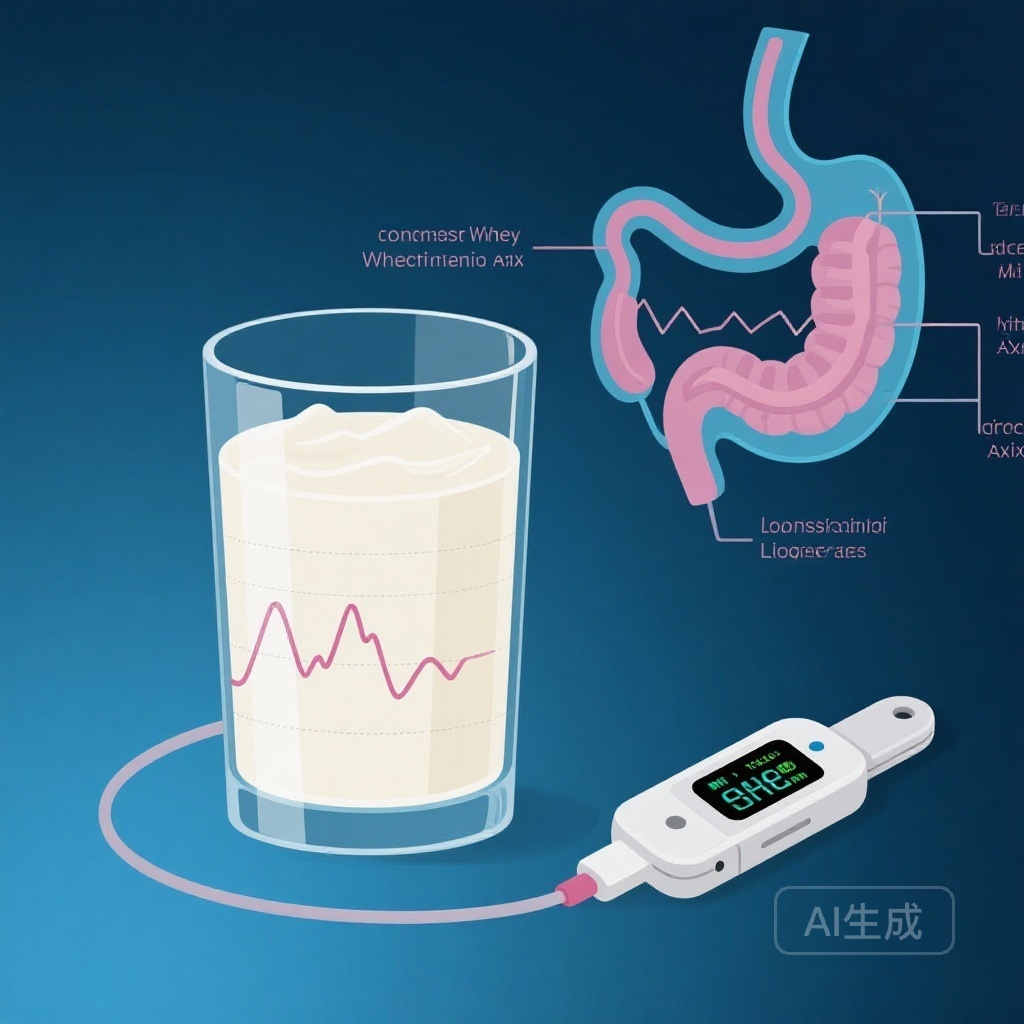
1. The Incretin Response: Whey protein is rich in bioactive peptides and amino acids (such as leucine and isoleucine) that stimulate the secretion of glucagon-like peptide-1 (GLP-1) and glucose-dependent insulinotropic polypeptide (GIP) from the L-cells and K-cells of the small intestine.
2. Enhanced Insulin Secretion: These incretins, in turn, enhance the glucose-dependent insulin response from pancreatic beta cells, preparing the body to handle the incoming carbohydrate load from the meal.
3. Delayed Gastric Emptying: The presence of protein in the duodenum triggers feedback loops that slow the exit of food from the stomach. This slower entry of glucose into the bloodstream prevents the sharp “spikes” that are difficult for the GDM-affected pancreas to manage.
Expert Commentary: Translating Data to Clinical Practice
This study is significant because it provides a practical, relatively inexpensive, and safe nutritional tool for a high-risk population. Unlike pharmacological interventions, whey protein is a food-grade supplement with high patient acceptability.
However, clinicians should consider a few nuances. The 30-minute pre-load requires patient discipline and planning. Furthermore, while whey protein isolate is generally well-tolerated, its use in patients with dairy allergies is contraindicated. There is also the question of caloric addition; 20g of protein adds approximately 80 calories to the daily intake, which must be accounted for in the overall dietary plan to avoid excessive gestational weight gain.
One of the most compelling aspects of this study is the reduction in MAGE. By “flattening the curve,” clinicians may be able to reduce the frequency of glucose readings that exceed clinical thresholds, potentially delaying the need for insulin therapy. This has profound implications for patient quality of life and healthcare costs.
Limitations and Future Research
While the trial was well-powered and blinded, it focused exclusively on the breakfast meal. Future studies should investigate whether multi-meal supplementation offers cumulative benefits or if the “second-meal effect” of a morning pre-load carries over into lunch and dinner. Additionally, the primary outcome of the trial was glycemic variability; larger studies are needed to determine if this improvement in CGM metrics translates directly into a reduction in clinical outcomes such as cesarean section rates or large-for-gestational-age (LGA) births.
Summary
Pre-meal whey protein supplementation represents a potent adjunct to standard Medical Nutrition Therapy for gestational diabetes. By utilizing the body’s own incretin system, this strategy significantly blunts breakfast postprandial glucose excursions and stabilizes glycemic fluctuations throughout the third trimester. As clinicians look for ways to optimize GDM management, this “protein first” approach offers a scientifically sound, evidence-based option to improve metabolic health in pregnancy.
Funding and ClinicalTrials.gov
This research was funded by the Department of Clinical Medicine, Aarhus University, and Arla Foods Ingredients Group P/S. The trial is registered at ClinicalTrials.gov under the identifier NCT04767880.
References
1. Smedegaard S, Rittig N, Ovesen PG, et al. Once-daily supplementation with pre-meal whey protein lowers breakfast postprandial glucose levels in women with GDM throughout the third trimester: a randomised, controlled, clinical trial. Diabetologia. 2026;69(2):350-363. doi:10.1007/s00125-025-06587-0 IF: 10.2 Q1 .2. Jakubowicz D, Froy O. Biochemical and metabolic mechanisms by which dietary whey protein may combat obesity and Type 2 diabetes. J Nutr Biochem. 2013;24(1):1-5.
3. Hod M, Kapur A, Sacks DA, et al. The International Federation of Gynecology and Obstetrics (FIGO) Initiative on gestational diabetes mellitus: A pragmatic guide for diagnosis, management, and care. Int J Gynaecol Obstet. 2015;131 Suppl 3:S173-211.