Introduction: The Paradox of Successful Reperfusion
The management of ST-elevation myocardial infarction (STEMI) has undergone a revolution over the last three decades. The implementation of primary percutaneous coronary intervention (PCI) and the development of potent antiplatelet therapies have dramatically reduced mortality rates from the levels seen in the pre-reperfusion era. However, despite these technical successes, in-hospital mortality for STEMI remains stubbornly high in absolute terms, particularly in high-risk subgroups. A growing body of evidence suggests that while restoring flow to the epicardial coronary artery is necessary, it is not always sufficient to prevent myocardial death. In fact, the act of reperfusion itself can trigger a secondary wave of damage known as reperfusion injury.
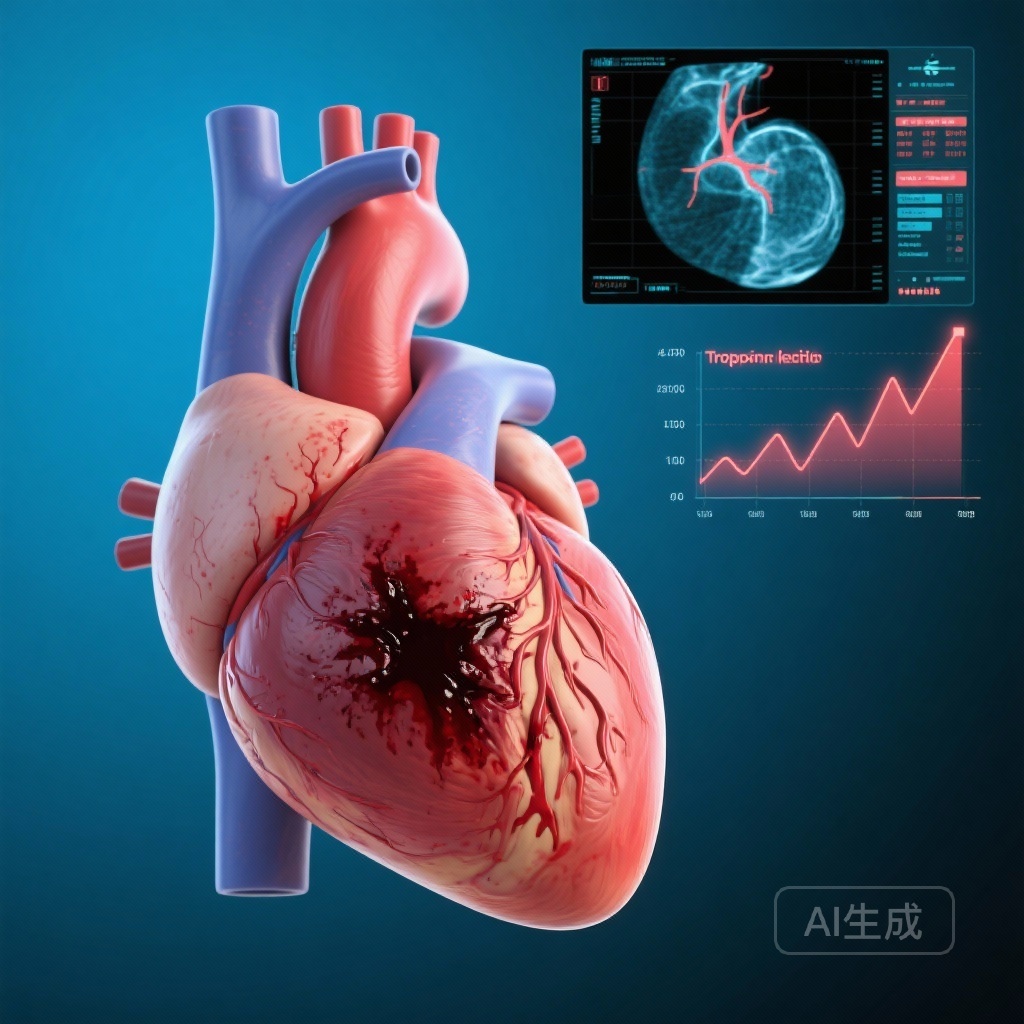
One of the most severe forms of reperfusion injury is intramyocardial hemorrhage (IMH). This occurs when the microvasculature, weakened by ischemia, ruptures upon the restoration of high-pressure blood flow, leading to the extravasation of erythrocytes into the myocardial interstitium. While IMH has long been recognized as a predictor of adverse long-term remodeling and heart failure, its immediate impact on acute, in-hospital survival has remained poorly defined. A landmark study recently published in NEJM Evidence by Vora et al. provides a critical link between hemorrhagic myocardial infarction (MI) and early mortality, offering a potential new diagnostic pathway using routine clinical biomarkers.
Highlights
The study provides several key insights into the clinical significance of hemorrhagic transformation after STEMI:
- Post-PCI high-sensitivity cardiac troponin I (hs-cTn-I) kinetics can serve as a highly accurate surrogate for diagnosing hemorrhagic MI without the immediate need for cardiac MRI.
- The diagnostic accuracy of hs-cTn-I for hemorrhage is highest within the first 10 hours post-PCI, achieving an area under the curve (AUC) greater than 0.92.
- Patients identified as having hemorrhagic MI have a 2.81-fold higher risk of in-hospital mortality compared to those with nonhemorrhagic MI.
- The findings suggest that intramyocardial hemorrhage is not merely a marker of infarct size but a distinct pathological entity that contributes to acute clinical instability.
Study Design and Methodology
This multicenter investigation employed a sophisticated multi-phase approach to bridge the gap between advanced imaging and bedside clinical practice. The study was structured into three distinct parts: a discovery phase, a validation phase, and a large-scale registry analysis.
Establishing the Biomarker Thresholds
The researchers first enrolled a discovery cohort of 154 patients and a validation cohort of 53 patients. All patients underwent primary PCI for STEMI followed by cardiac magnetic resonance (CMR) imaging, which is the gold standard for detecting intramyocardial hemorrhage. By correlating CMR findings with serial measurements of high-sensitivity cardiac troponin I (hs-cTn-I) taken at hourly intervals (up to 12 hours) and at 16, 20, 24, and 48 hours post-PCI, the team established time-dependent cutoff values for the diagnosis of hemorrhagic MI.
The Registry Analysis
To determine the clinical impact of these findings, the researchers applied the derived hs-cTn-I cutoffs to a massive STEMI registry. This registry included data from 6,180 patients across seven hospitals within a single large health system in the United States. By classifying these patients as having either hemorrhagic or nonhemorrhagic MI based on their troponin kinetics, the researchers were able to calculate the odds of in-hospital mortality with a high degree of statistical power.
Key Findings: Troponin as a Window into Myocardial Integrity
The results of the study demonstrate that the magnitude and speed of troponin release are significantly different in patients who develop hemorrhagic MI. The extravasation of blood into the myocardium appears to facilitate a more rapid and massive washout of cardiac proteins into the systemic circulation.
Diagnostic Accuracy
The diagnostic performance of hs-cTn-I was remarkably robust. During the first 10 hours post-PCI, the sensitivity for detecting hemorrhagic MI was greater than 0.91, and the specificity was greater than 0.86. The AUC remained above 0.92 during this window. While the diagnostic accuracy slightly decreased after 10 hours, it remained clinically useful, with an AUC greater than 0.84 up to 48 hours post-procedure. This suggests that the early post-reperfusion period is the optimal time for biomarker-based risk stratification.
In-Hospital Mortality Risk
The most striking finding emerged from the registry analysis. Patients classified as having hemorrhagic MI based on the troponin thresholds faced a significantly higher risk of death before discharge. The adjusted odds ratio (OR) for in-hospital mortality was 2.81 (95% confidence interval [CI], 2.17 to 3.64). This association remained significant even after adjusting for traditional risk factors, including age, comorbidities, and initial infarct severity. This indicates that the presence of hemorrhage itself is a potent, independent driver of acute mortality.
Mechanistic Insights: Why Hemorrhage Kills
The biological plausibility of these findings is supported by our understanding of iron-mediated toxicity and microvascular collapse. When red blood cells rupture within the myocardium, they release hemoglobin and subsequent breakdown products, such as iron and heme. These substances are highly pro-inflammatory and pro-oxidative. They trigger the recruitment of neutrophils and macrophages, leading to an intense inflammatory response that can extend the zone of injury beyond the initial ischemic territory.
Furthermore, intramyocardial hemorrhage is often the precursor to microvascular obstruction (MVO), also known as the no-reflow phenomenon. The physical presence of blood and edema within the myocardial wall increases interstitial pressure, effectively compressing the small capillaries and preventing nutrient blood flow even though the main artery is open. This can lead to mechanical complications, such as ventricular rupture or acute papillary muscle dysfunction, and predispose the heart to lethal arrhythmias—all of which contribute to the nearly threefold increase in mortality observed in the study.
Expert Commentary and Clinical Implications
For clinicians, the ability to identify hemorrhagic MI using troponin kinetics represents a significant step toward personalized post-MI care. Currently, CMR is not feasible for many acute STEMI patients due to hemodynamic instability or lack of immediate access to imaging facilities. By using hs-cTn-I—a test already performed routinely in every hospital—physicians can identify high-risk patients within hours of leaving the catheterization lab.
However, some limitations must be considered. While troponin is a highly sensitive marker, its levels can be influenced by renal function and the timing of the initial ischemic insult. The study’s reliance on a single health system’s registry, while large, may also require further validation in diverse global populations with varying PCI protocols. Furthermore, while we can now better identify these patients, the medical community still lacks a definitive therapy to prevent or mitigate intramyocardial hemorrhage once it has occurred. Potential interventions, such as modified reperfusion strategies or targeted anti-inflammatory therapies, are currently the subject of intense investigation.
Conclusion
The study by Vora et al. fundamentally shifts our understanding of post-PCI risk. It establishes that hemorrhagic myocardial infarction is a major, yet often overlooked, contributor to in-hospital mortality. By demonstrating that post-PCI troponin kinetics can accurately diagnose this condition, the research provides a practical tool for early risk stratification. As we move forward, the focus must shift from simply opening the artery to protecting the microvasculature, ensuring that the benefits of reperfusion are not undermined by the devastating consequences of intramyocardial hemorrhage.
Funding and Clinical Registry Information
This research was funded by the National Institutes of Health (NIH) National Heart, Lung, and Blood Institute (NHLBI) under grant numbers HL133407, HL136578, and HL147133, among others. The study is registered at ClinicalTrials.gov with the identifier NCT05872308.
References
1. Vora KP, Kalra A, Shah CD, et al. In-Hospital Mortality in Hemorrhagic Myocardial Infarction. NEJM Evid. 2025;4(9):EVIDoa2400294. doi:10.1056/EVIDoa2400294.
2. Ibanez B, Heusch G, Ovize M, Van de Werf F. Evolving nature of myocardial ischemia-reperfusion injury in the era of primary PCI. J Am Coll Cardiol. 2015;65(14):1454-1475.
3. Bulluck H, Dharmakumar R, Arai AE, Berry C, Hausenloy DJ. Cardiovascular Magnetic Resonance in Acute ST-Segment Elevation Myocardial Infarction: Recent Advances, Gaps in Knowledge, and Future Directions. JACC Cardiovasc Imaging. 2018;11(6):887-903.