Highlights
– In a retrospective single‑institution cohort of 1,564 patients with oropharyngeal squamous cell carcinoma (OPSCC), the 3‑year cumulative incidence of any‑grade osteoradionecrosis (ORN) was 3.02% overall.
– Proton therapy was associated with a higher 3‑year ORN rate than IMRT (6.36% vs 2.69%; HR 2.62, 95% CI 1.39–4.93); in definitive treatment patients the HR was 3.62 (95% CI 1.85–7.09).
– On multivariable analysis proton modality, concurrent chemotherapy, and current/former smoking were independently associated with ORN; grade ≥3 ORN was rare (0.67%) and similar across modalities.
Background
Osteoradionecrosis of the jaw (ORN) is a debilitating late toxicity of head and neck radiotherapy, characterized by exposed, nonhealing irradiated bone that can cause pain, infection, fracture, and functional loss. Historically described through clinical series and pathophysiologic models emphasizing hypovascularity and hypoxia, ORN remains a clinically important, albeit infrequent, complication following curative‑intent radiotherapy for oropharyngeal squamous cell carcinoma (OPSCC) (Marx RE, J Oral Maxillofac Surg. 1983).
Modern photon techniques such as intensity‑modulated radiation therapy (IMRT) reduced high‑dose volumes to normal tissues and changed the epidemiology of late toxicities. Proton therapy provides distinct dosimetric advantages in many head and neck sites because of a finite range (Bragg peak) and reduced exit dose, potentially lowering integral dose to normal tissues and late toxicity. However, differences in dose distribution at the mandible, distal‑edge uncertainties, and increased linear energy transfer (LET) at the Bragg peak raise biologic and practical concerns about mandibular bone toxicity after protons. Robust clinical data on comparative ORN risk between IMRT and proton therapy for OPSCC have been limited.
Study design
Yang and colleagues performed a retrospective cohort study at a single high‑volume academic center including consecutive OPSCC patients treated with curative‑intent radiotherapy from January 2013 to December 2023 (Yang et al., JAMA Otolaryngol Head Neck Surg. 2025). Patients received either IMRT or proton therapy (uniform scanning or pencil beam scanning). ORN diagnosis and grade were adjudicated by a standardized multidisciplinary review process. The primary endpoint was the 3‑year cumulative incidence of ORN. Cox proportional hazards models were used to identify predictors of ORN; analyses were performed and updated through April 2025.
Key baseline features: 1,564 patients (mean age 61.5 years), predominantly male (86.7%), with 88.8% treated with IMRT (n=1,389) and 11.2% with proton therapy (n=175). Subgroup analysis focused on definitive‑intent RT patients (n=1,344). Covariates included smoking status, HPV status, tumor and nodal stage, chemotherapy use, and radiation dose.
Key findings
Overall incidence and modality comparison
– The overall 3‑year cumulative incidence of any‑grade ORN was 3.02% (95% CI, 2.22%–4.09%).
– The 3‑year ORN rate was higher after proton therapy compared with IMRT: 6.36% (proton) vs 2.69% (IMRT), with an unadjusted hazard ratio (HR) of 2.62 (95% CI, 1.39–4.93).
Definitive‑intent subgroup
– Among 1,344 definitive‑intent patients, ORN developed in 47 of 1,210 IMRT patients (3‑year rate 2.38%; 95% CI, 1.61%–3.51%) versus 11 of 134 proton patients (3‑year rate 7.47%; 95% CI, 3.40%–16.02%). The HR for proton vs IMRT in this subgroup was 3.62 (95% CI, 1.85–7.09).
Multivariable predictors
– On adjusted analysis the following were independently associated with ORN: proton modality (HR 2.92; 95% CI, 1.55–5.50), concurrent chemotherapy (HR 3.29; 95% CI, 1.03–10.50), and smoking (HR 2.33; 95% CI, 1.38–3.92).
Severity and clinical impact
– Grade 3 or greater ORN (requiring major intervention, hospitalization, or causing significant morbidity) occurred in 0.67% of patients overall and did not significantly differ between modalities.
Interpretation of effect sizes and absolute risk
– Although the relative increase in hazard with proton therapy was notable (approximately 2.6–3.6‑fold depending on cohort), the absolute 3‑year risk difference was small in absolute terms (approximately 3–5 percentage points). High‑grade ORN was rare across both modalities.
Expert commentary and critical appraisal
Strengths
– Large, contemporary single‑institution cohort with multidisciplinary ORN adjudication provides real‑world relevance for modern RT techniques performed between 2013 and 2023.
– Use of multivariable models to account for several clinical risk factors (smoking, chemotherapy) strengthens causal inference beyond unadjusted comparisons.
Limitations and potential biases
– Retrospective design: causality cannot be definitively established and unmeasured confounding is possible. Important potential confounders include baseline dental status, periradiation dental extractions, precise mandible dose metrics (e.g., V50–V70 Gy to mandible, Dmean/Dmax), and LET distributions for protons — variables not fully reported in the summary results.
– Selection bias: proton therapy patients represented a minority (11.2%) and may have been enriched for more complex anatomy, re‑irradiation, or other clinical features influencing dose to mandible or treatment decisions; although the authors restricted analyses to definitive patients and adjusted for known covariates, residual confounding remains possible.
– Technologic heterogeneity across time: proton techniques (uniform scanning vs pencil beam scanning), immobilization and image guidance, and institutional experience evolved over the decade, which could influence outcomes.
– Dosimetry and biologic dose weighting: proton plans have range uncertainties and LET heterogeneity that can increase relative biologic effect at the distal edge; without LET‑weighted dose metrics or mandible dose–volume data, mechanistic attribution is speculative.
Biologic plausibility
– Several plausible mechanisms could explain a higher ORN rate after proton therapy in certain circumstances. The distal fall‑off (Bragg peak) concentrates dose, and range uncertainties could deposit unexpectedly high dose to focal mandibular subregions. Proton beams can also exhibit elevated LET near the distal edge, potentially increasing biologic damage to bone beyond physical dose predictions. If critical mandibular volumes receive high, focal doses, the risk of ORN could increase despite lower integral dose elsewhere. These concepts are under active investigation in proton radiobiology and treatment planning.
Clinical significance
– From a clinician’s perspective, the absolute risk of ORN remains low, and severe cases are uncommon. However, the relative signal observed mandates attention because ORN causes substantial morbidity and can be difficult to treat. The findings do not imply that proton therapy is inferior overall for OPSCC; rather, they highlight the need for careful patient selection, rigorous mandible‑sparing planning, and prospective data collection.
Practical implications for clinicians
– Pre‑treatment risk assessment: incorporate dental evaluation, smoking status, prior dental extractions or infections, and chemotherapy plans into modality selection and consent conversations. Inform patients that while severe ORN is rare, proton therapy may be associated with a higher risk of any ORN in some series.
– Mandible‑centric planning: when using protons, emphasize robust optimization and evaluation of mandibular dose, including worst‑case scenario assessments for range uncertainty. Consider multi‑field optimization, beam angles that avoid distal edge crossing the mandible, and explicit mandible dose constraints when feasible.
– Dosimetric reporting: centers using protons should document mandible DVH statistics and, where available, consider LET or variable RBE analyses to identify hotspots that may portend increased bone toxicity.
– Preventive care: universal strategies to reduce ORN remain essential — pretherapy dental clearance, conservative extractions with adequate healing interval before radiotherapy, aggressive oral hygiene, and smoking cessation support. Coordinate care with dental and maxillofacial surgery colleagues.
Research and policy recommendations
– Prospective data collection: prospective registries and randomized trials (where feasible) should collect standardized mandible dose metrics, dental variables, LET/variable RBE metrics for protons, and long‑term toxicity outcomes to clarify causality and dose–response.
– Dosimetric and biologic modelling: studies that integrate LET‑weighted dose, variable RBE models, and spatial mapping of mandibular subvolumes are needed to derive actionable dose constraints for proton plans.
– Guidelines and consensus: professional societies (e.g., ASTRO, ESTRO, national guideline bodies) should consider these emerging data when issuing recommendations about proton therapy indications and planning priorities in head and neck cancer.
Conclusions
Yang et al. report an important signal: in a large institutional cohort of OPSCC patients treated between 2013 and 2023, proton therapy was associated with a higher 3‑year incidence of ORN than IMRT after adjustment for key clinical covariates, while high‑grade ORN remained uncommon. These findings are hypothesis‑generating and should prompt rigorous dosimetric studies, prospective data collection, and careful clinical decision‑making rather than wholesale rejection of protons in OPSCC. Clinicians should combine careful pretherapy dental care, mandible‑conscious planning, and patient counseling to mitigate ORN risk while leveraging the potential benefits of proton therapy for appropriate patients.
Funding and clinicaltrials.gov
The summary article by Yang et al. did not report a randomized clinical trial registration in the provided material; their work was a retrospective institutional analysis. Broader research into comparative late toxicity after protons versus photons is supported variably by institutional funds, public grants, and industry partnerships at different centers; refer to the original paper for detailed acknowledgments and funding statements.
References
1. Yang F, Dee EC, Singh A, et al. Osteoradionecrosis After Intensity‑Modulated Radiation Therapy or Proton Therapy in Oropharyngeal Carcinoma. JAMA Otolaryngol Head Neck Surg. 2025 Nov 26. doi:10.1001/jamaoto.2025.4179. PMID: 41296362.
2. Marx RE. Osteoradionecrosis: a new concept of its pathophysiology. J Oral Maxillofac Surg. 1983 Jul;41(5):283–288.
3. National Comprehensive Cancer Network (NCCN). NCCN Clinical Practice Guidelines in Oncology: Head and Neck Cancers. Version 2.2025. Available at: https://www.nccn.org (accessed 2025).
Thumbnail prompt for AI image generation
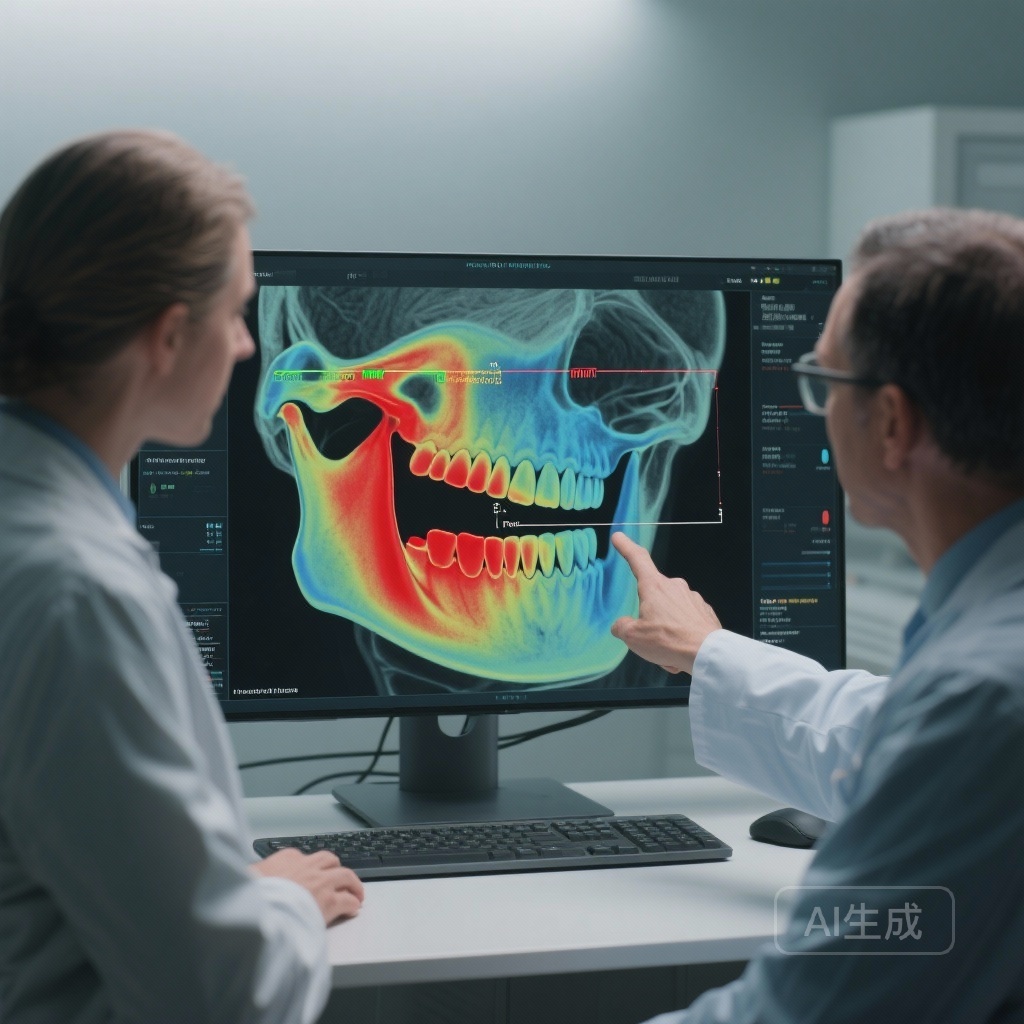
High‑resolution medical illustration: axial CT scan of the head and neck displayed on a clinical workstation with two overlaid color dose maps (one photon IMRT, one proton) contrasted side‑by‑side; the mandible highlighted in red; a radiation oncologist and head and neck surgeon in scrubs point at the screen discussing plans; muted clinical colors, photorealistic, cinematic lighting, 3:2 aspect ratio.