Highlights
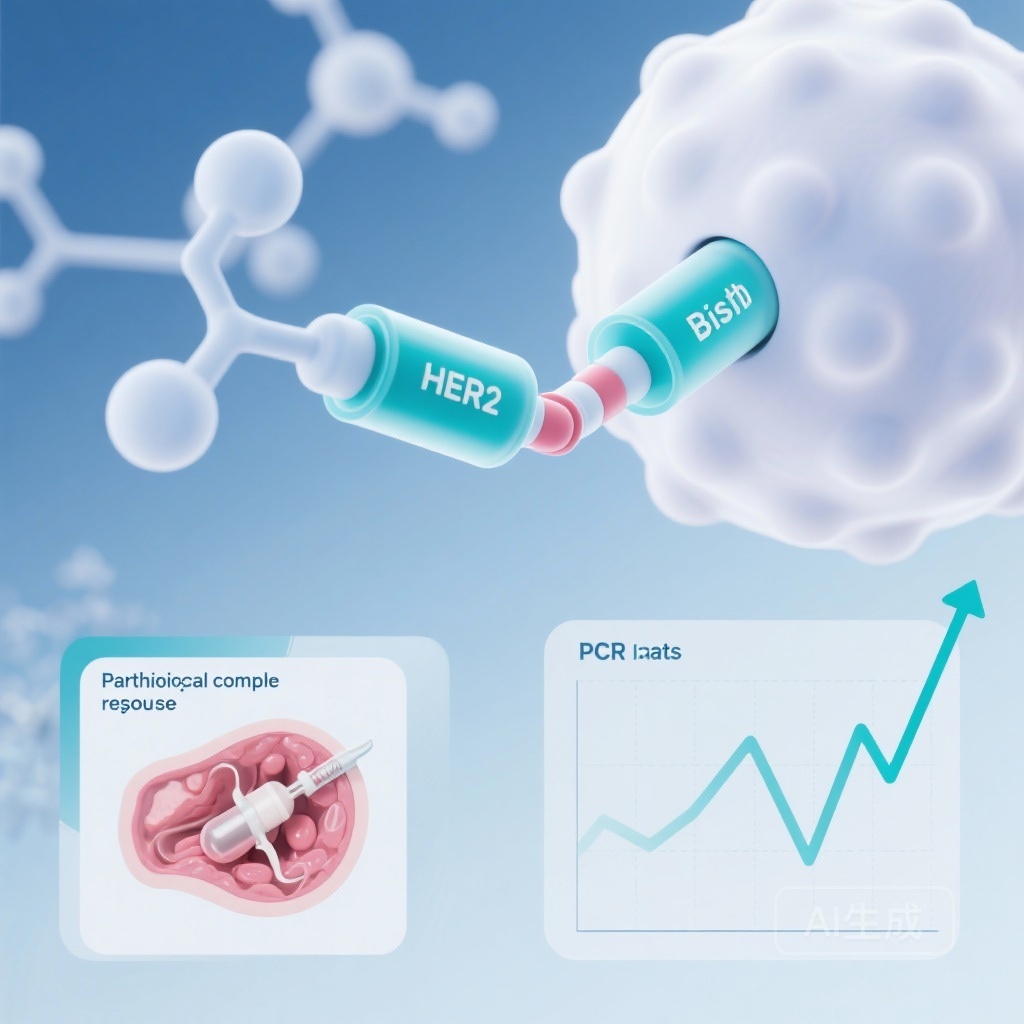
– TQB2102, a bispecific HER2-directed antibody-drug conjugate (ADC), produced tpCR rates of 57.7%–76.9% across four randomized neoadjuvant cohorts (n=26 each) in stage II–III HER2-positive breast cancer.
– Longer exposure (eight cycles) and higher dose cohorts trended toward higher tpCR, with cohort 2 (6.0 mg/kg, 8 cycles) showing the highest tpCR (76.9%).
– Grade ≥3 treatment-related adverse event (TRAE) rates ranged from 23.1% to 30.8% across cohorts; no treatment-related deaths were reported.
– Results justify larger randomized trials comparing TQB2102 to standard trastuzumab/pertuzumab-based neoadjuvant regimens, with attention to cardiac and pulmonary safety and long-term outcomes.
Background and clinical context
HER2-positive breast cancer comprises approximately 15–20% of breast cancers and historically carried a poor prognosis before the advent of HER2-directed therapy. The incorporation of monoclonal antibodies (trastuzumab and pertuzumab), antibody-drug conjugates (ADCs), and small molecules has transformed outcomes. In the neoadjuvant setting, pathologic complete response (pCR) — absence of invasive tumor in breast and lymph nodes at surgery — is used both as a clinical goal and a regulatory/epidemiologic surrogate for long-term outcomes, particularly in aggressive subtypes including HER2-positive tumors.
Despite advances, unmet needs remain: some tumors are refractory to dual antibody therapy plus chemotherapy, and toxicity of multi-agent regimens can limit use. Bispecific HER2-directed ADCs represent an emerging strategy designed to increase tumor targeting and payload delivery while potentially overcoming tumor heterogeneity in HER2 expression.
Study design
Li et al. conducted a randomized, open-label, multicenter, phase II trial (NCT06198751) that enrolled patients with stage II–III HER2-positive breast cancer. Patients were stratified by hormone receptor status and randomized 1:1 into four cohorts (26 patients each):
- Cohort 1: TQB2102 6.0 mg/kg every 3 weeks for six cycles
- Cohort 2: TQB2102 6.0 mg/kg every 3 weeks for eight cycles
- Cohort 3: TQB2102 7.5 mg/kg every 3 weeks for six cycles
- Cohort 4: TQB2102 7.5 mg/kg every 3 weeks for eight cycles
The primary end point was total pathologic complete response (tpCR) rate across cohorts (n = 26 per cohort). The statistical plan defined efficacy as demonstrated if the lower limit of the 90% Clopper–Pearson exact binomial confidence interval for tpCR exceeded 40% (historic control benchmark). Safety endpoints included incidence and severity of treatment-related adverse events (TRAEs) graded by CTCAE criteria.
Key findings
Between February 5 and September 24, 2024, 104 patients were enrolled (26 per cohort). Major efficacy and safety results reported were:
- Cohort 1 (6.0 mg/kg × 6 cycles): tpCR 57.7% (15 of 26; 90% CI 43.2–71.3; P = .04)
- Cohort 2 (6.0 mg/kg × 8 cycles): tpCR 76.9% (20 of 26; 90% CI 62.3–87.6; P < .01)
- Cohort 3 (7.5 mg/kg × 6 cycles): tpCR 61.5% (16 of 26; 90% CI 46.5–74.8; P = .02)
- Cohort 4 (7.5 mg/kg × 8 cycles): tpCR 69.2% (18 of 26; 90% CI 54.6–81.3; P < .01)
By the pre-specified criterion, all cohorts exceeded the 40% lower-limit threshold; the P-values reported indicate tpCR rates were statistically superior to the historical control. Numerically, cohort 2 (6.0 mg/kg, eight cycles) achieved the highest tpCR (76.9%). Extending treatment from six to eight cycles appeared associated with higher tpCR in both dose strata (6.0 mg/kg: 57.7% → 76.9%; 7.5 mg/kg: 61.5% → 69.2%), suggesting cumulative exposure may be important.
Safety
Rates of grade ≥3 TRAEs were similar across cohorts: cohort 1, 23.1% (6 of 26); cohort 2, 30.8% (8 of 26); cohort 3, 30.8% (8 of 26); cohort 4, 26.9% (7 of 26). Importantly, no treatment-related deaths occurred. The published summary did not list detailed organ-specific toxicity profiles in the abstract; longer follow-up and full-text safety tables will be critical for evaluating cardiac toxicity, interstitial lung disease/pneumonitis (a recognized risk with some HER2-directed ADCs), hematologic toxicities, and neuropathy.
Interpretation and clinical implications
The tpCR rates observed with TQB2102 are clinically notable and, in several cohorts, exceed typical historical control benchmarks for conventional trastuzumab-based neoadjuvant regimens. For context, neoadjuvant trials of trastuzumab ± pertuzumab plus chemotherapy have reported pCR rates that vary by regimen and hormone receptor status; pooled analyses show higher pCR translates into greater long-term benefit in HER2-positive disease, supporting pCR as a reasonable intermediate endpoint for phase II development (CTNeoBC pooled analysis).
Potential mechanistic advantages of a bispecific HER2-directed ADC include improved binding avidity through simultaneous engagement of two HER2 epitopes, promoting internalization and payload delivery in tumors with heterogeneous HER2 expression. Enhanced delivery of a cytotoxic payload could improve tumor cell kill without necessarily increasing systemic toxicity, though the latter must be validated.
Comparative considerations
This phase II study did not include a direct comparator arm with standard-of-care neoadjuvant regimens (e.g., taxane + trastuzumab ± pertuzumab). Therefore, although tpCR rates are promising, direct comparative efficacy and safety remain unestablished. The observed grade ≥3 TRAE rates (≈23–31%) are within a range often seen with intensive neoadjuvant regimens, but detailed toxicity characterization (cardiac, pulmonary, hepatic, hematologic) is necessary to fully define the therapeutic index.
Expert commentary and critical appraisal
Strengths of the study include randomized allocation across dose and duration cohorts, prespecified statistical threshold tied to historical control, and multicenter conduct. The finding that extending cycles from six to eight increases tpCR — especially at the 6.0 mg/kg dose — is hypothesis-generating and suggests dose/duration optimization may be key for ADCs in the neoadjuvant setting.
Key limitations are notable and temper enthusiasm:
- Small cohort sizes (n = 26) limit precision around estimates and subgroup analyses (e.g., hormone receptor–positive vs negative).
- Open-label design and absence of a contemporaneous standard-of-care comparator restrict inference about relative benefit and harms.
- Short-term endpoint (tpCR) is an imperfect surrogate: while associated with long-term outcomes in pooled analyses, its predictive value varies across subgroups and trials.
- Safety reporting in the publicly available summary is limited; ADC-class adverse events such as interstitial lung disease and cardiac dysfunction warrant active surveillance.
- Generalizability will require evaluation across diverse populations and in centers outside trial settings.
From a regulatory and clinical trial design perspective, the next logical steps are a randomized phase III study comparing TQB2102 (optimized dose and duration) versus a standard trastuzumab/pertuzumab plus chemotherapy backbone with long-term follow-up for event-free survival (EFS), overall survival (OS), and comprehensive safety endpoints. Correlative studies (HER2 expression heterogeneity, biomarkers of internalization, circulating tumor DNA dynamics) would help define mechanisms of response and resistance and may identify patient subgroups most likely to benefit.
Conclusion and next steps
Li et al. report the first-in-human randomized phase II results of TQB2102, a bispecific HER2-directed ADC, in the neoadjuvant treatment of early and locally advanced HER2-positive breast cancer. The agent demonstrated robust tpCR rates across dose and duration cohorts and an acceptable rate of grade ≥3 TRAEs with no treatment-related deaths in this trial. These data are encouraging and support further development in randomized comparative trials with careful attention to detailed safety ascertainment and long-term outcomes.
For clinicians, the results are not practice changing at this stage but represent an important signal warranting participation in subsequent randomized trials. For investigators, the trial highlights the potential for bispecific ADC architecture to improve tumor targeting in HER2-driven disease and emphasizes the need for optimized schedules, biomarker-driven patient selection, and vigilant monitoring for class-specific toxicities.
Funding and clinicaltrials.gov
Study registry: ClinicalTrials.gov identifier NCT06198751. Funding sources are reported in the original publication by Li et al.; readers should consult the full JCO manuscript for detailed funding and conflict of interest disclosures.
References
1. Li JJ, Zhang WJ, Zeng XH, et al. Efficacy and Safety of Neoadjuvant TQB2102 in Locally Advanced or Early Human Epidermal Growth Factor Receptor 2-Positive Breast Cancer: A Randomized, Open-Label, Multicenter, Phase II Trial. J Clin Oncol. 2025 Nov 25:JCO2501153. doi:10.1200/JCO-25-01153 IF: 41.9 Q1 . Epub ahead of print.
2. Cortazar P, Zhang L, Untch M, et al.; CTNeoBC Working Group. Pathological complete response and long-term clinical benefit in breast cancer: the CTNeoBC pooled analysis. Lancet. 2014;384(9938):164-172.
3. Gianni L, Pienkowski T, Im YH, et al. Efficacy and safety results from the NeoSphere trial: pertuzumab and trastuzumab in HER2-positive breast cancer. N Engl J Med. 2012;366:109-119.
4. von Minckwitz G, Huang CS, Mano MS, et al.; KATHERINE Study Group. Trastuzumab emtansine (T-DM1) for residual invasive HER2-positive breast cancer. N Engl J Med. 2019;380:617-628.