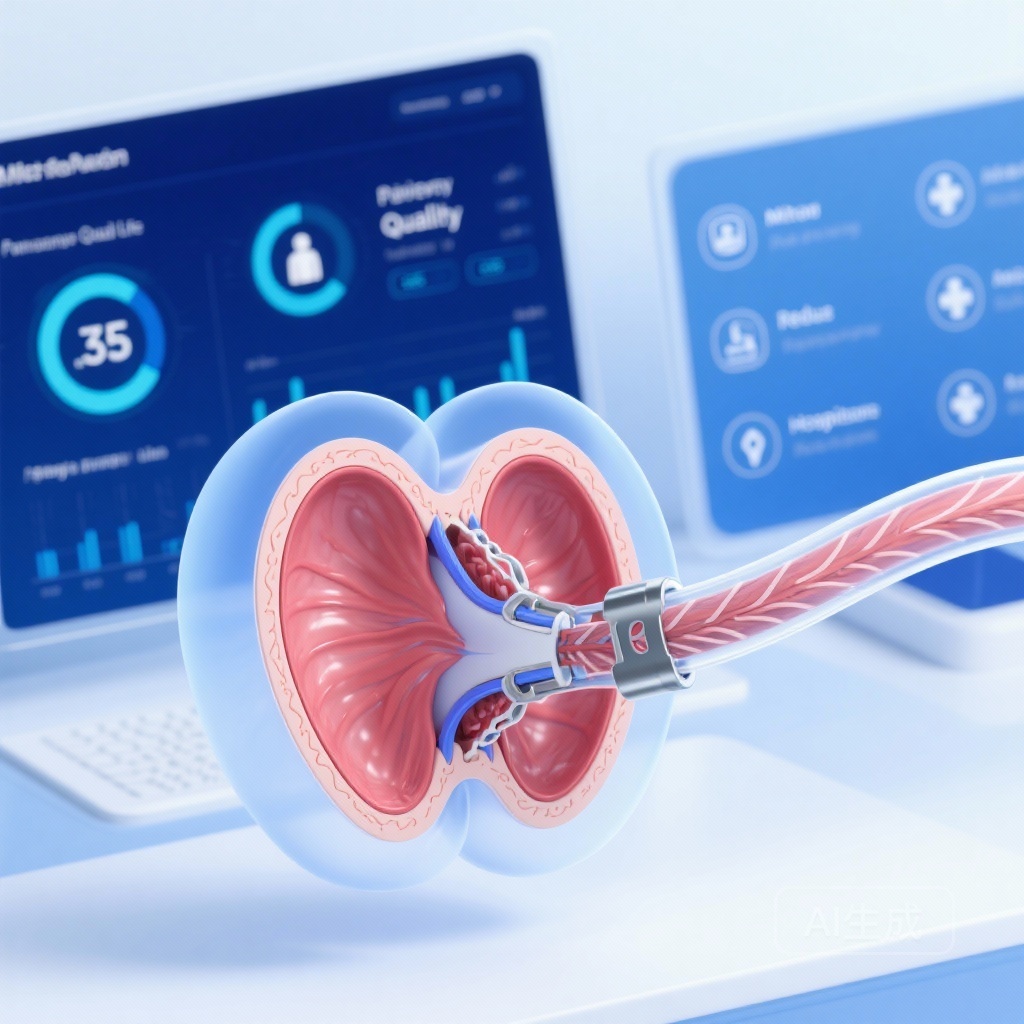
Highlights of the RESHAPE-HF2 Sub-analysis
In patients with heart failure and moderate-to-severe ventricular secondary mitral regurgitation (vSMR), mitral transcatheter edge-to-edge repair (M-TEER) demonstrated a consistent reduction in the risk of cardiovascular death or heart failure hospitalization regardless of the patient’s baseline health status. Furthermore, M-TEER was associated with significant, sustained improvements in quality of life, as measured by the Kansas City Cardiomyopathy Questionnaire (KCCQ), across all domains and time points up to 24 months. The odds of achieving a clinically meaningful improvement in health status were more than three times higher in the M-TEER group compared to medical therapy alone.
Introduction: The Challenge of Secondary Mitral Regurgitation
Ventricular secondary mitral regurgitation (vSMR) remains a significant therapeutic challenge in the management of heart failure (HF). Unlike primary mitral regurgitation, which results from intrinsic valvular pathology, vSMR is a consequence of left ventricular dysfunction, remodeling, and displacement of the papillary muscles, leading to incomplete leaflet coaptation. This condition creates a vicious cycle of volume overload, further ventricular dilation, and worsening heart failure symptoms. For years, the management of vSMR was limited to guideline-directed medical therapy (GDMT) and cardiac resynchronization therapy (CRT). However, many patients remain symptomatic despite optimal medical management. The introduction of mitral transcatheter edge-to-edge repair (M-TEER) offered a mechanical solution for this functional problem. While previous trials like COAPT and MITRA-FR provided varying perspectives on the efficacy of M-TEER, the RESHAPE-HF2 trial was designed to further clarify the clinical benefits and, specifically, how these benefits translate to the patient’s subjective health status and functional capacity.
Study Design and Methodology
The RESHAPE-HF2 trial was a randomized, controlled, open-label trial conducted across multiple centers. It aimed to evaluate the safety and efficacy of M-TEER using the MitraClip system in patients with symptomatic heart failure and moderate-to-severe vSMR.
Patient Population and Randomization
The trial enrolled 505 patients. These participants were characterized by symptomatic heart failure despite stable GDMT and moderate-to-severe vSMR, defined by a mean effective regurgitant orifice area (EROA) of 0.25 cm2. Notably, the study included a diverse range of regurgitant severities, with 14 percent of patients having an EROA greater than 0.40 cm2 and 23 percent having an EROA less than 0.20 cm2. Patients were randomized in a 1:1 ratio to receive either M-TEER plus GDMT or GDMT alone.
Assessment of Health Status
The primary tool for assessing health status was the Kansas City Cardiomyopathy Questionnaire (KCCQ), a validated, disease-specific instrument. The KCCQ-Clinical Summary Score (CSS) was used to categorize patients into tertiles based on their baseline health status: low (66.1). The CSS incorporates the physical limitation and symptom frequency domains. Other scores analyzed included the Total Symptom Score (TSS) and the Overall Summary Score (OSS). The impact of M-TEER on clinical outcomes (cardiovascular death and HF hospitalizations) was analyzed across these tertiles to determine if baseline health status influenced treatment efficacy.
Key Findings: Clinical Outcomes by Baseline Health Status
The analysis demonstrated that the clinical benefits of M-TEER are robust and not restricted to any specific subgroup of baseline health status.
Primary Composite Endpoint
M-TEER reduced the risk of cardiovascular death or heart failure hospitalization across all KCCQ-CSS tertiles. The hazard ratios (HR) were 0.71 for the lowest tertile, 0.50 for the intermediate tertile, and 0.73 for the highest tertile. A P-trend value of 0.53 indicated that there was no significant interaction between baseline health status and the treatment effect. This suggests that even patients who feel relatively well at baseline (high KCCQ scores) derive a similar relative risk reduction from the procedure as those who are severely symptomatic.
Total Heart Failure Hospitalizations
Similar consistency was observed for total heart failure hospitalizations. The reduction in hospitalization frequency was maintained across all health status categories (P-trend = 0.48), reinforcing the procedural benefit in reducing the burden on the healthcare system and improving patient stability.
Impact of M-TEER on Patient-Reported Outcomes
Beyond traditional clinical endpoints, the RESHAPE-HF2 trial placed a heavy emphasis on how patients actually feel and function.
KCCQ Score Improvements
M-TEER led to significant improvements in KCCQ-CSS, TSS, and OSS compared to medical therapy alone. These improvements were not just immediate but were sustained at 1, 6, 12, and 24 months. By the 24-month mark, the mean difference in health status scores between the M-TEER and GDMT groups remained statistically and clinically significant (P < 0.05).
Responder Analysis
To better quantify the clinical relevance of these changes, the researchers performed a responder analysis at 6 months. Patients in the M-TEER arm were significantly more likely to experience meaningful improvements: an Odds Ratio (OR) of 3.38 for a 5-point improvement, 3.12 for a 10-point improvement, and 3.25 for a 15-point improvement in KCCQ-CSS. Conversely, patients treated with M-TEER were much less likely to experience a 5-point deterioration (OR 0.34). These findings highlight that M-TEER not only makes patients feel better but also protects against the progressive decline in health status often seen in advanced heart failure.
Expert Commentary and Clinical Implications
The results from RESHAPE-HF2 provide critical insights for the clinical community. The finding that M-TEER is effective across a wide range of baseline KCCQ scores is particularly important for patient selection.
Bridging the Gap Between Trials
Historically, the COAPT and MITRA-FR trials created a debate regarding which vSMR patients benefit most from M-TEER. COAPT suggested that patients with disproportionate MR (severe MR relative to the degree of LV dilation) benefited most, while MITRA-FR showed neutral results in a population with more advanced LV dilation and less severe MR. RESHAPE-HF2, by including a broader spectrum of EROA and demonstrating consistent benefits across health status tertiles, suggests that the therapeutic window for M-TEER may be wider than previously thought.
The Importance of Health Status as a Primary Goal
In modern heart failure management, health status is no longer a secondary concern; it is a primary therapeutic target. For many patients, especially the elderly or those with multiple comorbidities, the improvement in quality of life and the ability to perform daily activities are as important as survival. The RESHAPE-HF2 data confirms that M-TEER is a powerful tool for achieving these patient-centered goals. The consistent OR for improvement across 5, 10, and 15-point thresholds suggests a profound impact on the daily lives of these individuals.
Conclusion
The sub-analysis of the RESHAPE-HF2 trial provides compelling evidence that M-TEER is an effective intervention for patients with heart failure and moderate-to-severe vSMR. By demonstrating that clinical benefits and quality-of-life improvements are independent of baseline health status, the study supports the use of M-TEER in a broad range of symptomatic patients. Clinicians should consider these findings when discussing treatment options with patients, emphasizing that M-TEER offers a high probability of both reducing hospitalization risk and significantly enhancing overall well-being.
References
1. Butler J, Khan MS, Friede T, et al. Mitral transcatheter edge-to-edge repair and outcomes according to baseline health status: the RESHAPE-HF2 trial. Eur Heart J. 2025; ehaf1035. 2. Stone GW, Lindenfeld J, Abraham WT, et al. Transcatheter Mitral-Valve Repair in Patients with Heart Failure and Secondary Mitral Regurgitation (COAPT). N Engl J Med. 2018; 379:2307-2318. 3. Obadia JF, Messika-Zeitoun D, Leurent G, et al. Percutaneous Repair or Medical Treatment for Secondary Mitral Regurgitation (MITRA-FR). N Engl J Med. 2018; 379:2297-2306.