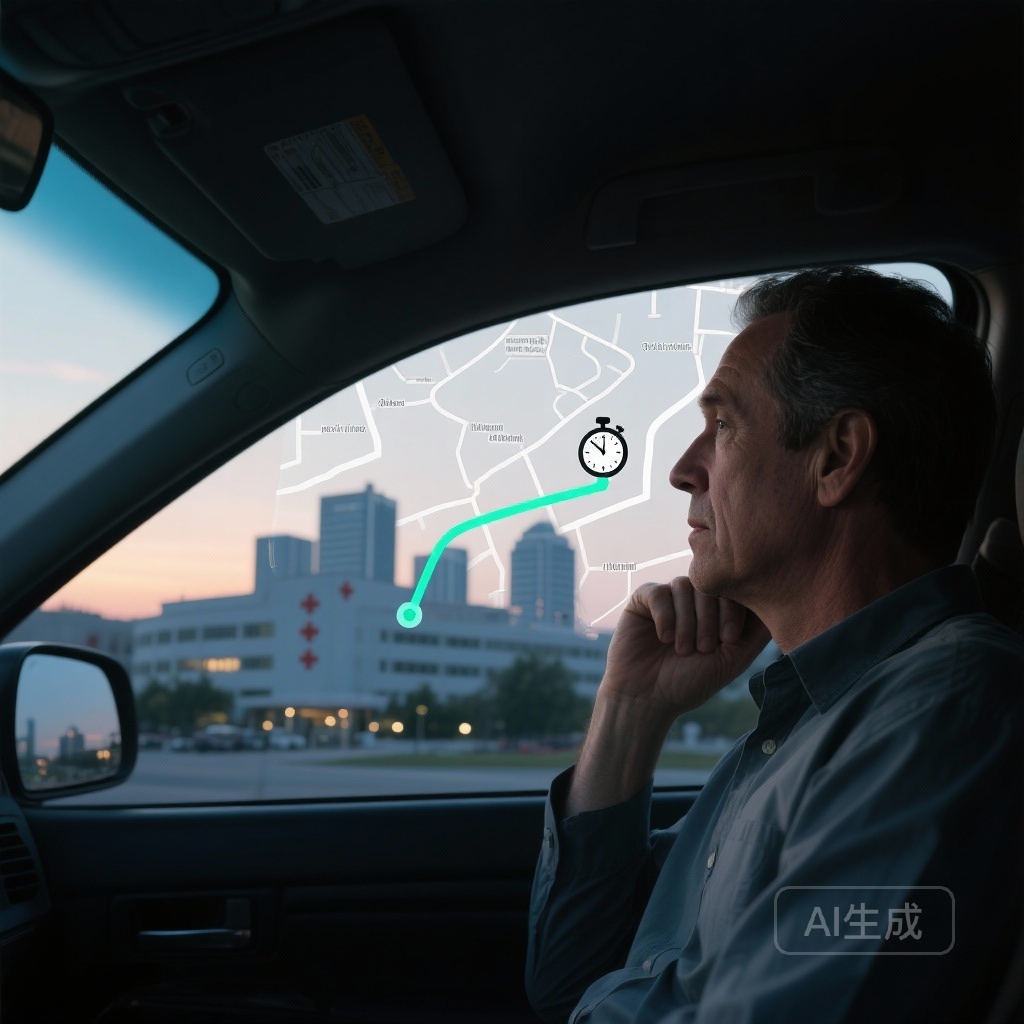
Highlight
– In a retrospective cohort of 159,943 US men with prostate cancer (2000–2015), estimated travel time to the treating facility ≥30 minutes was associated with lower adjusted risks of all-cause (aHR 0.91, 95% CI 0.89–0.93) and prostate cancer–specific mortality (aHR 0.90, 95% CI 0.86–0.95).
– The authors suggest this counterintuitive finding may reflect higher-quality or more specialized care concentrated at centers that draw patients from greater distances.
– Results were generally consistent across subgroups, but interpretations must consider selection effects and access barriers that can delay diagnosis or reduce treatment uptake.
Background
Timely and equitable access to high-quality cancer care is a core component of improving outcomes. For prostate cancer, the most commonly diagnosed malignancy in US men, outcomes depend on stage at diagnosis, tumor biology, and the appropriateness and timeliness of definitive or multimodal treatments (surgery, radiation, systemic therapy). Geographic access has long been studied as a potential determinant of cancer outcomes, but many analyses use straight-line (Euclidean) distance as a proxy for travel burden. Straight-line distance can misclassify patient experience in regions with irregular road networks, geographic barriers, or variable traffic patterns. Travel time estimated on road networks is a more patient-centered measure of access and may better capture logistical burdens that influence the decision to seek care, choice of treating facility, and adherence to complex treatment regimens.
Study design
Korn et al. used the Multilevel Epidemiologic Tumor Registry for Oncology (METRO), a population-based registry that integrates geomasked residential and treatment facility data from several state cancer registries, to evaluate whether estimated travel time from a patient’s residence to the treating facility was associated with mortality among men diagnosed with prostate cancer. The cohort included 159,943 men aged 40–99 years from seven geographic regions (Hawaii, Louisiana, Massachusetts, New Jersey, Ohio, Utah, and the Seattle–Puget Sound area) diagnosed between 2000 and 2015, with follow-up through January 1, 2018.
Exclusions applied were missing follow-up, autopsy diagnosis, or missing residential or treatment facility data. Travel time was categorized as <30 minutes versus ≥30 minutes using masked geocodes and road network estimations to reflect plausible travel burden. Primary outcomes were all-cause mortality and prostate cancer–specific mortality, analyzed using Cox proportional hazards models adjusted for demographic, clinical, and registry-level covariates. Analyses were performed between May 2024 and March 2025.
Key findings
Population and follow-up
The analytic cohort included 159,943 men (mean age 66.3 years, SD 9.5). Median follow-up was approximately 101 months (IQR 57.3–120.0 months). Of the cohort, 44.1% were estimated to have a travel time under 30 minutes to their treating facility and 55.9% had an estimated travel time of 30 minutes or longer.
Primary outcomes
Contrary to an a priori expectation that longer travel burden would worsen outcomes, longer travel time (≥30 minutes) was associated with a lower risk of death. Adjusted hazard ratios showed a 9% relative reduction in all-cause mortality (aHR 0.91; 95% CI 0.89–0.93) and a 10% relative reduction in prostate cancer–specific mortality (aHR 0.90; 95% CI 0.86–0.95) compared with travel <30 minutes.
Subgroup and sensitivity analyses
The association of longer travel time with lower mortality was reported to be largely consistent across most predefined subgroups (e.g., age categories, stage groups), although the authors emphasize that findings should be interpreted cautiously given potential heterogeneity in regional care patterns and unmeasured confounding. The paper notes the importance of considering access barriers—patients with poor transportation or financial constraints who cannot travel may experience worse outcomes due to delayed or foregone care, a pattern that would not be captured fully by these analyses and could bias associations.
Effect size and clinical significance
The observed effect sizes are modest (relative risk reductions in the single-digit percentages), but they are notable given the large sample size and long follow-up. From a population-health perspective, even small relative improvements aggregated across many patients could translate into meaningful absolute numbers of lives, but causality cannot be inferred from observational data.
Interpretation and expert commentary
These findings appear paradoxical at first glance: higher travel time is often viewed as a barrier to care and—by extension—worse outcomes. The authors propose plausible explanations that are consistent with existing health-services literature.
1) Centralization and specialization
Specialized tertiary or high-volume centers frequently attract patients from wider catchment areas. High-volume surgeons and multidisciplinary cancer centers can offer more guideline-concordant care, advanced technologies, and participation in clinical trials—factors associated with better surgical and oncologic outcomes in several cancers. The association found by Korn et al. may therefore reflect treatment at higher-quality centers by patients willing or able to travel, producing an apparent protective effect of longer travel time. This interpretation aligns with classic literature linking hospital and surgeon volume to improved outcomes for complex procedures (e.g., Birkmeyer et al., N Engl J Med 2002), and with more recent data supporting the benefits of concentrated specialist expertise for some oncologic treatments.
2) Selection and confounding
Patients who travel longer distances to seek care may differ systematically from those treated locally. They may have higher socioeconomic resources, stronger social support, greater health literacy, or selective referral for more favorable prognostic features. Although adjusted models included numerous covariates, residual confounding—particularly with unmeasured social determinants, performance status, or referral bias—remains a significant concern.
3) Measurement issues and interpretation limits
Travel-time estimates used geomasked geocodes and road networks to protect privacy but still approximate individual travel experiences. The dichotomization at 30 minutes simplifies a continuous exposure and may obscure nonlinear relationships. Importantly, travel time to the treating facility does not capture travel required for diagnostic workup, follow-up visits, or receipt of multimodal care at separate locations—potentially underestimating the overall logistical burden. Moreover, patients who cannot or do not travel may be underrepresented if they never reach treatment facilities captured in the registry.
4) Potential harms masked by aggregated analysis
A reassuring overall association does not negate the existence of vulnerable subpopulations for whom travel burden meaningfully worsens outcomes. For example, rural patients lacking transportation, older adults with mobility limitations, and socioeconomically disadvantaged groups may experience delayed diagnoses or suboptimal therapy uptake. Aggregated registry analyses can mask such disparities; targeted analyses by socioeconomic strata, race/ethnicity, insurance status, and rurality are essential to detect inequities.
Limitations
Key limitations include the observational design preventing causal inference; potential residual confounding by unmeasured factors (socioeconomic status, comorbidities beyond those recorded, performance status); reliance on geomasked residential coordinates and modeled travel times rather than patient-reported travel experiences; and possible selection bias in which patients who are comprehensively captured in treatment registries may differ from those who never reach documented care. The dichotomous travel-time cutoff simplifies complex behavior and may not reflect thresholds most relevant to patients. Finally, generalizability beyond the included regions may be limited, particularly to underserved or very remote areas.
Clinical and policy implications
For clinicians and health system leaders, the study highlights two complementary messages: (1) centralization and concentration of specialized cancer services may yield outcome benefits, supporting the role of regional centers of excellence for complex oncology care; and (2) improving access remains critical—benefits of centralized care will not be realized equitably unless systems address transportation, lodging, telehealth-enabled pre- and post-treatment visits, and supports for low-resource patients. Policy efforts that promote appropriate referral pathways while funding patient navigation and transportation assistance could help reconcile centralization benefits with equitable access.
Conclusion
Korn et al. report that estimated travel time of ≥30 minutes to the treating facility was associated with modestly lower all-cause and prostate cancer–specific mortality in a large, multistate registry cohort. The most plausible interpretation is that longer travel time selects for care at more specialized centers, which may confer outcome advantages. However, this pattern does not imply that travel burden is harmless; access barriers likely exert adverse effects for specific vulnerable populations. Future work should disentangle the effects of facility quality, patient selection, and social determinants by incorporating richer measures of socioeconomic status, comorbidity, patient-reported travel burden, and facility-level quality metrics. Interventions to combine the benefits of specialization with programs that mitigate travel-related barriers are needed to ensure equitable improvements in outcomes for all men with prostate cancer.
Funding and clinicaltrials.gov
The primary study was published in JAMA Network Open and reports investigator-initiated, registry-based funding sources as described in the manuscript. No clinicaltrials.gov registration is applicable because this was an observational registry analysis. For full funding disclosures and acknowledgments, see Korn SM et al., JAMA Netw Open 2025.
References
1. Korn SM, Dagnino F, Daniels D, et al. Travel Time to Treating Facility and Mortality in Men With Prostate Cancer. JAMA Netw Open. 2025;8(12):e2546812. doi:10.1001/jamanetworkopen.2025.46812 .
2. Birkmeyer JD, Siewers AE, Finlayson EV, et al. Hospital volume and surgical mortality in the United States. N Engl J Med. 2002;346(15):1128–1137. doi:10.1056/NEJMsa012337 .
3. Siegel RL, Miller KD, Fuchs HE, Jemal A. Cancer statistics, 2024. CA Cancer J Clin. 2024;74(1):7-33. doi:10.3322/caac.21679 .