Highlights
– National Medicare cohort mapped incident epilepsy at a small-area level using privacy-preserving aggregation (692 “MaxCounties”).
– Wide spatial heterogeneity: incidence varied >10-fold across MaxCounties (141–1476 per 100,000 persons in 2019).
– Area-level insufficient sleep and lack of household vehicle access were independently associated with high epilepsy incidence (OR ~2.0 each, highest vs lowest tertile).
– Findings emphasize social and environmental determinants—sleep, mobility, heat exposure, insurance coverage, and racial composition—as potential targets for prevention and resource allocation.
Background
Epilepsy incidence rises with age, and older adults represent a growing share of persons with new-onset seizures owing to demographic aging and the persisting burden of cerebrovascular disease, neurodegenerative disorders, and traumatic brain injury. Geographic variation in incidence may reflect local differences in these clinical risk factors but also contextual social and environmental determinants of health (SEDH)—for example, access to care, transportation, sleep health, and environmental exposures—that could influence both risk and detection.
Small-area analyses can identify local hotspots and inform targeted prevention, clinical service planning, and outreach. However, privacy constraints and sparse counts have historically limited county-level mapping of rare outcomes such as new-onset epilepsy in older adults. The study by Dong et al. (JAMA Neurology, 2025) uses a large Medicare sample and a privacy-preserving regionalization method to describe spatial heterogeneity in incident epilepsy and to examine associations with area-level SEDH.
Study design
This was a retrospective cohort study of Medicare Fee-for-Service (FFS) beneficiaries aged ≥65 years using administrative claims from 2016–2019 across all counties in the contiguous United States. The analytic cohort comprised a random sample of 4,999,999 beneficiaries with oversampling of non-Hispanic Black and Hispanic beneficiaries (1.50× and 1.75× respectively). After exclusions, 4,817,147 beneficiaries were analyzed.
Incident epilepsy cases were defined by claims and ICD-10 diagnostic codes in 2019, with exclusion of beneficiaries who had epilepsy claims during 2016–2018 to ensure incident case capture. To satisfy privacy rules and ensure stable rates, the Max-P regionalization algorithm aggregated 3,108 counties into 692 “MaxCounties,” each containing at least 11 incident cases.
Area-level SEDH variables were obtained from public sources and linked to beneficiaries’ residence. The investigators used machine learning (random forest) to screen variable importance followed by multivariable logistic regression (comparing MaxCounties in the highest tertile of incidence versus others) to estimate adjusted associations. Data analysis was conducted January–March 2025.
Key findings
Sample characteristics and incidence
Among 4,817,147 beneficiaries, 20,263 incident epilepsy cases were identified in 2019. The mean (SD) age of incident cases was 78.7 (7.5) years; 54.6% were women. After regional aggregation, incidence rates across MaxCounties varied markedly—more than tenfold—ranging from 141 to 1,476 per 100,000 persons in 2019.
Top predictors from random forest models
Random forest variable importance rankings highlighted several SEDH factors associated with higher area-level incidence: insufficient sleep prevalence, ambient heat index, physical inactivity, percentage uninsured, proportion of non-Hispanic Black residents, and obesity prevalence. These are not mutually exclusive and may reflect correlated pathways linking social and environmental exposures to neurological risk.
Adjusted associations from multivariable regression
In multivariable logistic regression comparing MaxCounties in the highest tertile of incidence to other areas, two SEDH variables showed robust associations:
- Insufficient sleep: MaxCounties in the highest tertile for insufficient sleep had nearly double the odds of high epilepsy incidence compared with the lowest tertile (OR 1.99; 95% CI, 1.10–3.60).
- Lack of household vehicle access: MaxCounties with greater proportions of households without vehicle access had increased odds of high incidence (OR 1.93; 95% CI, 1.16–3.25).
Other factors identified by the machine learning screen—heat index, physical inactivity, uninsured rate, non-Hispanic Black population share, and obesity—were also associated with incidence in bivariate patterns and were influential in the random forest models, though effect sizes in adjusted regression were presented particularly for the sleep and vehicle access variables.
Interpretation and potential mechanisms
Sleep and seizure risk: The strong association with insufficient sleep prevalence is biologically plausible. Sleep deprivation is a well-established seizure precipitant and may lower seizure threshold in persons with latent epileptogenic pathology. At the population level, higher prevalence of insufficient sleep could increase the probability of symptomatic seizures and thereby incident epilepsy diagnoses, or could heighten detection through care-seeking for sleep-related comorbidities.
Mobility and access to care: Lack of household vehicle access likely reflects constrained mobility and structural barriers to timely ambulatory care, specialty neurology evaluation, and management of vascular and traumatic risk factors that predispose to late-onset epilepsy. Reduced mobility also increases vulnerability to social isolation and delayed care for prodromal neurological events (e.g., stroke), which may ultimately increase seizure risk.
Environmental heat and physiological stress: Heat index emerged in machine learning models; elevated temperatures can worsen sleep, exacerbate cardiovascular disease, and increase risk of dehydration and metabolic derangements that may trigger seizures—especially among older adults with comorbidities and polypharmacy.
Socioeconomic and racial disparities: Associations with uninsured rate, obesity prevalence, physical inactivity, and proportion of non-Hispanic Black residents likely capture interrelated social determinants—structural racism, neighborhood deprivation, healthcare access inequities—that shape upstream risks for stroke, traumatic brain injury, and neurodegenerative disease, all established contributors to late-life epilepsy.
Expert commentary and limitations
This study advances population neurology by applying a privacy-preserving small-area approach to a large national claims dataset, revealing marked spatial heterogeneity in incident epilepsy among older adults and implicating modifiable contextual factors. The findings should be interpreted within several important limitations:
- Case ascertainment stems from administrative claims and ICD-10 codes, which can misclassify epilepsy versus acute symptomatic seizures or other paroxysmal events. Validation studies of claims-based algorithms vary in sensitivity and specificity.
- The cross-sectional ecological design at the MaxCounty level links area-level exposures to area-level incidence and cannot prove individual-level causation. Unmeasured confounding and ecological fallacy are possible.
- The analytic sample included Medicare FFS beneficiaries; results may not generalize to Medicare Advantage enrollees, younger populations, or non-Medicare populations.
- Regional aggregation (Max-P) was necessary for privacy and statistical stability but reduces geographic resolution and may mask within-region heterogeneity.
- Some SEDH variables are correlated (multicollinearity), which complicates causal interpretation of individual predictors. The study used random forest to screen predictors and regression for adjusted associations, but residual confounding may persist.
Despite these limitations, the study generates actionable hypotheses: that sleep health and transportation/infrastructure are plausible, modifiable levers to reduce risk or improve detection and management of epilepsy in older adults.
Implications for clinicians, health systems, and policy
Clinicians should be mindful that patients living in communities with higher prevalence of insufficient sleep, limited transportation, and other adverse SEDH may be at increased risk for new-onset seizures and may face barriers to timely specialty care. Screening for sleep disorders, fall and injury prevention, and proactive vascular risk management are already recommended for older adults and may reduce epilepsy risk.
Health systems and public health agencies can use small-area incidence maps to guide allocation of neurology services, outreach for sleep and mobility interventions, and community investments—transportation programs, heat mitigation, and targeted public health campaigns—to neighborhoods with disproportionately high incidence.
Conclusions and research priorities
Dong et al. provide compelling evidence of marked spatial heterogeneity in late-life epilepsy incidence across the contiguous United States and identify insufficient sleep and lack of household vehicle access as prominent contextual correlates. These findings strengthen the case for integrating social and environmental determinants into neurological risk assessment and prevention strategies.
Key research priorities include: validating claims-based case definitions against clinical records in diverse settings; longitudinal, multilevel analyses that combine individual- and area-level data to unpack causal pathways; intervention studies addressing sleep health and transportation access in high-incidence communities; and expanding surveillance to incorporate Medicare Advantage populations and non-Medicare older adults.
Funding and clinicaltrials.gov
Funding: Not reported in the abstract. Readers should consult the full paper for detailed funding disclosures and potential conflicts of interest.
ClinicalTrials.gov: Not applicable (observational administrative claims study).
References
1. Dong W, Cabulong A, Vu L, et al. Incidence and Risk Factors of Epilepsy Among Older Adults in the US Medicare Population. JAMA Neurol. 2025 Nov 10:e254347. doi:10.1001/jamaneurol.2025.4347. PMID: 41212547; PMCID: PMC12603946.
2. World Health Organization. Epilepsy. https://www.who.int/news-room/fact-sheets/detail/epilepsy. Accessed November 2025.
3. Centers for Disease Control and Prevention. Epilepsy Data and Statistics. https://www.cdc.gov/epilepsy/data/index.html. Accessed November 2025.
Thumbnail image prompt (for editorial illustration)
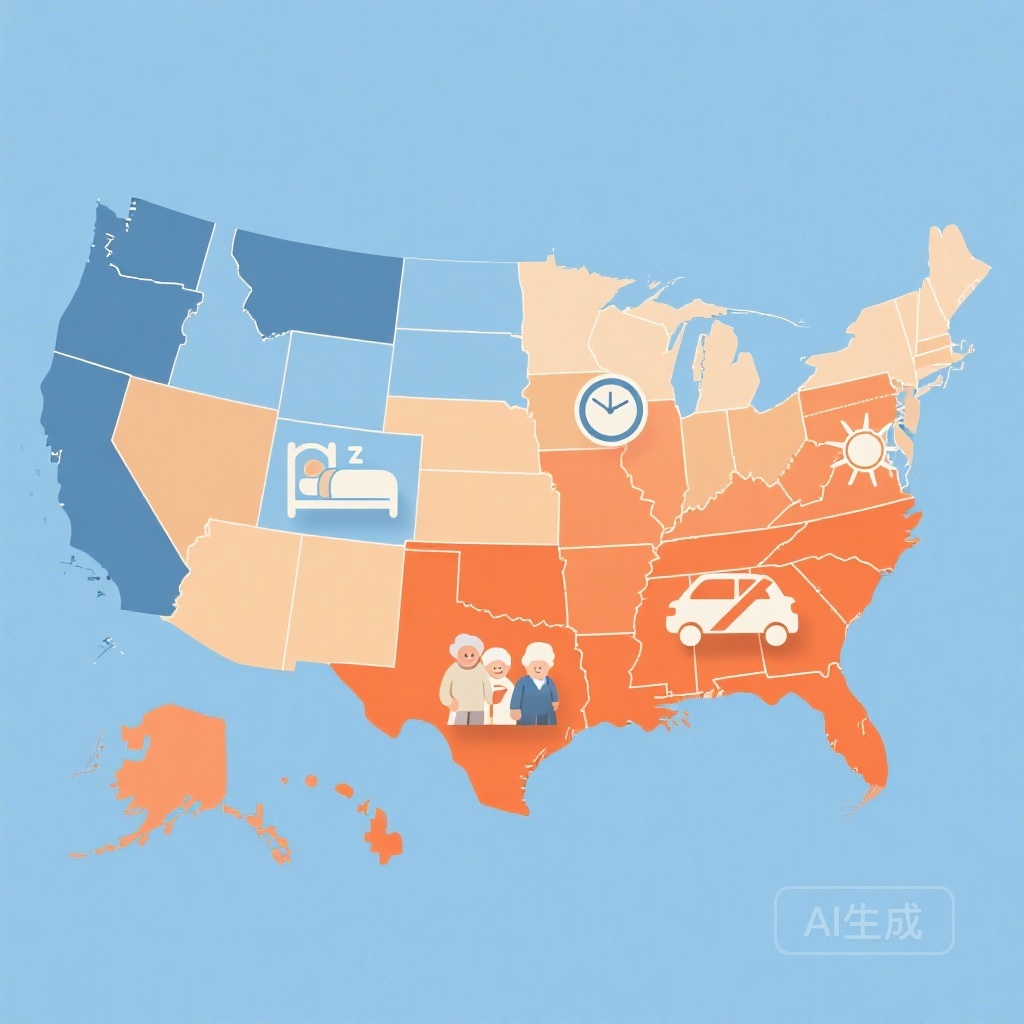
“A clean, modern infographic-style image showing a US map with counties shaded in a choropleth gradient indicating epilepsy incidence; overlaid icons include an elderly person silhouette, a bed and clock symbol (insufficient sleep), a car with a no-access symbol (transport barriers), and a stylized sun/heat wave; color palette of muted blues and warm oranges, flat vector design, high contrast, journal cover aesthetic.”