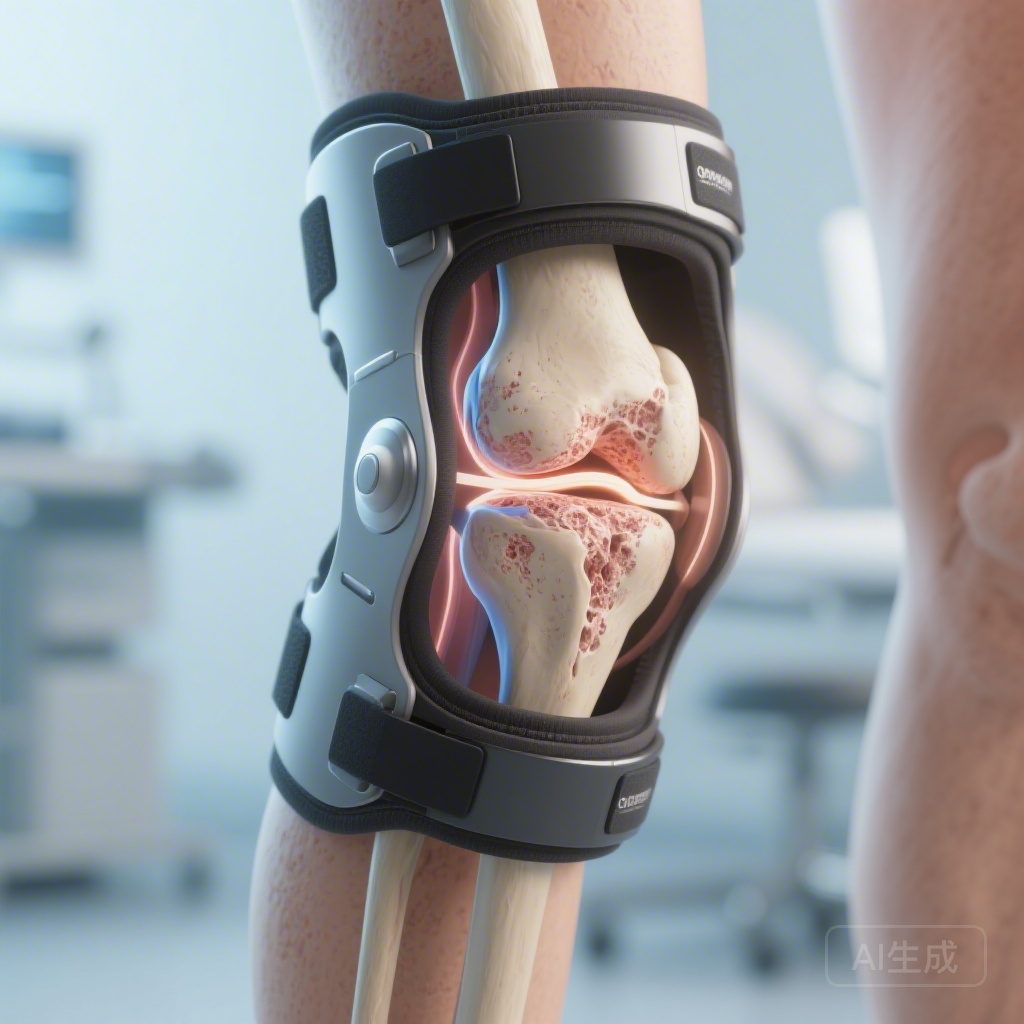
Highlights
- The PROP OA trial indicates that adding a compartment-specific knee brace to standard advice and exercise significantly improves patient-reported outcomes (KOOS-5) at six months.
- The most substantial benefit was observed in pain reduction, with an adjusted mean difference of 6.13 on the KOOS pain scale.
- The intervention included a structured adherence program using motivational interviewing and text reminders, addressing a common barrier in orthopedic bracing.
- Adverse events were minor and expected, confirming that knee bracing is a safe non-pharmacological option for managing osteoarthritis symptoms.
Background: The Challenge of Knee Osteoarthritis Management
Knee osteoarthritis (OA) is a leading cause of chronic pain and physical disability worldwide, placing an immense burden on both individual quality of life and global healthcare systems. Current international guidelines, including those from the National Institute for Health and Care Excellence (NICE) and the Osteoarthritis Research Society International (OARSI), emphasize core treatments such as education, exercise, and weight management. However, many patients continue to experience debilitating symptoms despite adhering to these first-line interventions.
While pharmacological options like non-steroidal anti-inflammatory drugs (NSAIDs) and intra-articular injections are available, they are often associated with systemic side effects or provide only transient relief. This has led to an increased interest in biomechanical interventions, specifically knee bracing. Bracing aims to alter the mechanical loading environment of the knee joint, theoretically reducing stress on the most affected compartments (medial, lateral, or patellofemoral). Despite the logical appeal of bracing, high-quality evidence from large-scale randomized controlled trials has been historically limited, particularly regarding the integration of bracing into primary care pathways. The PRovision of knee Bracing for Knee Osteoarthritis (PROP OA) trial was designed to bridge this evidence gap.
Study Design and Methodology
The PROP OA trial was a multicenter, parallel-group, superiority, statistician-blinded, randomized controlled trial conducted across various sites in England, including Cheshire, Manchester, North Tyneside, and Staffordshire. The study enrolled 466 adults aged 45 years or older who presented with symptomatic knee osteoarthritis.
Participant Stratification and Randomization
Participants were randomized 1:1 to either the control group (Advice, Information, and Exercise – AIE) or the intervention group (AIE plus Bracing – AIE+B). A unique feature of this trial was the tailored approach to bracing. Rather than applying a one-size-fits-all brace, participants in the AIE+B group were fitted with a brace specific to their predominant symptomatic compartment: patellofemoral, tibiofemoral unloading (medial or lateral), or a neutral stabilizing brace for multi-compartmental involvement.
The Intervention Protocols
The control group (AIE) received a single in-person consultation with a trained physiotherapist who provided personalized advice, written information, and instructions for a home-based exercise program. The intervention group (AIE+B) received the same AIE protocol but was also fitted with a compartment-specific brace. Crucially, the trial incorporated an adherence-enhancing component. This included brief motivational interviewing during the fitting session and targeted text message reminders over the initial weeks to encourage consistent brace use. A follow-up consultation at two weeks was also offered to address any fit or comfort issues.
Outcome Measures
The primary outcome was the Knee Osteoarthritis Outcome Score (KOOS-5) at six months. KOOS-5 is a composite score (0-100) derived from five subscales: pain, symptoms, activities of daily living, sport and recreation function, and knee-related quality of life. Secondary outcomes included these subscale scores individually, as well as pain levels during weight-bearing activities, measured at three, six, and 12 months post-randomization.
Key Findings: Does Bracing Make a Difference?
The results of the PROP OA trial provide robust evidence for the clinical utility of knee bracing. Of the 466 participants randomized (mean age 64; 46% female), follow-up rates remained high throughout the study period, with 85% of participants providing analysable data at the primary six-month endpoint.
Primary Outcome: KOOS-5 at Six Months
At the six-month mark, the AIE+B group showed a statistically significant improvement in the KOOS-5 score compared to the AIE-only group. The adjusted mean difference was 3.39 (95% Confidence Interval [CI] 0.96 to 5.82), representing an effect size of 0.24. While the absolute difference in the composite score was modest, it confirmed the superiority of the combined intervention.
Secondary Outcomes and Pain Reduction
The secondary outcomes revealed more pronounced benefits, particularly in the domain of pain. The adjusted mean difference for the KOOS pain subscale at six months was 6.13 (95% CI 3.36 to 8.91), yielding a moderate effect size of 0.39. Participants in the bracing group also reported significant improvements in pain during weight-bearing activities compared to the control group. Interestingly, the benefits appeared most significant at the three- and six-month intervals, with the magnitude of the difference between groups diminishing slightly by the 12-month follow-up, though still favoring the intervention group.
Safety and Tolerability
One of the primary concerns with orthopedic bracing is the potential for skin irritation, discomfort, or non-compliance. In the PROP OA trial, adverse events were reported but were generally minor and expected, such as localized skin redness or temporary discomfort. No serious adverse events related to the brace were identified, reinforcing the safety profile of this non-invasive treatment modality.
Expert Commentary: Interpreting the Evidence
The findings of the PROP OA trial are significant for several reasons. First, the trial addresses the “real-world” application of bracing by utilizing a multicenter design and recruiting from community settings. The inclusion of an adherence intervention (motivational interviewing and text reminders) is a critical methodological strength. Often, clinical trials of medical devices fail because they do not account for the behavioral aspects of device use; PROP OA demonstrates that with proper support, patients can and will utilize braces effectively.
Biomechanical Plausibility
The success of the compartment-specific approach aligns with our biomechanical understanding of OA. For instance, a tibiofemoral unloading brace works by applying a corrective force that shifts the load away from the damaged articular cartilage. By reducing the peak knee adduction moment (in the case of medial OA), the brace can alleviate the mechanical triggers of pain and inflammation. The PROP OA data suggests that this mechanical unloading translates into perceptible clinical improvement for the patient.
Clinical Significance vs. Statistical Significance
Critics may point to the “small” effect size of 0.24 for the primary outcome. However, in the context of chronic pain management, where improvements are often incremental, a safe and non-systemic intervention that provides a 6-point improvement on a pain scale is clinically meaningful. For many patients, this difference can represent the threshold between being able to complete a daily walk or remaining sedentary. Furthermore, the absence of serious side effects makes bracing an attractive “step-up” therapy before considering more invasive options like corticosteroid injections or joint replacement surgery.
Conclusion: Implications for Clinical Practice
The PROP OA trial provides high-level evidence that compartment-specific knee bracing, when combined with an adherence-support program, is superior to exercise and advice alone for patients with knee osteoarthritis. While the improvements in the overall composite score are modest, the specific reduction in pain is substantial and clinically relevant.
For clinicians, these results suggest that knee bracing should be considered earlier in the treatment algorithm, particularly for patients who have not achieved adequate symptom control with core treatments. The key to success lies not just in the hardware of the brace itself, but in the “software” of the delivery—ensuring the brace is correctly matched to the affected compartment and providing the behavioral support necessary to ensure long-term adherence.
Funding and Trial Registration
The PROP OA trial was funded by the National Institute for Health and Care Research (NIHR). The trial is registered under the International Standard Randomised Controlled Trial Number ISRCTN28555470.
References
Holden MA, Nicholls E, Abdali Z, Birrell F, Borrelli B, Callaghan M, Dziedzic K, Felson D, Foster NE, Halliday N, Ingram C, Jinks C, Jowett S, Peat G; PROP OA trial team. Provision of knee bracing for knee osteoarthritis (PROP OA): multicentre, parallel group, superiority, statistician blinded, randomised controlled trial. BMJ. 2026 Jan 26;392:e086005. doi: 10.1136/bmj-2025-086005. PMID: 41587822.