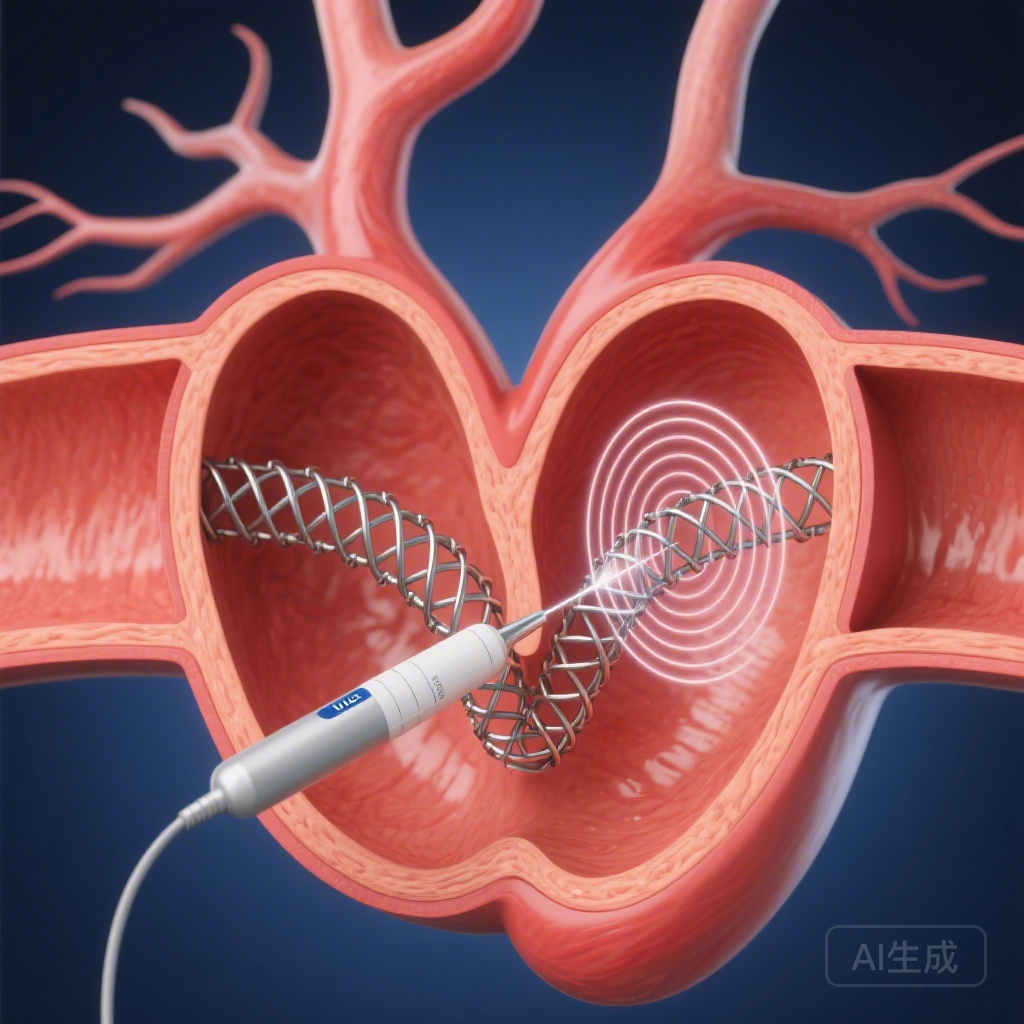
The Paradigm Shift in Complex Bifurcation Management: DKCRUSH VIII Results
The management of complex coronary bifurcation lesions remains one of the most technically demanding frontiers in interventional cardiology. Despite the evolution of drug-eluting stents (DES) and refined techniques like the Double Kissing (DK) crush, these lesions are inherently prone to higher rates of restenosis and stent thrombosis. The DKCRUSH VIII trial, recently published and presented at major cardiovascular forums, provides definitive evidence that intravascular ultrasound (IVUS) guidance is no longer just an adjunctive tool but a necessary standard for optimizing clinical outcomes in this high-risk population.
Highlights of the Trial
The DKCRUSH VIII trial yielded several landmark findings that will likely influence future clinical practice guidelines: 1. IVUS-guided PCI resulted in a 60% relative risk reduction in the primary composite endpoint of target vessel failure (TVF) at one year. 2. The clinical benefit was primarily driven by a significant decrease in target vessel myocardial infarction (TVMI) and clinically driven target vessel revascularization (TVR). 3. The majority of patients (96.8%) were treated with the DK crush technique, confirming the efficacy of IVUS specifically within this complex procedural framework. 4. Success was attributed to achieving IVUS-defined optimization targets rather than the mere use of the imaging modality itself.
Background: The Challenge of Complex Bifurcations
Coronary bifurcation lesions account for approximately 15% to 20% of all percutaneous coronary interventions (PCI). Among these, complex bifurcations—often defined by the DEFINITION criteria, which include side branch (SB) lesion length of 10 mm or greater and significant stenosis—present unique anatomical challenges. These include difficult side branch access, plaque shifting, and the risk of incomplete stent expansion or malapposition. While the DK crush technique has emerged as a superior two-stent strategy for such lesions, the limitations of two-dimensional angiography in visualizing three-dimensional vessel structures can lead to suboptimal stent deployment. IVUS offers a detailed cross-sectional view, allowing operators to assess vessel size, plaque morphology, and stent apposition with precision that angiography cannot match.
Trial Design and Methodology
The DKCRUSH VIII trial was a multicenter, randomized, open-label trial conducted across 24 high-volume centers in China. The study enrolled 555 patients with clinical indications for PCI and complex bifurcation lesions as defined by the DEFINITION criteria. A significant portion of the cohort (approximately 44%) had lesions involving the left main coronary artery, further emphasizing the high-risk nature of the study population. Participants were randomly assigned in a 1:1 ratio to either IVUS-guided PCI (n = 277) or angiography-guided PCI (n = 278). The primary endpoint was target vessel failure (TVF) at 12 months, a composite of cardiac death, target vessel myocardial infarction, or clinically driven target vessel revascularization. IVUS optimization in the intervention group was strictly defined, requiring minimal stent areas (MSA) to meet specific thresholds: at least 5.0 mm² in the side branch, 6.0 mm² in the main branch distal to the bifurcation, 7.0 mm² at the bifurcation site, and 8.0 mm² in the main branch proximal to the bifurcation.
Detailed Results and Clinical Impact
The results at the 1-year follow-up were striking. The primary endpoint of TVF occurred in 6.1% (17 patients) of the IVUS-guided group compared to 14.7% (41 patients) in the angiography-guided group. This translated to a Hazard Ratio (HR) of 0.40 (95% CI: 0.23-0.71; P = 0.002).
Analysis of Secondary Endpoints
When breaking down the composite endpoint, the reduction in TVF was largely attributed to lower rates of TVMI and TVR. Cardiac death rates were low in both groups, but the technical precision afforded by IVUS significantly mitigated the risk of periprocedural and late ischemic events. Notably, the study found that the benefits were most pronounced when operators successfully met all IVUS optimization criteria. In cases where IVUS was used but optimization targets were not reached, the outcomes were comparable to the angiography-guided group, reinforcing the concept that imaging is a tool for action, not just observation.
Mechanistic Insights: Why IVUS Guidance Matters
The superiority of IVUS in this trial can be explained by several mechanistic factors inherent to the DK crush technique. The DK crush involves multiple steps, including side branch stenting, crushing, first kissing balloon inflation, main branch stenting, and a final kissing balloon inflation. At each stage, IVUS allows for: 1. Accurate Vessel Sizing: Angiography often underestimates vessel diameter due to diffuse disease or vessel remodeling. IVUS ensures that stent diameters are matched to the true external elastic lamina (EEL). 2. Identification of Malapposition: Incomplete contact between the stent struts and the vessel wall is a major precursor to stent thrombosis. IVUS can detect subtle malapposition that is invisible on angiography. 3. Optimization of the ‘Crush’ and ‘Kiss’: Ensuring that the side branch stent is adequately crushed and that the bifurcation carina is correctly reconstructed requires the high-resolution internal imaging provided by IVUS.
Expert Commentary and Clinical Implications
Clinical experts suggest that DKCRUSH VIII provides the missing link in bifurcation evidence. While previous trials like ULTIMATE demonstrated the benefits of IVUS in all-comer PCI, DKCRUSH VIII focuses specifically on the most complex subset of lesions. For the practicing interventionalist, these data suggest that IVUS should be integrated into the workflow of any two-stent bifurcation procedure. The trial also highlights the importance of standardized optimization protocols. It is not enough to simply “pull the IVUS catheter”; the operator must be prepared to use the information to perform additional post-dilatation or larger balloon sizing to meet the required MSA targets.
Study Limitations
Despite its robust findings, the trial has limitations. It was an open-label study, which is inherent to imaging trials where the operator cannot be blinded to the tool being used. Additionally, the study was conducted in high-volume centers in China where the DK crush technique was pioneered; therefore, the generalizability of these results to centers with less experience in complex bifurcation stenting may vary. Long-term follow-up beyond one year will be essential to determine if these early benefits translate into sustained improvements in mortality and stent thrombosis rates over the lifetime of the patient.
Conclusion
The DKCRUSH VIII Randomized Clinical Trial marks a significant milestone in interventional cardiology. By demonstrating a 60% reduction in TVF, the study confirms that IVUS-guided PCI is the superior strategy for managing complex coronary bifurcation lesions. As the complexity of patients treated in the cardiac catheterization lab continues to rise, the adoption of IVUS-guided optimization protocols will be paramount in reducing ischemic complications and improving the long-term prognosis for patients undergoing complex coronary interventions.
References
1. Gao X, Kan J, Chen Y, et al. IVUS or Angiography Guidance for Percutaneous Coronary Intervention in Complex Coronary Bifurcation Lesions: The DKCRUSH VIII Randomized Clinical Trial. J Am Coll Cardiol. 2026. PMID: 41914946. 2. Chen SL, Zhang JJ, Han Y, et al. Double Kissing Crush vs. Provisional Stenting for Left Main Distal Bifurcation Lesions: DKCRUSH-V Randomized Trial. J Am Coll Cardiol. 2017;70(21):2605-2617. 3. Zhang J, Gao X, Kan J, et al. Intravascular Ultrasound Versus Angiography-Guided Drug-Eluting Stent Implantation: The ULTIMATE Trial. J Am Coll Cardiol. 2018;72(24):3126-3137.