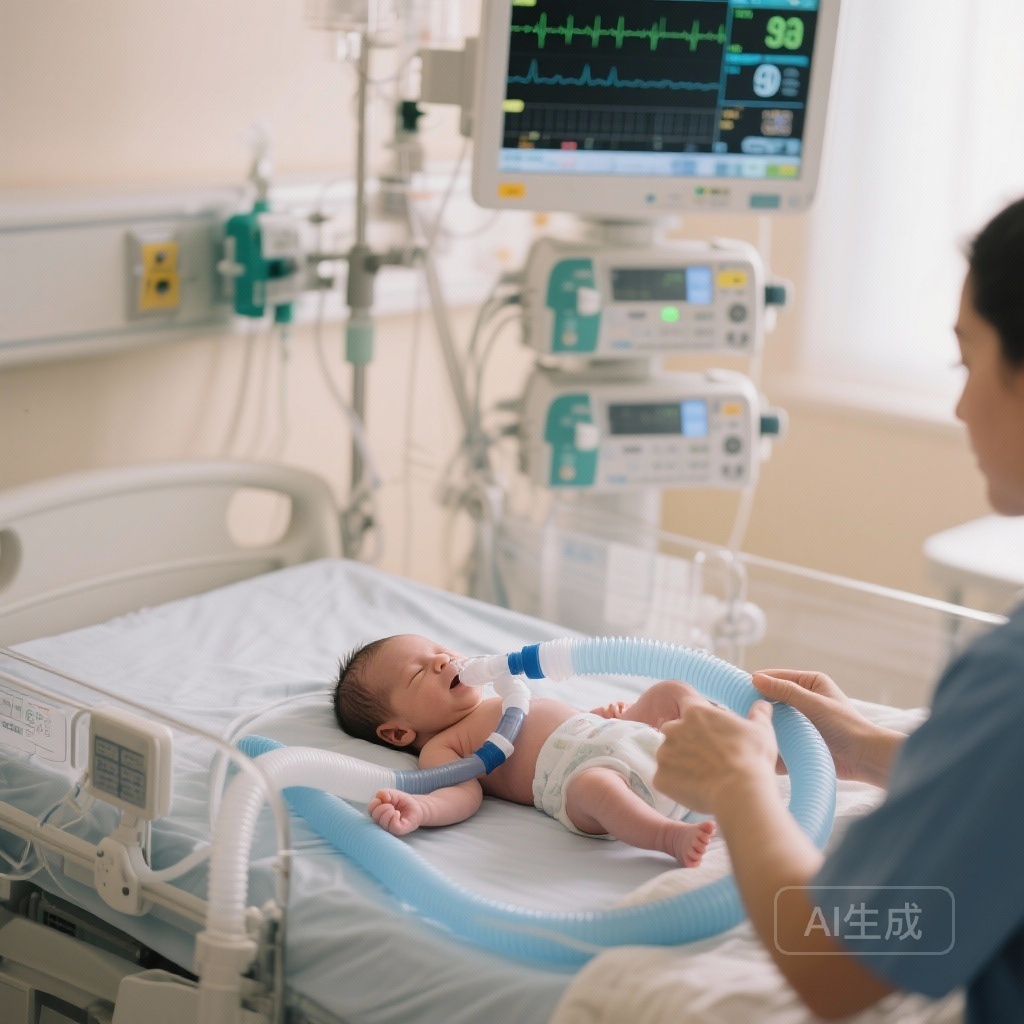
Highlight
– A 2025 Cochrane systematic review including three randomized trials (368 infants) found very low- to low-certainty evidence that high-frequency oscillatory ventilation (HFOV) does not clearly reduce failed therapy or pulmonary air leaks compared with conventional ventilation (CV) in infants born ≥35 weeks with severe pulmonary dysfunction.
– Meta-analysis suggested a possible increase in mortality with HFOV (RR 1.47, 95% CI 0.92–2.34), but the evidence is low certainty and imprecise.
– No randomized data reported long-term neurodevelopmental outcomes; trials were small and predated many modern CV strategies, limiting applicability to current practice.
Background and clinical context
Acute pulmonary dysfunction leading to respiratory failure remains an important cause of morbidity and mortality in term and near‑term neonates. Common etiologies include meconium aspiration syndrome, pneumonia/sepsis, persistent pulmonary hypertension of the newborn (PPHN) with parenchymal disease, and primary surfactant deficiency in late preterm/near‑term infants. Mechanical ventilation is often life‑saving, but ventilator-associated lung injury (VALI) — volutrauma, barotrauma, atelectrauma — is a concern. Over several decades, high-frequency oscillatory ventilation (HFOV) has been used as an alternative strategy intended to maintain lung volumes with very small tidal volumes at high frequencies to minimize volumetric injury and optimize oxygenation.
Historically, randomized trials and meta-analyses in extremely preterm infants have focused on HFOV versus conventional mechanical ventilation (CV) with mixed results, and practice has evolved substantially (volume-targeted ventilation, noninvasive support, lung-protective strategies). For term and near‑term infants with severe pulmonary dysfunction, the balance of benefits and harms of HFOV versus modern CV approaches remained uncertain — a knowledge gap addressed by the 2025 Cochrane update by Phattraprayoon et al.
Study design and methods (Cochrane review overview)
The Cochrane review updated in 2025 searched CENTRAL, MEDLINE, Embase, trial registries, and conference abstracts to identify randomized and quasi-randomized trials that compared HFOV with CV in infants born at ≥35 weeks’ gestation with severe pulmonary dysfunction within 28 days of life. Eligible trials reported outcomes such as treatment failure on assigned mode, mortality during hospitalization or within the first year, pulmonary air leak, duration of mechanical ventilation, and long‑term neurodevelopmental outcomes (≥2 years). Risk of bias was assessed using Cochrane RoB 1, and evidence certainty was appraised with GRADE. Meta-analyses used fixed-effect models, reporting risk ratios (RR) or mean differences (MD) with 95% confidence intervals (CIs).
Included trials and population
Three trials enrolling a total of 368 term or near‑term infants with severe pulmonary dysfunction met inclusion criteria. Trials enrolled infants within the first 28 days of life requiring mechanical ventilation for lung disease; underlying diagnoses were heterogeneous (typical categories include meconium aspiration, pneumonia, and PPHN-associated parenchymal disease), and trial eras predate many contemporary ventilator modes and adjunctive strategies. Trial-level risk of bias was judged generally low for random sequence generation and allocation concealment, but lack of blinding of clinicians and assessors introduced risk of detection bias for subjective outcomes. Mortality was judged an objective outcome with low detection bias.
Key findings
This section summarizes the primary and clinically relevant secondary outcomes reported in the review. Where applicable, effect estimates and certainty judgements from the Cochrane review are given.
Treatment failure on assigned ventilation mode
Across three trials (368 infants), HFOV had no clear advantage in preventing failure on the assigned mode (RR 1.19, 95% CI 0.86–1.64). The confidence interval crosses unity and is wide, indicating statistical imprecision. GRADE assessment rated this evidence as very low certainty due to risk of bias (lack of blinding), imprecision, and inconsistency across trials. Practically, clinicians cannot be confident that HFOV reduces or increases the need to change ventilation strategy compared with CV.
Mortality (in hospital or within first year)
Meta-analysis of mortality across the three included trials suggested a higher risk with HFOV compared with CV (RR 1.47, 95% CI 0.92–2.34). This point estimate indicates a 47% relative increase in risk, but the CI includes the possibility of no effect and is compatible with both modest harm and no clinically important difference. The evidence was graded as low certainty — downgraded for imprecision and potential biases. The trials were underpowered to detect mortality differences, and event rates were modest; thus, a true effect (harm or null) remains uncertain.
Pulmonary air leak (pneumothorax, surgical air leak)
Two trials (197 infants) reported air leak outcomes. The pooled RR for air leak with HFOV was 0.91 (95% CI 0.33–2.54), a very imprecise estimate crossing both meaningful benefit and harm. GRADE rated this as very low-certainty evidence. Given small numbers, clinicians should not infer a reliable protective effect of HFOV against barotrauma in this population.
Duration of mechanical ventilation
Only one trial (112 infants) contributed data; mean difference in days of ventilation was 0.70 (95% CI -0.97 to 2.37), a clinically negligible and statistically non‑significant difference. Evidence graded very low certainty, again limited by small sample size and single-study contribution.
Long‑term neurodevelopmental outcomes
None of the included randomized trials reported neurodevelopmental outcomes at two years or later. Therefore, the crucial patient‑centered outcomes of survival without neurodevelopmental impairment and quality of life remain entirely unassessed in randomized evidence for HFOV versus CV in term/near‑term infants.
Safety and other adverse events
Aside from air leak and mortality, adverse event reporting was sparse and inconsistent. Trials differed in reporting of hemodynamic instability, need for extracorporeal membrane oxygenation (ECMO), or sedation requirements. The limited adverse-event data preclude a robust safety profile comparison between HFOV and CV in this population.
Expert commentary and interpretation
Clinical interpretation of these results requires appreciation of the trials’ context. The RCTs were small, heterogeneous with respect to diagnoses, and conducted in eras before widespread adoption of modern lung‑protective CV strategies (e.g., volume‑targeted ventilation, permissive hypercapnia protocols, sophisticated synchrony modes). As such, external validity to contemporary NICU practice is limited.
Mechanistically, HFOV aims to reduce volutrauma and cyclic alveolar collapse by using very small tidal volumes at high frequencies while maintaining lung volume with mean airway pressure. In term infants with focal disease (e.g., meconium aspiration), heterogeneous lung units and variable compliance may influence how HFOV distributes ventilation and interacts with pulmonary vascular resistance — potentially affecting oxygenation and hemodynamics. HFOV can also increase intrathoracic pressure, affecting venous return and cardiac output, which may contribute to worse outcomes in certain subgroups if not carefully managed.
The apparent signal toward increased mortality must be treated cautiously: it may be a chance finding, related to unmeasured confounding in small trials, or a true effect. Because mortality is an objective outcome with low detection bias, the observed point estimate warrants attention, but low certainty means it should not be taken as definitive proof of harm. Importantly, absent data on neurodevelopmental outcomes, clinicians cannot balance short-term survival against long-term functional outcomes — a central concern when selecting ventilator strategies in neonates.
Clinical implications
Given current evidence, HFOV should not be considered clearly superior to conventional ventilation for term or near‑term infants with severe pulmonary dysfunction, and clinicians should be cautious about routine use as primary mode. Recommended practical approaches include:
– Individualized decision-making: reserve HFOV for specific clinical situations (e.g., refractory hypoxemia despite optimized CV) rather than routine first-line use.
– Optimize conventional ventilation using current lung-protective practices (volume-targeted ventilation, appropriate PEEP, permissive hypercapnia as tolerated, and careful oxygen targeting).
– When HFOV is used, monitor hemodynamics closely, titrate mean airway pressure carefully, and consider echocardiography to assess cardiac function and pulmonary hypertension.
– Enroll eligible infants in high-quality randomized trials when available and feasible; obtain family counseling that evidence for long-term outcomes is lacking.
Limitations of the evidence and research gaps
Key limitations highlighted by the review and relevant to trialists and funders:
– Small number of trials and events limit precision and power for clinically meaningful outcomes, especially mortality and neurodevelopment.
– Absence of long-term neurodevelopmental follow-up is a critical gap; survival alone is not an adequate endpoint in neonatal ventilation trials.
– Heterogeneous trial populations (mixed diagnoses) hamper disease‑specific inference; different pathophysiologies (e.g., diffuse alveolar disease vs localized obstruction) may respond differently to HFOV.
– Trials predate many contemporary CV strategies; head-to-head comparisons with modern CV (volume-targeted modes, lung-protective protocols) are needed.
– Standardization of ventilator settings, weaning criteria, sedation practices, and co-interventions (surfactant, inhaled nitric oxide, ECMO thresholds) will be essential in future trials to reduce confounding.
Recommendations for future research
Well‑designed randomized trials are needed with these design features:
– Adequate sample size to detect differences in mortality and powered co-primary outcomes that include long-term neurodevelopment (e.g., death or moderate-to-severe neurodevelopmental impairment at 18–24 months).
– Stratification by primary diagnosis (meconium aspiration, PPHN with parenchymal disease, pneumonia) to permit disease‑specific inference.
– Comparison of HFOV with contemporary CV strategies (volume-targeted ventilation, lung-protective algorithms) rather than older CV approaches.
– Harmonized ventilator protocols, prespecified management of adjuncts (surfactant, inhaled nitric oxide), and core outcome sets including hemodynamic measures and parent-reported outcomes.
– Preplanned subgroup and safety analyses (hemodynamics, ECMO requirement, air leak) and long-term follow-up to at least two years.
Conclusion
The 2025 Cochrane update concludes that evidence is insufficient to support routine use of HFOV over conventional ventilation in term and near‑term infants with severe pulmonary dysfunction. There is a possible signal toward increased mortality with HFOV, but the estimate is imprecise and low certainty. Absence of data on neurodevelopmental outcomes is a major limitation. Until rigorous contemporary trials provide clearer answers, clinicians should individualize ventilation strategies, prioritize lung‑protective conventional ventilation, reserve HFOV for rescue or context‑specific indications, and consider enrolling patients in high‑quality randomized studies.
Funding and trial registration
The Cochrane review (Phattraprayoon et al., 2025) had no dedicated funding. Individual trials included in the review may have had their own funding; readers should consult the original trial reports for details. There remains an urgent need for randomized trials registered in clinicaltrials.gov or other international registries comparing HFOV with modern volume‑targeted conventional ventilation in term/near‑term infants with predefined long‑term outcomes.
References
1. Phattraprayoon N, Ho JJ, Fiander M, Priyadarshi M. High-frequency oscillatory ventilation versus conventional ventilation for infants with severe pulmonary dysfunction born at or near term. Cochrane Database Syst Rev. 2025 Nov 11;11(11):CD002974. doi: 10.1002/14651858.CD002974.pub3 IF: 9.4 Q1 . PMID: 41216897 IF: 9.4 Q1 ; PMCID: PMC12604084 IF: 9.4 Q1 .
(Note: clinicians should consult the full Cochrane review and individual trial reports for trial‑level details, ventilator settings, and supplementary analyses.)