Highlights
– In a multicentre randomized superiority trial (NCT05548114), EUS-guided gastroenterostomy (EUS-GE) showed superior clinical outcomes vs surgical gastrojejunostomy (SGJ) for malignant gastric outlet obstruction (GOO).
– The trial primary composite endpoint occurred in 7.9% of patients after EUS-GE versus 38.9% after SGJ (risk difference −31.0%, 95% CI −47.6% to −11.4%, p=0.002).
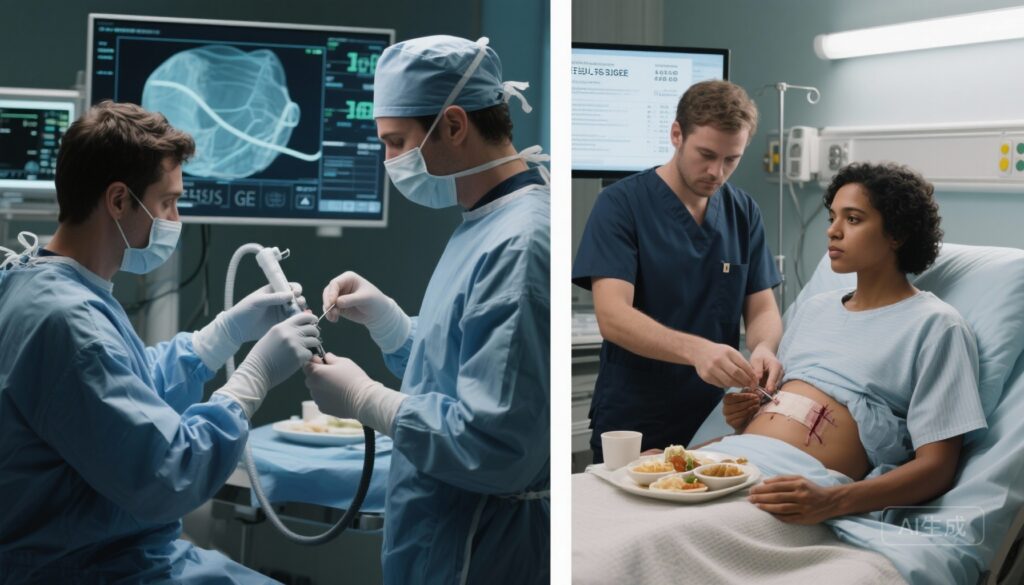
– Secondary benefits of EUS-GE included faster progression to solid diet (median 2 vs 5 days), shorter hospitalization (median 3 vs 9 days), improved physical and social quality-of-life domains, and lower treatment costs (US$33,934 vs US$51,437).
Background and clinical context
Malignant gastric outlet obstruction (GOO) is a frequent, debilitating complication of advanced periampullary, pancreatic, distal gastric and duodenal malignancies. Patients develop progressive nausea, vomiting, inability to tolerate oral intake, weight loss and impaired quality of life. Management is palliative and aims to restore enteral nutrition, reduce symptoms, avoid repeated hospital stays, and allow continuation of systemic therapy when appropriate.
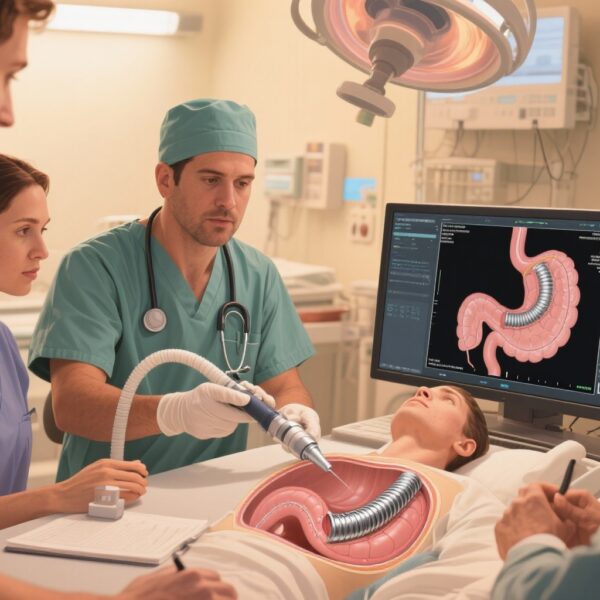
Historic options include endoscopic enteral stenting, which provides rapid symptom relief but may be limited by tumor ingrowth/overgrowth and stent dysfunction, and surgical gastrojejunostomy (SGJ), which is durable but invasive and associated with longer recovery. Endoscopic ultrasound–guided gastroenterostomy (EUS-GE) is a newer, minimally invasive approach that creates a bypass by deploying a lumen-apposing metal stent (LAMS) between the stomach and a jejunal loop under EUS guidance. Early series suggested durable symptom relief and reduced reintervention compared with enteral stents, but randomized data comparing EUS-GE with SGJ have been lacking until now.
Study design
This report presents results of a multicentre, randomized superiority trial (Bang JY et al.; Gut. 2025; NCT05548114) comparing EUS-GE with SGJ in patients with malignant GOO. Seventy-four patients were randomized: 38 to EUS-GE and 36 to SGJ. The trial enrolled patients with malignant obstruction of the gastric outlet deemed suitable for either procedure.
Primary endpoint: a composite outcome measured at hospital discharge and through 6 months (or until death), comprising any of the following: Gastric Outlet Obstruction Scoring System (GOOSS) score of 0–1 at discharge, need for reintervention or supplemental nutrition during follow-up, or procedure-related adverse events during the 6 months.
Secondary endpoints included time to solid diet, length of hospitalisation, health-related quality of life (HRQoL) domains, and treatment costs. Trial methods appear to have been pragmatic and designed to capture outcomes salient to palliative care—oral intake, reinterventions, complications, quality of life and economic consequences.
Key findings
Primary composite outcome: The composite endpoint occurred in 3 of 38 patients (7.9%) in the EUS-GE arm versus 14 of 36 (38.9%) in the SGJ arm (risk difference −31.0%, 95% CI −47.6% to −11.4%; p=0.002). This result met the prespecified superiority threshold, indicating fewer poor outcomes with EUS-GE based on the composite definition.
Oral intake and nutritional outcomes
Patients in the EUS-GE group advanced to a solid diet more rapidly: median 2 days (interquartile range 2–3) compared with 5 days (IQR 3.5–9) in the SGJ group. The composite endpoint included failure to achieve adequate oral intake, need for supplemental nutrition and reinterventions; EUS-GE performed favorably on these clinically meaningful components.
Length of hospital stay
Median length of hospitalization was substantially shorter with EUS-GE: 3 days (IQR 3–6) versus 9 days (IQR 6–12.5) after SGJ. Shorter hospitalization is an important outcome in palliative patients, with implications for cost, quality of life and the ability to resume systemic therapy.
Health-related quality of life
HRQoL measures favored EUS-GE, with statistically significant improvements in physical functioning (p=0.0016) and social functioning (p=0.011). These domains align with the trial’s clinical priorities—restoration of oral intake and faster recovery enabling social participation.
Costs
Reported treatment costs were lower after EUS-GE: mean US$33,934 versus US$51,437 for SGJ, difference −US$17,503 (95% CI −US$27,807 to −US$7,920). The cost advantage is likely driven by shorter hospitalisation, fewer days in high-dependency settings and fewer reinterventions, though device and procedural costs may vary across healthcare systems.
Adverse events and durability
The composite endpoint incorporated procedure-related adverse events and need for reintervention; overall the composite favored EUS-GE. The manuscript reports the composite numbers but does not present a detailed, itemized breakdown of each component in the summary we received. Longer-term stent durability, late complications and comparative mortality were not reported in full here and warrant careful review in the full text.
Expert commentary and interpretation
This randomized trial provides the most rigorous evidence to date that EUS-GE can be a superior, less invasive alternative to SGJ for many patients with malignant GOO. The magnitude of benefit—faster return to oral intake, much shorter hospitalization, improved HRQoL and reduced costs—is clinically meaningful in a palliative population where minimizing recovery time and maximizing functional status are priorities.
Strengths
– Randomized, multicentre design offers higher internal validity than prior observational series.
– Use of a patient-centered composite endpoint (oral intake, reintervention, adverse events) that aligns with palliative goals.
– Inclusion of cost and HRQoL outcomes strengthens translation to clinical decision-making and health policy.
Limitations and caveats
– Operator expertise and learning curve: EUS-GE is a technically demanding procedure requiring advanced endoscopy skills and experience with LAMS deployment. The trial was performed at centers with EUS-GE capability; results may not generalize to hospitals without such expertise.
– Open-label design: Blinding of treating teams and patients was not feasible and may influence secondary outcomes like hospital discharge timing and subjective HRQoL assessments.
– Composite endpoint composition: While clinically relevant, composite endpoints can mask which component(s) drove differences. The reported summary does not provide a full breakdown of individual components (e.g., separate counts for reinterventions, supplemental nutrition, and adverse events); readers should consult the full manuscript for those details.
– Follow-up duration: Six months (or until death) is relevant for palliative populations but may not capture rare late complications or very long-term patency. Differential survival between groups could also influence some outcomes and warrants assessment.
– Patient selection: The trial enrolled patients judged suitable for either procedure. It remains uncertain how findings apply to subgroups such as those with very short life expectancy, extensive peritoneal disease, ascites, or altered anatomy.
How this fits with current practice
Historically, clinicians weighed enteral stenting versus SGJ based on life expectancy, performance status and local expertise: endoscopic stents for shorter expected survival, SGJ for longer survival due to greater durability. EUS-GE potentially combines advantages of both—minimally invasive access with more durable bypass—positioning it as a preferred option in centers with capability, particularly for patients expected to live long enough to benefit from a durable solution but who would prefer to avoid major surgery.
Implications for practice and research
Clinical practice: Where institutional expertise with EUS-GE exists, the trial supports considering EUS-GE as first-line palliative bypass for malignant GOO in appropriate candidates, emphasizing multidisciplinary assessment (oncology, surgery, interventional endoscopy, nutrition, palliative care).
Health systems: The cost savings reported are compelling, but local device costs, procedure volumes and staffing models will influence economic impact. Implementation requires training programs, credentialing, and pathways to ensure patient safety.
Research priorities:
- Head-to-head trials comparing EUS-GE with enteral stenting in patients with short–to–intermediate survival to define optimal selection across stages of disease.
- Longer-term follow-up studies to define stent patency, late adverse events, and impact on survival and ongoing systemic therapy delivery.
- Implementation research on training curricula, competency thresholds and spread of EUS-GE techniques to non-tertiary centers.
- Health-economic analyses across different healthcare systems accounting for device costs, readmissions and reinterventions.
Conclusion
This well-conducted randomized trial demonstrates that EUS-guided gastroenterostomy is superior to surgical gastrojejunostomy for many clinically important outcomes in patients with malignant gastric outlet obstruction. EUS-GE led to faster restoration of oral intake, shorter hospitalization, better physical and social quality of life domains, fewer poor composite outcomes, and lower costs. Adoption should be considered in centers with appropriate expertise, while further research should clarify long-term durability, broader generalizability and optimal patient selection compared with enteral stenting.
Funding and trial registration
ClinicalTrials.gov registration: NCT05548114. Funding sources were not specified in the summary provided here; please consult the full publication for declarations of funding and potential conflicts of interest.
References
Bang JY, Puri R, Lakhtakia S, Thakkar S, Waxman I, Siddiqui I, Arnold K, Chaudhary A, Mehta S, Singh A, Venkat Rao G, Basha J, Gupta R, Modak S, Singh S, Boone B, Dautel P, Dixon MEB, Kim HM, Sutton B, Arnoletti JP, Rösch T, Varadarajulu S. Endoscopic or surgical gastroenterostomy for malignant gastric outlet obstruction: a randomised trial. Gut. 2025 Sep 24:gutjnl-2025-336339. doi: 10.1136/gutjnl-2025-336339. Epub ahead of print. PMID: 40998416.