Highlight
– In the STELLAR randomized phase III trial (NCT02796261), adding eflornithine to lomustine did not improve overall survival in the overall recurrent grade 3 astrocytoma population (median OS 23.4 v 20.3 months; HR 0.94).
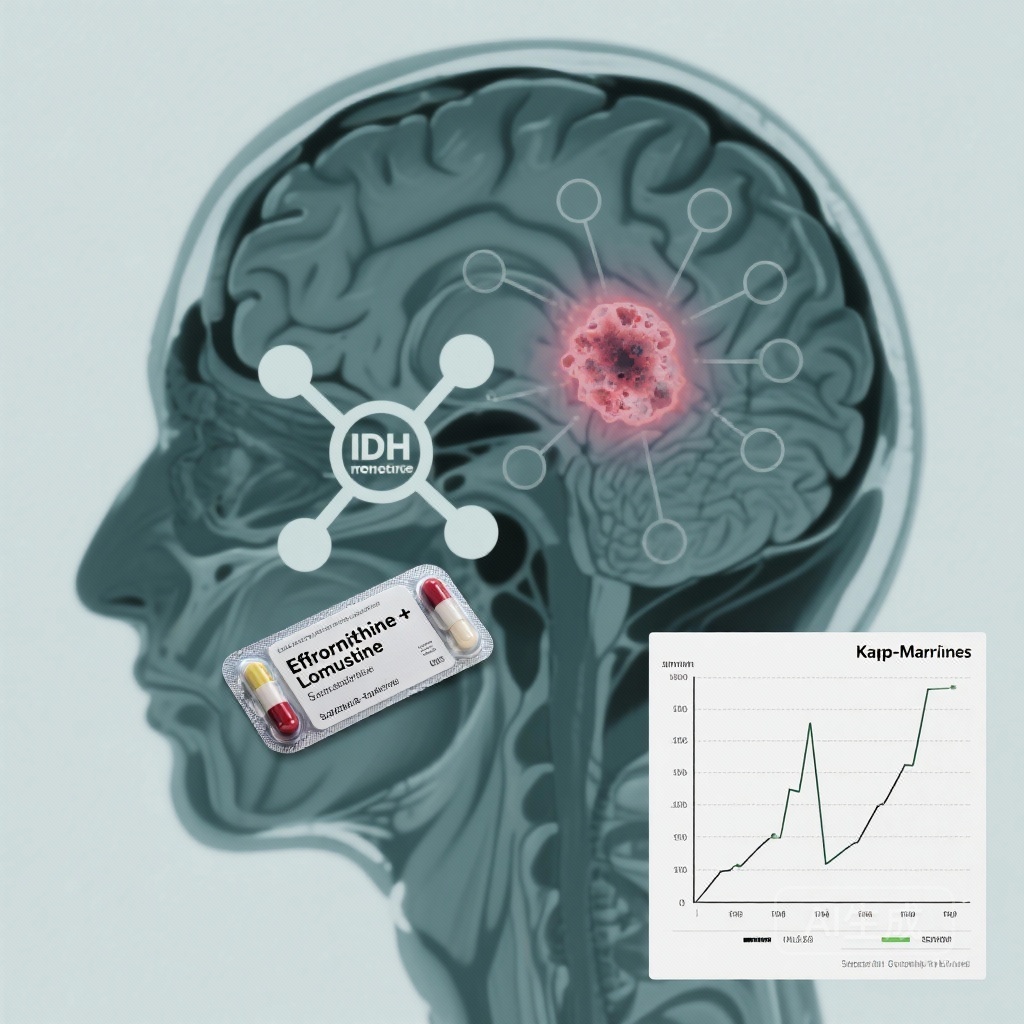
– In a prespecified subgroup analysis following 2021 WHO CNS reclassification, patients with IDH‑mutant, grade 3 astrocytoma (n = 196) had clinically meaningful benefit: median OS 34.9 v 23.5 months (HR 0.64) and median PFS 15.8 v 7.2 months (HR 0.57) for eflornithine + lomustine versus lomustine alone.
– Treatment was associated with reversible myelosuppression (grade ≥3: 42% v 29%) and hearing impairment (24% v 0%); no new safety signals emerged.
Background
Diffuse astrocytic tumors span a biologically and clinically heterogeneous spectrum. The 2021 WHO CNS5 classification established molecular markers — particularly isocitrate dehydrogenase (IDH) mutation status — as primary determinants of classification and prognosis for diffuse gliomas. IDH‑mutant grade 3 astrocytomas typically have a more protracted clinical course than IDH‑wildtype tumors or histologic grade 4 glioblastoma, and can retain sensitivity to therapies that slow tumor growth rather than directly induce cytotoxic tumor cell death.
For patients with recurrent anaplastic (grade 3) astrocytoma after standard radiotherapy and temozolomide (TMZ), effective systemic options are limited. Lomustine (CCNU) is commonly used in the recurrent setting, but durable disease control is uncommon. Eflornithine (difluoromethylornithine, DFMO) is an irreversible ornithine decarboxylase inhibitor that depletes intracellular polyamines, producing cytostatic effects that may be particularly active in slower-growing, IDH‑mutant gliomas. Prior early‑phase studies provided rationale for combining DFMO with alkylators such as lomustine.
Study Design
STELLAR (ClinicalTrials.gov: NCT02796261) was a phase III, randomized, open‑label trial comparing oral eflornithine plus lomustine versus lomustine monotherapy in adults with first recurrence of anaplastic astrocytoma after prior radiotherapy and TMZ. Key eligibility at trial initiation included age ≥18 years, Karnofsky performance status ≥70, first recurrence ≥6 months after completion of prior radiotherapy + TMZ, and no imaging criteria consistent with grade 4 glioblastoma. Randomization was 1:1 and stratified by IDH mutation status, age, resection extent, and geography.
Treatment arms: the combination arm received eflornithine 2.8 g/m2 orally every 8 hours on a 2‑weeks‑on/1‑week‑off schedule plus lomustine 90 mg/m2 orally every 6 weeks. The control arm received lomustine 110 mg/m2 orally every 6 weeks. The primary endpoint was overall survival (OS); secondary endpoints included progression‑free survival (PFS), safety, and subgroup analyses by molecular and grade classification.
Key Findings
A total of 343 patients were randomized across 74 sites in eight countries. In the overall randomized population (as enrolled under WHO CNS4 criteria), the trial did not meet its primary endpoint: median OS was 23.4 months with eflornithine + lomustine versus 20.3 months with lomustine alone (hazard ratio [HR] 0.94), indicating no statistically significant survival benefit in the broad study cohort.
IDH‑Mutant, Grade 3 Subgroup
Following evolution of the WHO classification (CNS5, 2021) and a prespecified re‑definition in 2024 (before unblinding), investigators analyzed a subset of patients meeting criteria for IDH‑mutant, CNS grade 3 astrocytoma (n = 196). In this molecularly defined subgroup, the combination produced clinically meaningful and statistically robust improvements:
- Median overall survival: 34.9 months (eflornithine + lomustine) versus 23.5 months (lomustine alone); HR 0.64.
- Median progression‑free survival: 15.8 months versus 7.2 months; HR 0.57.
These effect sizes correspond to an absolute OS benefit of ~11.4 months and a doubling of median PFS, findings consistent with a cytostatic mechanism that delays clinical and radiographic progression rather than rapidly inducing tumor shrinkage.
No Benefit in CNS Grade 4 Tumors
In patients reclassified as CNS grade 4 (which includes IDH‑wildtype tumors meeting glioblastoma criteria), no meaningful differences in OS or PFS were observed between arms. This differential efficacy aligns with the biologic hypothesis that agents targeting polyamine metabolism may be more effective in slower‑growing IDH‑mutant disease than in rapidly proliferating grade 4 tumors.
Safety and Tolerability
The safety profile reflected known toxicities of the agents. Grade ≥3 treatment‑emergent adverse events of particular relevance included reversible myelosuppression (42% in the eflornithine + lomustine arm versus 29% with lomustine alone) and hearing impairment (24% v 0%). The hearing toxicity warrants attention; auditory monitoring and early supportive measures should be considered. No new safety signals beyond the expected toxicity profiles were reported in the trial.
Expert Commentary and Interpretation
The STELLAR results are notable for demonstrating a clinically meaningful benefit of adding eflornithine to lomustine in a biologically defined subgroup of recurrent IDH‑mutant, grade 3 astrocytoma. Several points are important for interpretation:
- Biologic plausibility: IDH‑mutant astrocytomas generally have slower kinetics and distinct metabolic vulnerabilities. Eflornithine’s inhibition of polyamine biosynthesis produces cytostatic effects that may translate into prolonged disease control in this context more readily than in aggressive, high‑grade IDH‑wildtype tumors.
- Subgroup definition and timing: investigators reclassified patients per WHO CNS5 and defined the IDH‑mutant grade 3 subgroup in 2024 before unblinding. This pre‑unblinding definition strengthens the validity of the subgroup analysis compared with a purely post hoc exploration, but it remains a subset analysis and therefore warrants cautious interpretation and, ideally, prospective confirmation.
- Open‑label design: absence of blinding can introduce bias in subjective endpoints and subsequent treatment decisions. OS is less vulnerable to this bias than PFS or response rates, but cross‑over or imbalances in subsequent therapies could still influence survival outcomes.
- Safety considerations: increased myelosuppression and notable hearing impairment necessitate proactive monitoring, dose adjustments, and patient counseling. The benefit–risk balance favors the combination in IDH‑mutant grade 3 tumors based on the reported survival gains, but individualized decisions are required.
Clinical and Research Implications
If these findings are corroborated and adopted, eflornithine combined with lomustine could become a preferred systemic salvage option for patients with recurrent IDH‑mutant grade 3 astrocytoma after radiotherapy + TMZ. Important next steps include:
- Regulatory review and potential label expansion contingent on review of the full dataset and subgroup pre‑specification details.
- Prospective validation or confirmatory studies specifically designed for IDH‑mutant grade 3 disease to address residual uncertainty from subgroup analyses and to optimize dosing schedules to mitigate toxicity.
- Translational studies to define biomarkers predictive of response (beyond IDH), mechanisms underlying hearing toxicity, and combinations that may further improve outcomes while minimizing adverse effects.
Limitations
Key limitations include the open‑label design and that the primary analysis in the overall randomized population was negative. The positive effects were observed in a molecularly selected subgroup defined after WHO CNS5 implementation but before unblinding, which strengthens the argument for a real effect yet does not fully obviate the need for prospective confirmation. Details regarding subsequent lines of therapy and their potential impact on OS were not fully detailed in the summary report and could influence interpretation.
Conclusion
STELLAR provides compelling evidence that eflornithine plus lomustine significantly prolongs PFS and improves OS in patients with recurrent IDH‑mutant, grade 3 astrocytoma after prior radiotherapy and temozolomide. The benefit appears disease‑specific and is consistent with eflornithine’s cytostatic mechanism. Clinicians should weigh the observed survival gains against higher rates of myelosuppression and hearing impairment when considering this regimen. Confirmation in prospective, molecularly targeted trials and careful toxicity monitoring will be important next steps before broad adoption.
Funding and clinicaltrials.gov
The STELLAR trial is registered at ClinicalTrials.gov (NCT02796261). Funding and sponsor details are reported in the primary manuscript: Colman H et al., J Clin Oncol. 2025 Dec 1:JCO2501204. Readers should consult the full publication for detailed funding, study governance, and author disclosures.
References
1. Colman H, Lombardi G, Wong ET, et al. STELLAR: Phase III, Randomized, Open‑Label Study of Eflornithine Plus Lomustine Versus Lomustine Alone in Patients With Recurrent Grade 3 Astrocytoma. J Clin Oncol. 2025 Dec 1:JCO2501204. PMID: 41325560.
2. Louis DN, Perry A, Wesseling P, et al. The 2021 WHO Classification of Tumors of the Central Nervous System: a summary. Acta Neuropathol. 2021;141(2):197–106.
3. Yan H, Parsons DW, Jin G, et al. IDH1 and IDH2 mutations in gliomas. N Engl J Med. 2009;360(8):765–773.
4. Gerner EW, Meyskens FL Jr. Polyamines and cancer: old molecules, new understanding. Nat Rev Cancer. 2004;4(10):781–792.
5. Pegg AE. Mammalian polyamine metabolism and function. IUBMB Life. 2009;61(9):880–894.