Highlight
– A multicomponent ED-initiated intervention (education + PACHT-c pharmacist/APRN consultation + smartphone-enabled home BP monitoring and behavior text messages) reduced mean systolic BP by 4.9 mm Hg at 6 months versus usual care (95% CI, 0.8–9.0 mm Hg; P = .02).
– The trial enrolled 574 urban ED patients with elevated BP; 413 had 6-month BP data. Rates of achieving BP ≤140/90 mm Hg were numerically higher in the intervention arm (42.9% vs 36.9%) but not statistically significant (P = .22).
– Findings support the ED as an actionable access point for BP identification and linkage to home-monitoring and pharmacist-led care, especially in underserved populations.
Background — Why this matters
Hypertension is the leading modifiable risk factor for cardiovascular disease worldwide and remains suboptimally diagnosed and treated in many populations. Emergency departments (EDs) are high-volume access points for patients with limited primary care access and therefore present an opportunity to identify elevated blood pressure (BP) and initiate linkage to management. Mobile health (mHealth) tools and team-based care (including pharmacists and advanced practice nurses) have been studied in outpatient settings and can improve BP control, but their integration into ED-discharge workflows has been limited.
Study design — TOUCHED at a glance
The TOUCHED randomized clinical trial (NCT03749499) enrolled adult patients presenting to a single urban academic ED from February 12, 2019, through March 31, 2023, whose ED BP met study criteria (≥140/90 mm Hg and ≤180/110 mm Hg) and who were discharged home. Participants (n = 574) were randomized to usual care versus an Education and mHealth Empowerment (E2) multicomponent intervention. Follow-up visits were at 3 and 6 months.
The E2 intervention consisted of three components:
- Post-Acute Care Hypertension consultation (PACHT-c) — a brief ED-based consult with a clinical pharmacist or advanced practice nurse to provide education, initial recommendation, and linkage.
- Smartphone-enabled home BP monitoring kit (Withings device + mobile app) with instructions to conduct daily self-monitoring and automated behavior-change text messages.
- Primary care referral to facilitate follow-up and continuity.
Usual care was standard hypertension discharge instructions and a referral for outpatient follow-up. The primary endpoint was change in systolic blood pressure (SBP) from baseline to 6 months. Secondary outcomes included proportion achieving BP ≤140/90 mm Hg at 6 months and implementation/process measures.
Key findings and interpretation
Enrollment and population: 574 participants were randomized. Mean (SD) age was 51.1 (12.5) years; 56% female. The cohort was predominantly Black (72%) and Hispanic or Latino (20%), reflecting an urban, diverse population often at high cardiovascular risk and with barriers to longitudinal care.
Primary outcome — systolic BP change at 6 months: Among the 413 participants who had BP data at 6 months (210 in the E2 group and 203 in usual care), the E2 intervention produced a greater mean reduction in SBP compared with usual care. The between-group difference in mean SBP change was 4.9 mm Hg favoring the intervention (95% CI, 0.8–9.0 mm Hg; P = .02).
Clinical significance: A 4.9 mm Hg reduction in SBP is modest but clinically relevant at the population level. Epidemiologic data and guideline interpretations indicate that even small average reductions in SBP across a population translate to measurable reductions in stroke and ischemic heart disease events over time. While the trial was not powered to detect differences in clinical events, the SBP reduction magnitude is comparable to other effective system-level interventions and to some single-agent antihypertensive effects.
Secondary outcome — BP control: A similar proportion of patients achieved BP ≤140/90 mm Hg at 6 months in the intervention group (42.9% [90 of 210]) versus the usual-care group (36.9% [75 of 203]; P = .22). The lack of statistical significance for this binary control endpoint despite a significant continuous SBP reduction may reflect reduced power for this outcome, losses to follow-up, or a modest absolute effect size insufficient to shift a large proportion across the control threshold.
Engagement and feasibility: The intervention combined brief in-ED counseling with provision of a validated home BP device and app plus automated behavioral text messaging. The study demonstrates feasibility of delivering a multicomponent program at ED discharge and enrolling a diverse patient population into remote-monitoring pathways.
Safety
The published report did not identify safety signals attributable to the intervention; antihypertensive medication changes were guided by outpatient clinicians, and remote monitoring primarily informed patient engagement and follow-up. As with many remote BP-monitoring programs, appropriate safety measures include patient education on when to seek care for very high or symptomatic BP and clear pathways for medication adjustment by trained clinicians.
Expert commentary — strengths, limitations, and implementation considerations
Strengths:
- Randomized design in a real-world, high-risk ED population increases internal validity and practical relevance.
- Demographically diverse cohort often underrepresented in hypertension trials, improving applicability to urban safety-net populations.
- Multimodal intervention aligns with contemporary models of team-based care (pharmacist/APRN involvement) and leverages validated remote monitoring hardware and mHealth support.
Limitations:
- Single-center design limits external generalizability; ED systems, referral networks, and local primary care capacity vary widely.
- Loss to follow-up: Only 413 of 574 participants had 6-month BP data, and missing data can bias effect estimates if nonrandom.
- The intervention bundled several components, so the trial cannot isolate the relative contribution of the pharmacist consultation, the home BP device, or the text messaging to the observed effect.
- Short duration for cardiovascular outcomes: 6 months is sufficient to assess BP change but not downstream clinical events.
Generalizability and equity implications: The trial’s population—predominantly Black and Hispanic patients receiving care in an urban ED—reflects groups disproportionately affected by uncontrolled hypertension. The success of an ED-initiated pathway to engage these patients is an important equity signal. Nevertheless, scaling requires attention to device access, digital literacy, language concordance for messaging, reimbursement for pharmacist/APRN time, and integration with primary care for medication titration and long-term management.
Mechanistic plausibility
Combining brief education and linkage with objective home BP data and automated behavior prompts likely improves BP control through multiple mechanisms: increased patient awareness and self-efficacy, detection of elevated out-of-office BP to prompt timely follow-up, and strengthened care-team engagement enabling medication initiation or intensification. Pharmacist/APRN involvement can accelerate appropriate medication adjustments and adherence counseling—interventions previously shown to improve BP control in outpatient contexts.
Practical takeaways for clinicians and health systems
- The ED visit is a pragmatic touchpoint to screen for hypertension and offer pathways to treatment; brief, targeted interventions at discharge can improve short-term BP control.
- Multicomponent approaches that combine education, validated home BP monitoring, automated behavioral support, and linkage to a clinician who can recommend or optimize therapy are feasible and can achieve modest but meaningful BP reductions.
- Health systems seeking to replicate such programs should plan for device provisioning, digital support (apps and messaging), workforce capacity (pharmacists/APRNs), and mechanisms for prompt outpatient medication management to sustain gains.
Conclusion
The TOUCHED randomized clinical trial demonstrates that an ED-initiated, multicomponent Education and mHealth Empowerment (E2) intervention yields a statistically significant and clinically relevant reduction in mean systolic blood pressure at 6 months compared with usual care in a diverse urban population. While the absolute effect size is modest (≈4.9 mm Hg), the intervention is feasible, equity-relevant, and aligns with evidence supporting team-based care and home BP monitoring. Future work should test implementation across varied ED settings, identify the active components of the bundle, assess cost-effectiveness, and determine whether sustained BP improvements translate into fewer cardiovascular events over longer follow-up.
Funding and trial registration
TOUCHED was registered at ClinicalTrials.gov (NCT03749499). The published manuscript includes funding disclosures; readers should consult the JAMA Cardiology report for detailed sponsor and funding statements.
References
1. Prendergast H, Kitsiou S, Petzel Gimbar R, et al. Emergency Department-Based Education and mHealth Empowerment Intervention for Hypertension: The TOUCHED Randomized Clinical Trial. JAMA Cardiol. 2025 Jul 1;10(7):657-665. doi: 10.1001/jamacardio.2025.0675. PMID: 40266598; PMCID: PMC12019670.
2. Whelton PK, Carey RM, Aronow WS, et al. 2017 ACC/AHA/AAPA/ABC/ACPM/AGS/APhA/ASH/ASPC/NMA/PCNA Guideline for the Prevention, Detection, Evaluation, and Management of High Blood Pressure in Adults. Hypertension. 2018;71(6):e13–e115.
3. SPRINT Research Group. A Randomized Trial of Intensive versus Standard Blood-Pressure Control. N Engl J Med. 2015;373:2103–2116.
AI-friendly thumbnail prompt
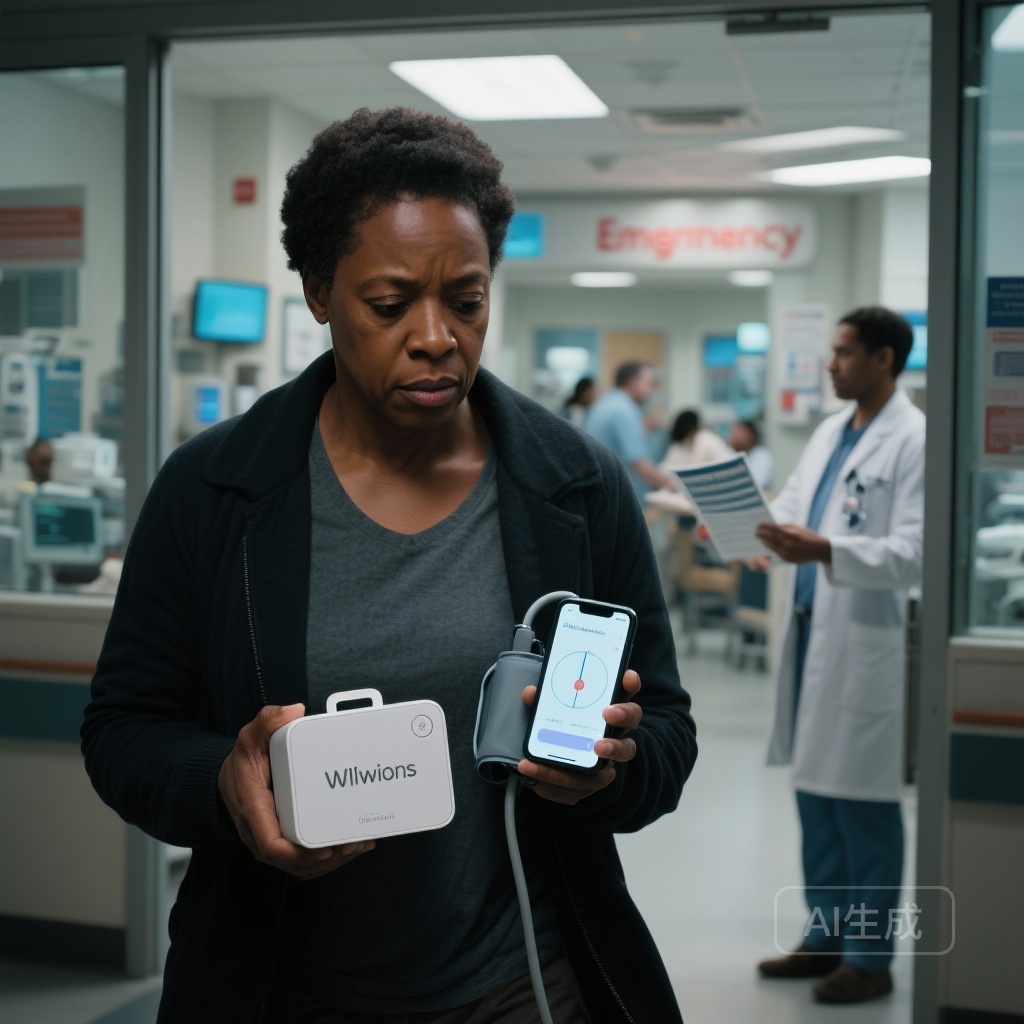
Realistic image of an urban emergency department discharge scene: a middle-aged Black patient holding a smartphone that displays a blood pressure reading and a boxed home BP cuff; a clinician (pharmacist or nurse practitioner) hands an education leaflet; background shows ED signage and diverse staff. Warm, hopeful, clinical documentary style, high resolution.