Introduction: The Resurgence of Metabolic Oncology
The concept of metabolic reprogramming, once considered a bystander effect of oncogenic signaling, has moved to the forefront of precision oncology. Central to this shift is the understanding of the Krebs cycle—not just as a bioenergetic hub, but as a source of oncometabolites that drive tumorigenesis through epigenetic and signaling alterations. Mutations in enzymes such as fumarate hydratase (FH), succinate dehydrogenase (SDH), and isocitrate dehydrogenase (IDH) lead to the accumulation of metabolites that stabilize hypoxia-inducible factors (HIFs), even in the presence of oxygen. This state of ‘pseudohypoxia’ triggers aggressive angiogenesis and metabolic shifts toward aerobic glycolysis. The BRISK trial (KCSG AL22-16) represents a critical effort to exploit these vulnerabilities using a dual-targeted approach with bevacizumab and erlotinib.
Mechanistic Rationale: Synergizing VEGF and EGFR Inhibition
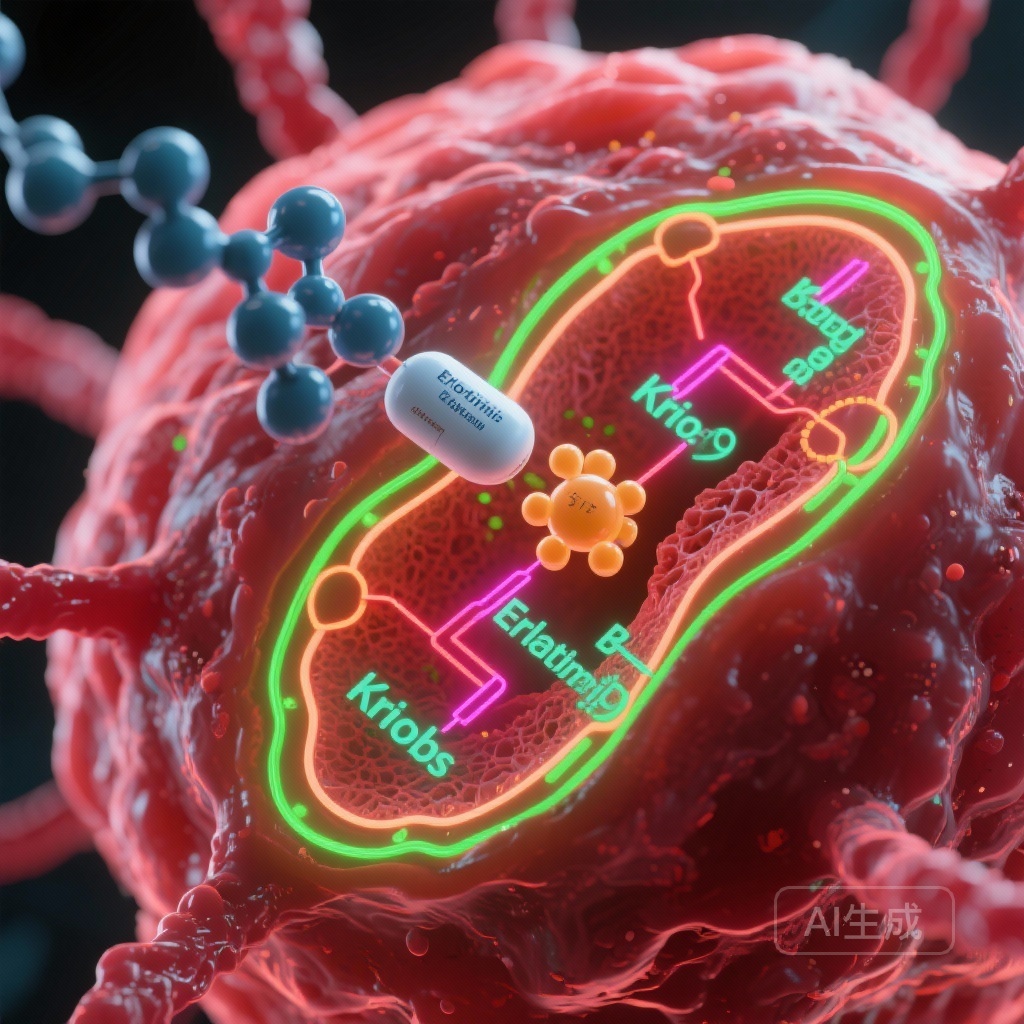
The biological rationale for combining bevacizumab (a VEGF-A inhibitor) and erlotinib (an EGFR tyrosine kinase inhibitor) in Krebs cycle-mutated tumors is multifaceted. First, the pseudohypoxic state induced by FH or SDH deficiency leads to the constitutive stabilization of HIF-1α, which upregulates vascular endothelial growth factor (VEGF). This creates a high dependency on VEGF-mediated angiogenesis. Second, epidermal growth factor receptor (EGFR) signaling has been shown to further enhance aerobic glycolysis (the Warburg effect) and provide survival signals that bypass metabolic stress. By simultaneously blocking the angiogenic drive and the glycolytic support provided by EGFR signaling, clinicians hope to ‘starve’ these metabolically unique tumors.
Study Design and Methodology
Patient Population
The BRISK study was a multicenter, open-label, phase II trial. Eligible participants were required to have advanced solid tumors harboring documented pathogenic mutations in FH, IDH1/2, SDHx, or MDH2. Patients needed to have measurable disease according to RECIST v1.1 or RANO 2.0 criteria for brain tumors. The study population was diverse, reflecting the broad spectrum of malignancies that can harbor these metabolic defects.
Intervention and Endpoints
Participants received a combination regimen consisting of bevacizumab (10 mg/kg intravenously on Day 1) and erlotinib (150 mg orally once daily). The treatment cycle was 14 days. The primary endpoint was the objective response rate (ORR). Secondary endpoints included progression-free survival (PFS), overall survival (OS), and safety. The trial also included exploratory transcriptomic analyses to identify potential biomarkers of response and resistance.
Key Findings: Breaking Down the Results
Overall Efficacy
Between February and November 2023, 35 patients were enrolled. The cohort included 19 patients with biliary tract cancer (BTC, 54.3%), 7 with brain tumors (20.0%), and 5 with FH-deficient renal cell carcinomas (FH-deficient RCC, 17.1%). The overall ORR across all tumor types was 37.1%, which included one complete response (CR) and 12 partial responses (PR). Perhaps more importantly, the disease control rate (DCR) reached 85.7%, suggesting that this combination is highly effective at stabilizing disease in these difficult-to-treat populations.
Subgroup Performance
The efficacy varied significantly by tumor type, providing clues for future trial designs:
- FH-deficient RCC: This group showed the most dramatic response, with an ORR of 80.0%. This confirms previous observations that FH-deficient tumors are exquisitely sensitive to the bevacizumab-erlotinib combination.
- Biliary Tract Cancer (BTC): Patients with BTC (often harboring IDH mutations) achieved an ORR of 36.8%, a notable result for a population that often has limited third-line options.
- Brain Tumors: The ORR was 28.6%, indicating activity even across the blood-brain barrier, though less pronounced than in other systemic sites.
Survival Outcomes
At a median follow-up of 11.7 months, the median PFS for the entire cohort was 8.3 months. The median OS had not yet been reached at the time of data cutoff, indicating a durable benefit for a significant portion of the participants.
Translational Insights: Transcriptomic Predictors of Response
The researchers conducted exploratory transcriptomic analyses to understand why some patients responded better than others. They found that patients with favorable PFS showed an enrichment in VEGF and immune-related pathways. Conversely, those with poor PFS exhibited enrichment in pathways related to amino acid metabolism, fatty acid metabolism, and oxidative phosphorylation (OXPHOS). This suggests that tumors capable of maintaining OXPHOS or utilizing alternative fuel sources (like fatty acids) may be more resistant to the metabolic stress induced by VEGF and EGFR inhibition.
Safety and Tolerability
The safety profile of the combination was consistent with the known toxicities of each agent. Common adverse events included rash, diarrhea, and hypertension. No new or unexpected safety signals were observed during the study, suggesting that the regimen is tolerable for patients with advanced solid cancers, provided they are monitored for vascular and dermatologic side effects.
Expert Commentary: Clinical Implications and Limitations
The BRISK trial is a significant step toward a ‘histology-agnostic’ approach to metabolic mutations. While the efficacy in FH-deficient RCC was expected based on the work of Srinivasan et al. at the NCI, the activity in BTC and other solid tumors is a novel and welcome finding. It suggests that the metabolic consequences of Krebs cycle mutations create a common therapeutic target across different organs of origin.
However, the study has limitations. The sample size is relatively small, and the cohort is heterogeneous. Furthermore, the exploratory transcriptomic data, while fascinating, requires validation in larger, prospective cohorts. The finding that OXPHOS enrichment correlates with resistance is particularly intriguing, as it may point toward a need for triple-combination therapies that also target the mitochondria in resistant cases.
Conclusion
The combination of bevacizumab and erlotinib demonstrates promising efficacy in advanced solid tumors with Krebs cycle gene mutations. With an ORR of 37.1% and a DCR of 85.7%, this regimen offers a potent option for patients whose tumors are driven by metabolic pseudohypoxia. Future research should focus on validating these findings in specific histological cohorts, such as IDH-mutated BTC, and investigating the role of metabolic plasticity in treatment resistance.
Funding and Clinical Trial Information
This study was supported by the Korean Cancer Study Group (KCSG) and was registered as KCSG AL22-16. ClinicalTrials.gov Identifier: NCT05342467 (or local equivalent registration).