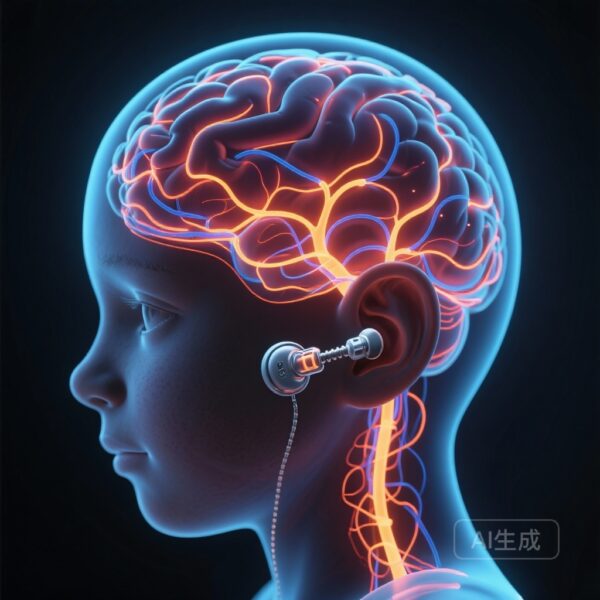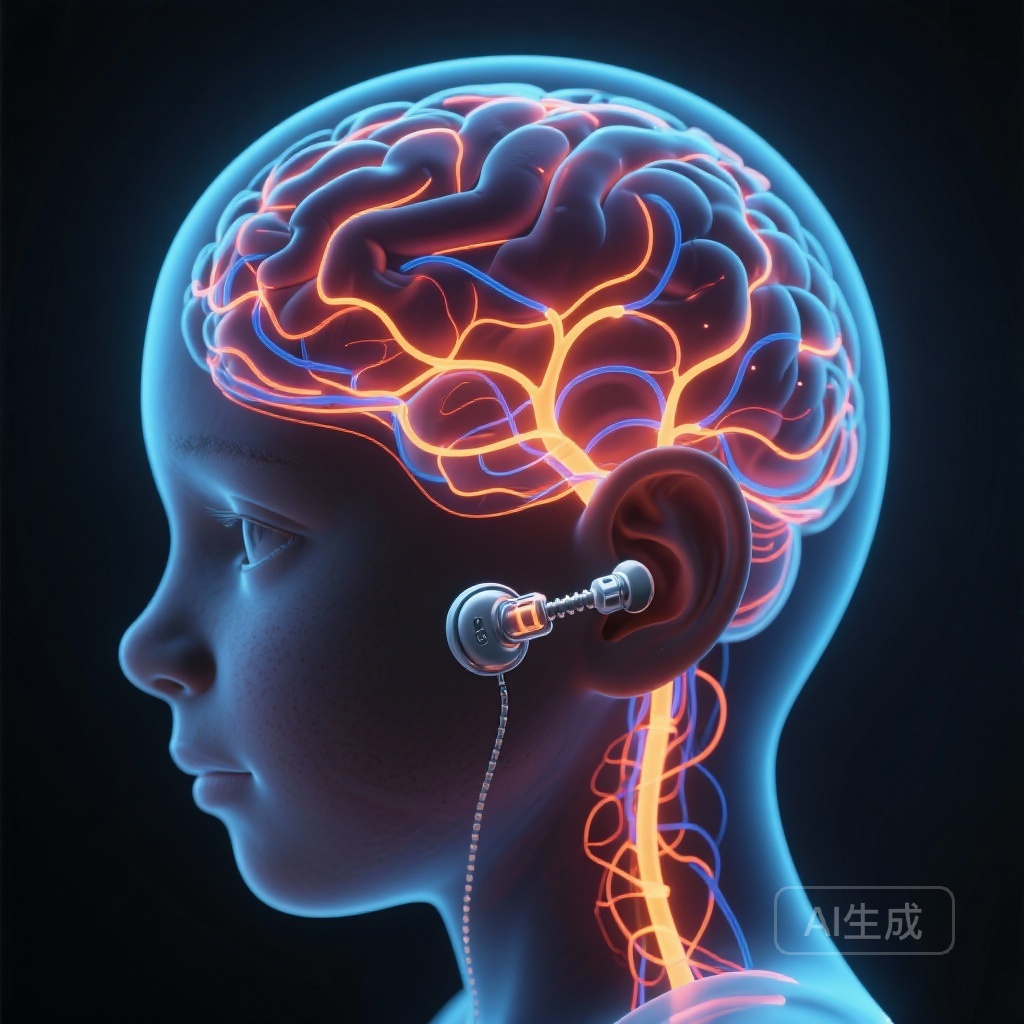
Deep Transfer Learning and Preimplant MRI: A Paradigm Shift in Predicting Pediatric Cochlear Implant Outcomes
Highlights
- Deep Transfer Learning (DTL) models achieved 92.39% accuracy in predicting spoken language outcomes after cochlear implantation, compared to significantly lower performance in traditional machine learning models.
- The study utilized 3D volumetric brain MRI data from a multicenter cohort of 278 children across the US, Australia, and Hong Kong, demonstrating cross-linguistic and cross-institutional robustness.
- The DTL model showed an area under the curve (AUC) of 0.98, indicating exceptional diagnostic performance in identifying children at risk for poor language improvement.
- These findings support the clinical integration of AI tools to facilitate personalized, early intervention strategies for pediatric hearing loss.
Background: The Challenge of Outcome Variability
Cochlear implants (CIs) have revolutionized the management of severe to profound sensorineural hearing loss in children, offering a gateway to spoken language development. However, despite the success of this technology, a significant clinical challenge persists: the variability in outcomes. While many children achieve near-native language proficiency, others exhibit limited progress despite early implantation and appropriate mapping. Traditionally, clinicians have relied on variables such as age at implantation, residual hearing, and socioeconomic status to forecast success. Yet, these factors remain insufficient for reliable individual-level prediction.
This unpredictability creates a critical gap in care. If clinicians could identify “low improvers” prior to surgery, they could implement intensified, customized rehabilitation programs or alternative communication strategies immediately. Recent advancements in neuroimaging and artificial intelligence (AI) offer a potential solution. The brain’s neuroanatomical state at the time of implantation—specifically the integrity of auditory and language-related pathways—is increasingly recognized as a primary determinant of post-CI success. This study by Wang et al. (2025) investigates whether deep transfer learning can leverage these neuroanatomical markers to provide the predictive precision that has long eluded the field.
Study Design and Methodology
This multicenter diagnostic study enrolled 278 children with bilateral sensorineural hearing loss from three major clinical centers: Ann & Robert H. Lurie Children’s Hospital of Chicago (US), the University of Melbourne (Australia), and the Chinese University of Hong Kong. The inclusion of English-, Spanish-, and Cantonese-speaking families provided a diverse linguistic and cultural dataset, enhancing the generalizability of the results.
All participants underwent 3D volumetric brain magnetic resonance imaging (MRI) prior to cochlear implantation. The study focused on children with 1 to 3 years of post-CI longitudinal language outcome data. The researchers compared two primary computational approaches:
1. Traditional Machine Learning (ML)
Traditional ML models require manual feature engineering, where researchers select specific neuroanatomical regions of interest (e.g., the volume of the Heschl’s gyrus or the white matter density of the arcuate fasciculus) and feed these discrete measurements into the algorithm.
2. Deep Transfer Learning (DTL)
DTL represents a more advanced form of AI. Unlike traditional ML, DTL uses representation learning to automatically extract complex, non-linear features directly from the raw MRI voxels. By utilizing a “bilinear attention-based fusion strategy,” the model could focus on the most discriminative task-specific information within the brain’s architecture, essentially “learning” which structural patterns most accurately correlate with language development.
The primary outcome measure was the binary classification of children into “high language improvers” versus “low language improvers,” based on standardized language assessments conducted post-implantation.
Key Findings: DTL vs. Traditional Machine Learning
The results of the analysis, conducted between 2023 and 2025, demonstrated a clear superiority of DTL over traditional methods. The DTL model achieved an overall accuracy of 92.39% (95% CI, 90.70%-94.07%). In contrast, traditional ML models, which rely on predefined anatomical metrics, failed to reach this level of precision.
Statistical performance metrics for the DTL model were remarkably high across the board:
- Sensitivity: 91.22% (95% CI, 89.98%-92.47%)
- Specificity: 93.56% (95% CI, 90.91%-96.21%)
- Area Under the Curve (AUC): 0.98 (95% CI, 0.97-0.99)
The high AUC suggests that the model is extremely robust at distinguishing between the two groups of improvers. The fact that these results were consistent across different clinical centers and languages (English, Spanish, and Cantonese) suggests that the neuroanatomical markers of language potential are universal rather than language-specific. This finding is particularly significant for the development of a global clinical tool.
Expert Commentary and Mechanistic Insights
The success of the DTL approach highlights a fundamental shift in how we understand the pediatric brain’s response to auditory stimulation. Traditional clinical models often treat the brain as a “black box,” focusing on external factors like the age of the child. However, the DTL model’s ability to predict outcomes with 92% accuracy suggests that the preimplant structural organization of the brain—specifically the connectivity and volume of the temporal and frontal cortices—contains the necessary information to determine how well a child will process the electrical signals from a CI.
One major advantage of DTL highlighted by the authors is the use of transfer learning. By pre-training the models on large, general datasets and then fine-tuning them on the specific pediatric CI cohort, the algorithms can identify subtle patterns that human observers or simple volumetric measurements might miss. The “attention-based” mechanism further allows the model to ignore “noise” in the MRI data and focus on the neural circuits most relevant to auditory-linguistic processing.
However, it is important to consider the study’s limitations. While the accuracy is high, the model is currently a binary classifier (high vs. low). Future iterations may need to predict language development on a continuous scale to offer more nuanced clinical guidance. Additionally, while the model is robust across the three centers studied, further validation in lower-resource settings where MRI protocols may vary is essential before widespread implementation.
Conclusion: Toward Precision Audiology
The study by Wang et al. provides compelling evidence that AI-driven analysis of preimplant neuroimaging can move the field toward a model of “precision audiology.” By identifying children likely to exhibit lower language improvements before they even undergo surgery, clinicians can proactively adjust the post-operative care pathway. This might include more frequent speech-language therapy, the use of visual support systems, or the early introduction of bimodal stimulation.
This diagnostic study confirms that a single DTL prediction model is feasible for global use in CI programs. As AI continues to integrate into clinical workflows, the ability to forecast individual developmental trajectories will become a cornerstone of pediatric hearing healthcare, ensuring that every child receives the tailored support they need to reach their full communicative potential.
References
Wang Y, Yuan D, Dettman S, Choo D, Xu ES, Thomas D, Ryan ME, Wong PCM, Young NM. Forecasting Spoken Language Development in Children With Cochlear Implants Using Preimplant Magnetic Resonance Imaging. JAMA Otolaryngol Head Neck Surg. 2025 Dec 26:e254694. doi: 10.1001/jamaoto.2025.4694. PMID: 41452608.