

Highlights
– A culturally tailored community health worker (CHW) program (Navigate‑Kidney) modestly reduced interdialytic weight gain (IDWG) among Hispanic/Latino adults on in‑center hemodialysis.
– The trial showed improvements in dialysis adherence (fewer shortened sessions) and increased patient activation (Patient Activation Measure) with CHW support.
– Results support integrating culturally responsive social‑needs navigation into dialysis care, but effect sizes were small; implementation and scalability require further study.
Background
Interdialytic weight gain (IDWG) is the rise in body weight that occurs between hemodialysis treatments and primarily reflects fluid accumulation. Elevated IDWG is associated with higher intradialytic hypotension risk, cardiovascular stress, hospitalizations, and worse quality of life. Minimizing IDWG—through dietary sodium and fluid restriction, dialysis prescription optimization, and attention to social and behavioral barriers—is a consistent clinical priority for patients, clinicians, and payers.
Hispanic and Latino populations with kidney failure disproportionately experience social determinants of health that can undermine adherence to fluid and dietary recommendations (limited health literacy in the language of care, food insecurity, housing instability, competing work demands, and limited access to culturally concordant education). Community health worker (CHW) programs prioritize culturally responsive education, social‑needs navigation, and patient advocacy. Prior systematic reviews indicate CHWs can improve outcomes across chronic conditions by bridging clinical care and community resources, but randomized evidence in dialysis populations, especially among Hispanic/Latino patients, has been limited.
Study design
The Navigate‑Kidney trial was an unblinded, parallel‑group, randomized clinical trial conducted at five in‑center dialysis units in Denver, Colorado, between November 2020 and August 2022. The trial enrolled 139 self‑identified Hispanic or Latino adults receiving maintenance in‑center hemodialysis and randomized them 1:1 to the Navigate‑Kidney CHW intervention (n = 68) or standard care (n = 71).
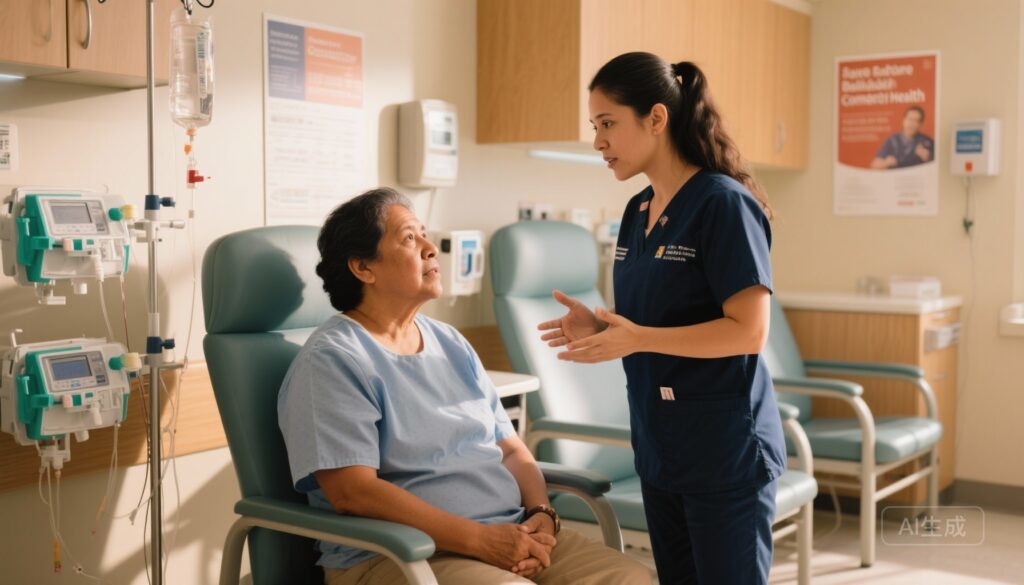
Intervention: CHWs delivered a framework‑driven, patient‑centered program that combined social needs screening and navigation, health system navigation, and culturally responsive kidney care education with emphasis on dietary modification and fluid restriction. CHWs met participants biweekly for at least six visits and used culturally tailored educational approaches and support strategies.
Comparator: Standard care consisted of the dialysis centers’ usual services without trial-driven culturally responsive CHW support.
Primary outcome: Change in interdialytic weight gain (IDWG) as a percentage of estimated dry weight, comparing the 90‑day pretrial period with 180 days postintervention, analyzed using piecewise linear mixed models.
Secondary outcomes: Missed and shortened dialysis sessions, healthcare utilization (e.g., hospitalizations), and patient activation measured by the Patient Activation Measure (PAM).
Key findings
Baseline characteristics: The randomized cohort (n = 139) had a mean age of 56.8 years (SD 12.9); 49% were female.
Primary outcome: Over 180 days postintervention, the between‑group difference in IDWG (expressed as percentage of estimated dry weight) favored Navigate‑Kidney with a mean difference of -0.46 percentage points (95% CI, -0.78 to -0.14 percentage points; P = .01).
Absolute IDWG: Mean IDWG was 3.26% (95% CI, 2.83%–3.68%) in the Navigate‑Kidney arm and 3.72% (95% CI, 3.30%–4.14%) in standard care. The absolute reduction is modest but statistically significant in the trial context.
Dialysis adherence: Participants in the Navigate‑Kidney group had fewer shortened dialysis sessions compared with standard care (median [IQR] change, 0.1 [−1.2 to 1.1] vs 0.6 [−0.5 to 1.8]; P = .02). The manuscript reports fewer shortened but not necessarily fewer missed sessions overall.
Patient activation: The Navigate‑Kidney arm demonstrated improvement in PAM scores compared with standard care (median [IQR] change, 1.8 [−2.2 to 5.2] points vs −2.2 [−7.4 to 2.5] points; P = .005), consistent with enhanced self‑management readiness and skills.
Other outcomes: The trial report did not present large or statistically significant reductions in hospitalizations or other major clinical events within the 180‑day follow‑up window; the primary measurable benefits were behavioral and process oriented (IDWG, session shortening, activation).
Interpretation and clinical relevance
The Navigate‑Kidney trial provides randomized evidence that culturally tailored CHW support can lead to modest reductions in fluid accumulation between dialysis sessions and measurable improvements in dialysis adherence and patient activation among Hispanic and Latino patients receiving hemodialysis. A reduction of ~0.46 percentage points in IDWG expressed as percent of estimated dry weight translates into a small absolute fluid decrease for most patients; however, even modest reductions in IDWG may reduce cardiovascular stress over time, particularly when implemented at scale or combined with other interventions.
The observed improvements in patient activation are clinically meaningful because activation is linked to adherence behaviors and downstream utilization in chronic disease populations. The decrease in shortened dialysis sessions suggests CHW support helped patients complete prescribed therapy—an important mediator of clinical outcomes.
Mechanisms and plausibility
CHWs likely affected IDWG and adherence through multiple mechanisms: culturally concordant education on sodium and fluid management, problem solving around social barriers to food and medication access, appointment and transportation support, and enhanced trust and communication between patients and the dialysis team. Improvements in PAM scores align with increased self‑efficacy and skills to apply behavioral recommendations.
Strengths
– Randomized design in a real‑world dialysis setting targeting a demographic group with documented disparities.
– Culturally tailored intervention, delivered by CHWs, focusing on social needs as well as kidney‑specific education.
– Objective primary outcome (weight change relative to dry weight) and clinically relevant secondary outcomes (session shortening, PAM).
Limitations
– The trial was unblinded, which is inherent to behavioral and CHW interventions but may introduce performance and detection biases for subjective endpoints.
– Follow‑up was limited to 180 days postintervention; durability of effects beyond this period is unknown.
– The magnitude of IDWG reduction was modest and the trial was not powered for hard clinical endpoints (cardiovascular events, mortality, hospitalizations).
– Conducted in a single metropolitan area (Denver) at five centers; generalizability to other geographic regions and dialysis unit models, or to non‑Hispanic populations, should be tested.
Implications for practice
For clinicians and dialysis program leaders serving Hispanic and Latino patients, the Navigate‑Kidney findings support integrating culturally concordant CHW programs as part of a multifaceted strategy to improve adherence, reduce fluid burden, and enhance patient activation. Given the modest effect size on IDWG, CHW interventions are best viewed as complementary to clinical measures such as individualized ultrafiltration strategies, dietary counseling by registered dietitians, and structural supports (transportation, medication access).
Operational considerations include training, supervision, and sustainable financing for CHW roles; alignment with social work, nursing, and dietetics in dialysis units; and monitoring for fidelity and outcomes. Policymakers and payers interested in value‑based care for dialysis populations may consider reimbursement pathways for CHW services that demonstrably improve adherence and patient‑reported outcomes.
Future research
Key unanswered questions include: whether the observed behavioral improvements translate into fewer hospitalizations and cardiovascular events over longer follow‑up; the cost‑effectiveness of CHW deployment in dialysis populations; optimal CHW training, caseload, and methods for integrating CHWs into multidisciplinary dialysis teams; and whether similar benefits extend to non‑Hispanic populations or in home dialysis settings.
Conclusion
The Navigate‑Kidney randomized clinical trial demonstrates that a culturally tailored CHW intervention modestly reduced interdialytic weight gain, improved dialysis adherence, and increased patient activation among Hispanic and Latino adults receiving in‑center hemodialysis. These findings support CHW models as a promising element of equitable, patient‑centered dialysis care, while highlighting the need for larger, longer‑term studies to evaluate clinical outcomes and implementation strategies.
Funding and trial registration
Trial registration: ClinicalTrials.gov Identifier: NCT03978806. Funding details are reported in the original publication (Cervantes et al., JAMA Internal Medicine, 2025).
References
1. Cervantes L, Juarez‑Colunga E, Powe NR, et al. Community Health Worker Support for Hispanic and Latino Individuals Receiving Hemodialysis: The Navigate‑Kidney Randomized Clinical Trial. JAMA Intern Med. 2025 Nov 7:e255305. doi:10.1001/jamainternmed.2025.5305
2. Hibbard JH, Stockard J, Mahoney ER, Tusler M. Development of the Patient Activation Measure (PAM): conceptualizing and measuring activation in patients and populations. Health Services Research. 2004;39(4 Pt 1):1005–1026.
3. Lewin S, Munabi‑Babigumira S, Glenton C, et al. Lay health workers in primary and community health care for maternal and child health and infectious diseases. Cochrane Database Syst Rev. 2010;(3):CD004015.
4. United States Renal Data System (USRDS). 2023 USRDS Annual Data Report: Epidemiology of Kidney Disease in the United States. Accessed 2024. https://www.usrds.org
Author disclosures
This article is a critical summary and interpretation of the published trial results. Readers should consult the primary trial report for complete methodological and funding details.


Clinical Utility and Value:
The Navigate-Kidney trial addresses a critical gap in health equity for dialysis populations by demonstrating that culturally tailored CHW interventions can produce measurable improvements in IDWG, treatment adherence, and patient activation among Hispanic/Latino hemodialysis patients. The study’s clinical utility lies in three key areas:
1. The modest but statistically significant reduction in IDWG (-0.46 percentage points) translates into decreased cardiovascular stress over time—particularly important given the cumulative nature of fluid overload-related morbidity in chronic dialysis populations.
2. The reduction in shortened dialysis sessions directly impacts adequacy of dialysis delivery, which is strongly associated with clinical outcomes including mortality and hospitalization rates.
3. The improvement in Patient Activation Measure scores signals enhanced self-management capacity—a validated predictor of long-term adherence and reduced healthcare utilization.
Areas for Enhancement:
While this trial provides valuable proof-of-concept, several limitations warrant attention in future research and implementation:
1. Hard clinical endpoints: The 180-day follow-up was insufficient to capture changes in cardiovascular events, mortality, or hospitalization rates. A pragmatic extension study with 24-36 month follow-up would establish whether behavioral improvements translate into reduced morbidity and cost savings.
2. Mechanistic insights: The trial did not measure intermediate biomarkers (natriuretic peptides, cardiac biomarkers, blood pressure variability) or patient-level barriers (food insecurity scores, health literacy metrics, social support indices). Understanding which CHW activities drive IDWG reduction would enable optimization of intervention components.
3. Implementation science: Critical operational questions remain unanswered: optimal CHW-to-patient ratio, training curricula, supervision models, integration with existing dialysis multidisciplinary teams, and reimbursement pathways. Hybrid effectiveness-implementation trials are needed.
4. Generalizability: Single-region recruitment limits external validity. Multi-site trials across diverse geographic settings, dialysis organizations (for-profit vs. non-profit), and extending to other demographic groups would strengthen the evidence base.
5. Cost-effectiveness analysis: While behavioral improvements are evident, decision-makers require formal economic evaluation comparing CHW program costs against downstream savings from reduced hospitalizations and improved quality-adjusted life years.
Clinical Practice Integration:
For dialysis programs serving high-disparity populations, Navigate-Kidney supports CHW integration as part of a comprehensive adherence strategy—complementing rather than replacing dietitian counseling, social work, and nursing education. Successful implementation will require alignment with value-based payment models and systematic outcome monitoring to ensure fidelity and effectiveness in real-world settings.