Highlights
- Cast immobilization demonstrated non-inferiority to open reduction and internal fixation (ORIF) for Weber B fractures that are stable on static radiographs but unstable under stress testing.
- At a two-year follow-up, Olerud-Molander Ankle Scores (OMAS) were comparable between the cast group (89) and the surgery group (87).
- Surgical intervention was associated with a higher rate of secondary procedures, primarily for hardware removal, and a greater risk of wound-related infections.
- The findings suggest that mechanical stability achieved via casting is sufficient for fractures with an initially congruent mortise, potentially shifting the standard of care away from routine surgery.
Introduction: The Dilemma of the Unstable Weber B Fracture
Lateral malleolus fractures, particularly those classified as Danis-Weber Type B, represent one of the most common injuries managed by orthopedic surgeons. While fractures with clear displacement or mortise widening on static radiographs are universally accepted as surgical candidates, a significant “grey area” exists: the unimalleolar Weber B fracture that appears congruent on initial static X-rays but demonstrates instability—specifically talar shift—during external rotation stress testing.
Traditionally, many surgeons have interpreted stress-test instability as an indicator of syndesmotic injury or deep deltoid ligament insufficiency, necessitating surgical stabilization to prevent post-traumatic osteoarthritis. However, the clinical necessity of converting a stress-positive but statically congruent ankle into a surgical case has been increasingly questioned. The SUPER-FIN trial (Surgery Versus Prolonged Immobilization) was designed to provide definitive evidence on whether conservative management can match the functional outcomes of surgery in this specific patient cohort.
Study Design and Methodology
The SUPER-FIN trial was a pragmatic, randomized, non-inferiority clinical trial conducted at a specialist university hospital trauma center in Finland between 2013 and 2021. The study targeted skeletally mature patients (age ≥16 years) presenting with isolated Weber B fibula fractures. The inclusion criteria were stringent: patients must have had a congruent ankle mortise on static radiographs but demonstrated instability during a standardized external rotation stress test under fluoroscopy.
Out of 840 screened patients, 126 met the criteria for a congruent but unstable mortise and were randomized 1:1 into two groups:
1. Cast Immobilization Group (n=62)
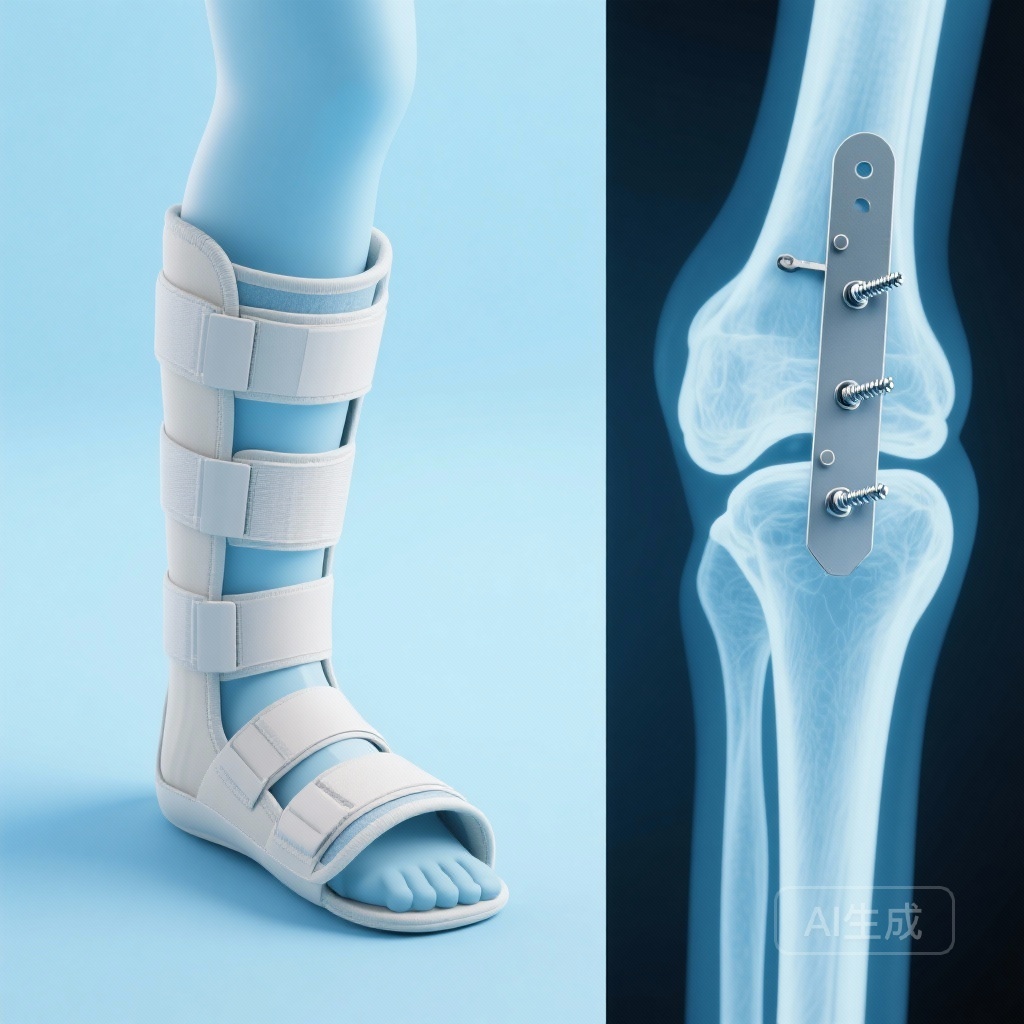
Participants received a conventional below-knee cast for six weeks. Weight-bearing protocols were standardized across the study to reflect pragmatic clinical practice.
2. Surgical Group (n=64)
Participants underwent open reduction and internal plate fixation (ORIF) followed by the same six-week casting protocol as the conservative group.
The primary outcome was the Olerud-Molander Ankle Score (OMAS) at two years post-injury. The OMAS is a validated patient-reported outcome measure ranging from 0 to 100, where higher scores reflect better function and fewer symptoms. The non-inferiority margin was pre-defined at -8 points, meaning that if the lower bound of the 95% confidence interval for the difference between groups did not exceed -8, the cast treatment would be considered non-inferior.
Key Findings: Functional and Radiographic Outcomes
Of the 126 randomized participants, 121 (96%) completed the two-year follow-up, providing robust data for the intention-to-treat analysis. The results clearly supported the non-inferiority of conservative management.
Primary Outcome: OMAS Results
The mean OMAS at two years was 89 in the cast immobilization group and 87 in the surgery group. The mean difference between groups was 1.3 points in favor of casting (95% CI, -4.8 to 7.3). Given that the lower bound of the confidence interval (-4.8) did not reach the pre-specified non-inferiority margin of -8, the study successfully demonstrated that cast immobilization is not clinically inferior to surgery.
Secondary Outcomes
No statistically significant differences were found in secondary measures, including:
- Ankle range of motion (ROM).
- Pain levels as measured by visual analog scales.
- Health-related quality of life (15D instrument).
- Radiographic outcomes, including the maintenance of mortise congruency.
Notably, radiographic non-union occurred in only one patient per group, suggesting that the biological healing environment provided by a cast is as effective as rigid internal fixation for these specific fractures.
Safety Profile and Treatment-Related Harms
While functional outcomes were similar, the safety profiles diverged significantly, highlighting the risks inherent to surgical intervention. The cast immobilization group experienced fewer treatment-related harms overall.
In the surgery group, complications included:
- One superficial wound infection.
- One case of delayed wound healing.
- Nine patients (14%) required secondary surgery to remove symptomatic hardware.
- Two postoperative infections following hardware removal (one deep, one superficial).
The requirement for hardware removal is a significant clinical burden, representing additional costs to the healthcare system and additional recovery time and risk for the patient. In contrast, the cast group avoided these surgical risks entirely, achieving high functional scores without the morbidity associated with metal implants.
Expert Commentary: Shifting the Paradigm
The SUPER-FIN trial adds to a growing body of evidence suggesting that we may be over-treating isolated lateral malleolus fractures. The reliance on the external rotation stress test as a definitive indicator for surgery is challenged by these findings. If a mortise is congruent on static, weight-bearing, or gravity stress views, the presence of a “positive” stress test under fluoroscopy may not translate to a functional deficit if the ankle is protected in a cast during the initial healing phase.
From a health policy perspective, these results have profound implications. Reducing the number of ORIF procedures for Weber B fractures could lead to substantial cost savings and a reduction in surgical waiting lists without compromising patient outcomes. However, clinicians must remain diligent in ensuring that the initial mortise is indeed congruent and that the patient is likely to adhere to the casting protocol.
Limitations of the study include its single-center design, which may affect generalizability, although the pragmatic nature of the trial reflects real-world orthopedic practice. Furthermore, long-term follow-up beyond two years would be beneficial to assess the potential development of very late post-traumatic arthritis, though current data suggests that if the mortise remains congruent through the first two years, the long-term prognosis is generally excellent.
Conclusion
The SUPER-FIN trial provides high-level evidence that for patients with unimalleolar Weber B fractures and a congruent ankle mortise, cast immobilization is a safe and effective alternative to surgery, even when instability is detected on stress testing. Given the equivalent functional outcomes and the significantly lower risk of complications and secondary procedures, conservative management should be considered the preferred treatment strategy for this patient population.
Funding and Trial Registration
The study was supported by institutional grants from the Oulu University Hospital and the Finnish Cultural Foundation. The trial is registered at ClinicalTrials.gov (NCT01758796).
References
Kortekangas T, Lehtola R, Leskelä HV, et al. Cast immobilisation versus surgery for unstable lateral malleolus fractures (SUPER-FIN): randomised non-inferiority clinical trial. BMJ. 2026;392:e085295. doi:10.1136/bmj-2025-085295.