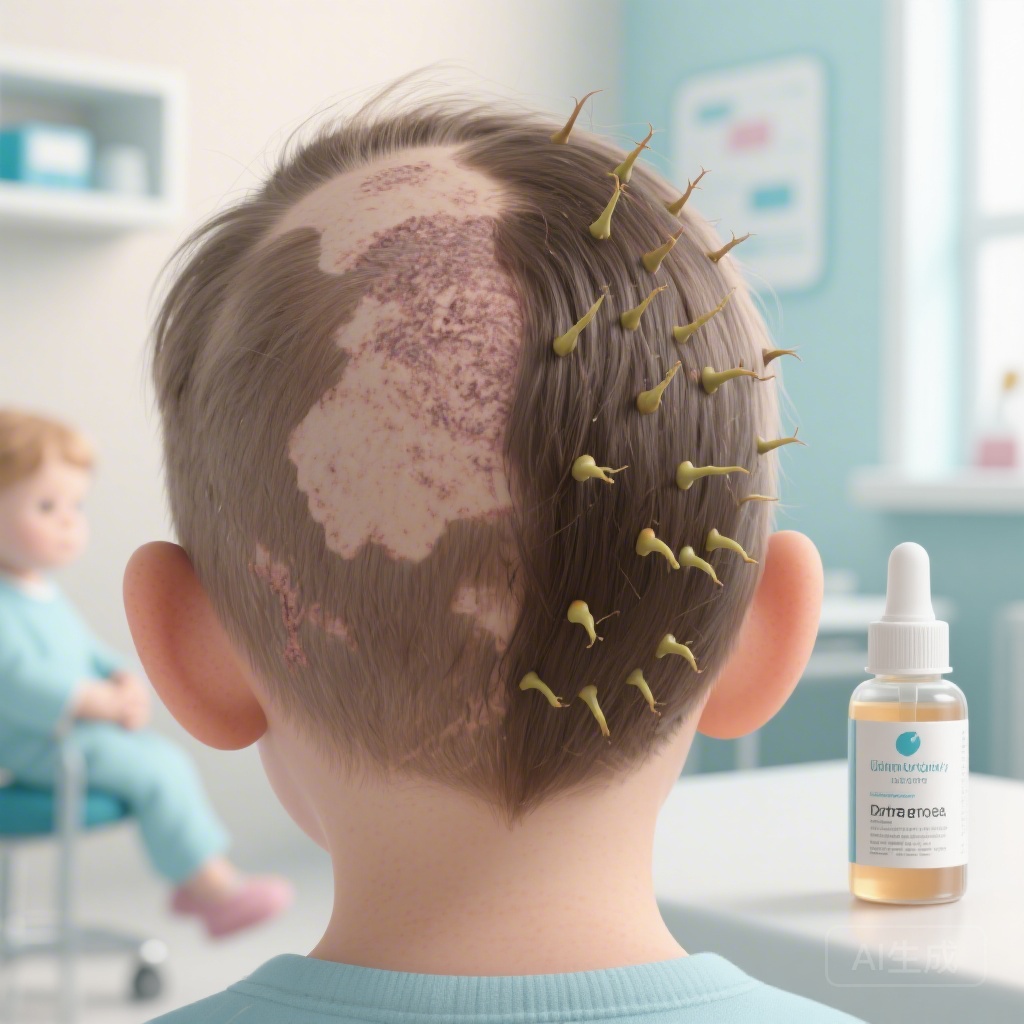
High-Level Highlights
The RAAINBOW phase II/III trial represents a significant milestone in pediatric dermatology, offering a new therapeutic horizon for children and adolescents suffering from alopecia areata (AA). The key highlights include:
- Significant Hair Regrowth: Cinainu-treated patients showed a 26.3% adjusted mean difference in SALT score improvement compared to placebo at Week 24.
- Sustained Clinical Benefit: The efficacy
**Writing the Core Content**I’m deep into the text, meticulously expanding on the research. I’m focusing on the RAAINBOW trial’s findings, and elaborating on the background, the methods, and results. I need to make the descriptions accurate and complete, using the appropriate HTML tags for structure. I’m paying close attention to the CDLQI and EQ-VAS results. I have to make sure I include the botanical details and statistical analysis.
of Cinainu not only persisted but increased during the 24-week untreated follow-up period, reaching a 39.4% difference by Week 48. - Quality of Life Impact: Substantial improvements were noted in the Children’s Dermatology Life Quality Index (CDLQI) and EuroQol Visual Analogue Scale (EQ-VAS), indicating a holistic benefit.
- Safety and Tolerability: No serious treatment-emergent adverse events (TEAEs) were related to the study drug, making it a viable long-term option for pediatric populations.
Introduction: The Unmet Need in Paediatric Alopecia Areata
Alopecia areata (AA) is a chronic, autoimmune-mediated form of nonscarring hair loss that can affect individuals of any age, though its onset in childhood is particularly distressing. The pathogenesis involves the collapse of the hair follicle’s immune privilege, driven by an inflammatory milieu where T-cell infiltration and Janus kinase (JAK)-dependent signaling pathways play central roles. For pediatric patients, the psychological burden is profound, often leading to social withdrawal, anxiety, and a significantly diminished quality of life (QoL).
Historically, treatment options for children have been limited. While topical corticosteroids and contact immunotherapy are commonly used, they often yield inconsistent results or are associated with side effects that limit long-term use. Recently, oral JAK inhibitors have revolutionized the treatment of severe AA; however, their use in pediatric populations and in moderate cases remains restricted due to concerns regarding systemic side effects and the need for intensive monitoring. This creates a therapeutic gap for a topical agent that is both effective and safe for long-term administration in children with moderate-to-severe disease. Cinainu, a topical solution comprising four specific botanical extracts, has emerged as a candidate to fill this gap through its multi-targeted anti-inflammatory, anti-apoptotic, and antioxidant properties.
Study Design: The RAAINBOW Trial Framework
The RAAINBOW study was designed as an international, double-blind, randomized, placebo-controlled, phase II/III trial. It aimed to rigorously evaluate the efficacy and safety of Cinainu in a vulnerable demographic: children and adolescents aged 2 to 17 years with moderate-to-severe AA.
Population and Randomization
A total of 107 pediatric patients were enrolled and randomized in a 2:1 ratio to receive either Cinainu or a matching placebo. The primary analysis focused on a subgroup of 62 patients who met predefined criteria for moderate-to-severe hair loss, defined by the Severity of Alopecia Tool (SALT) score. The SALT score is a standardized method where the scalp is divided into four areas, and the percentage of hair loss in each area is summed to provide a total score from 0 (no hair loss) to 100 (total scalp hair loss).
Intervention and Endpoints
Patients applied the solution twice daily for 24 weeks. This was followed by a 24-week follow-up period during which no treatment was administered, allowing researchers to observe the durability of the response. The primary efficacy endpoint was the relative change in the SALT score from baseline to Week 24. Secondary endpoints included the responder rate (defined as a ≥ 40% improvement in SALT score), absolute changes in SALT, and patient-reported quality of life outcomes via CDLQI and EQ-VAS.
Primary and Secondary Efficacy Outcomes
The results of the RAAINBOW trial provide robust evidence for the clinical utility of Cinainu in the pediatric setting.
SALT Score Improvements
At the primary endpoint of Week 24, the Cinainu group demonstrated a statistically significant improvement in the relative SALT score. The adjusted mean difference between the Cinainu and placebo groups was +26.3% (95% CI: 0.1–52.5; P = 0.0488). The effect size, measured by Cohen’s d, was 0.52, indicating a moderate clinical effect. By Week 48 (after 24 weeks of no treatment), the adjusted mean difference grew to +39.4% (95% CI: 13.1–65.6; P = 0.0033), with a large effect size of d = 0.80. This suggests that Cinainu may induce a biological shift in the hair follicle environment that persists even after the cessation of active therapy.
Responder Rates
The proportion of patients achieving at least a 40% improvement in their SALT score was significantly higher in the Cinainu group compared to the placebo group at Week 24 (26.2% vs. 5.0%; P = 0.0484). This categorical improvement is often more meaningful to clinicians and parents than mean changes, as it represents a visible and significant regrowth of hair.
Clinical Impact and Quality of Life Improvements
Beyond hair counts, the study emphasized the patient’s perspective. Alopecia areata in children is not merely a cosmetic issue but a dermatological condition with deep psychosocial impact. The RAAINBOW trial utilized the Children’s Dermatology Life Quality Index (CDLQI) and the EuroQol Visual Analogue Scale (EQ-VAS) to quantify this impact.
At Week 24, Cinainu-treated patients reported significant improvements in their quality of life. The effect sizes were notable: d = 0.61 for CDLQI and d = 0.69 for EQ-VAS. These benefits were sustained through the follow-up period, with the CDLQI effect size increasing to d = 0.79 at Week 48. These data suggest that the physical regrowth of hair translates directly into improved social functioning and psychological well-being for the pediatric patients.
Safety Profile and Tolerability
In pediatric medicine, the safety profile of a chronic treatment is as critical as its efficacy. The RAAINBOW trial reported that Cinainu was well tolerated throughout the study period. There were no serious adverse events (SAEs) attributed to the study drug. Most treatment-emergent adverse events (TEAEs) were mild to moderate and typically involved localized skin irritation, which is common with topical applications. The lack of systemic toxicity is a major advantage for Cinainu, particularly when compared to the monitoring requirements and potential risks associated with systemic immunosuppressants or JAK inhibitors.
Expert Commentary and Mechanistic Insights
The success of Cinainu in this trial can be attributed to its unique botanical formulation. While specific mechanisms are still being elucidated, the anti-inflammatory properties likely modulate the cytokine environment surrounding the hair bulb. By reducing interleukin-8 and potentially interfering with the oxidative stress that characterizes AA lesions, Cinainu helps restore the hair follicle’s normal cycling.
Clinicians noting the “delayed” or “sustained” effect seen in the follow-up period (Week 24 to Week 48) suggest that Cinainu might help re-establish immune privilege rather than just providing a transient suppressive effect. However, it is important to note the study’s limitations, including the relatively small sample size in the moderate-to-severe subgroup and the 24-week treatment duration, which may be short for a condition as chronic as AA. Future research should explore whether longer treatment durations or maintenance schedules could further enhance these outcomes.
Conclusions and Summary
The RAAINBOW trial provides high-quality evidence that Cinainu is an effective, safe, and well-tolerated topical treatment for children and adolescents with moderate-to-severe alopecia areata. With significant improvements in SALT scores and quality of life that persist well beyond the treatment phase, Cinainu addresses a major unmet need in pediatric dermatology. As clinicians look for options that balance efficacy with safety, this topical botanical solution offers a promising alternative to more invasive or systemic therapies.
Funding and clinicaltrials.gov
This study was supported by institutional funding and industrial sponsorship. Trial registration numbers: EudraCT 2016-003208-30 and ClinicalTrials.gov NCT03240627.
References
Blume-Peytavi U, Piraccini BM, Reygagne P, Guiraud J, Mukherjee B, Guichard A, Liu J, Pralong W, Harti S. Efficacy and safety of Cinainu in paediatric alopecia areata: an international, double-blind, randomized, placebo-controlled, phase II/III trial. Br J Dermatol. 2026 Jan 6;194(1):37-46. doi: 10.1093/bjd/ljaf279. PMID: 40668972.