Highlights
- Optimized Bismuth Quadruple Therapy (OBQT) achieved a 95% eradication rate in intention-to-treat analysis.
- OBQT was significantly more effective than standard clarithromycin-based triple therapy (81%).
- The optimized regimen maintained high efficacy regardless of baseline clarithromycin resistance or CYP2C19 genotype.
- Safety and adherence profiles were comparable between the two treatment arms.
Background and Disease Burden
Helicobacter pylori (H. pylori) remains one of the most prevalent chronic bacterial infections globally, affecting approximately half of the world’s population. It is the primary etiological factor for peptic ulcer disease and is classified as a Class I human carcinogen by the International Agency for Research on Cancer. In regions with high gastric cancer incidence, such as Chile and other parts of Latin America, successful eradication of H. pylori is a critical public health priority for primary cancer prevention.
For decades, standard triple therapy (STT)—consisting of a proton pump inhibitor (PPI), amoxicillin, and clarithromycin—was the gold standard for first-line treatment. However, the global rise in antimicrobial resistance, particularly to clarithromycin, has drastically reduced the efficacy of STT. In Chile, recent data indicate that the effectiveness of this regimen has plummeted below 80%, a threshold generally considered unacceptable for clinical practice. Consequently, there is an urgent need to validate more robust, empiric treatment strategies that can overcome local resistance patterns.
Study Design and Methodology
To address this clinical gap, Medel-Jara and colleagues conducted a randomized, double-blind clinical trial (NCT05664685) in a Chilean population. The study compared an “optimized” bismuth quadruple therapy (OBQT) against the traditional standard triple therapy (STT) in treatment-naïve individuals with confirmed active H. pylori infection.
The Treatment Arms
The trial randomized 127 participants into two distinct 14-day treatment protocols:
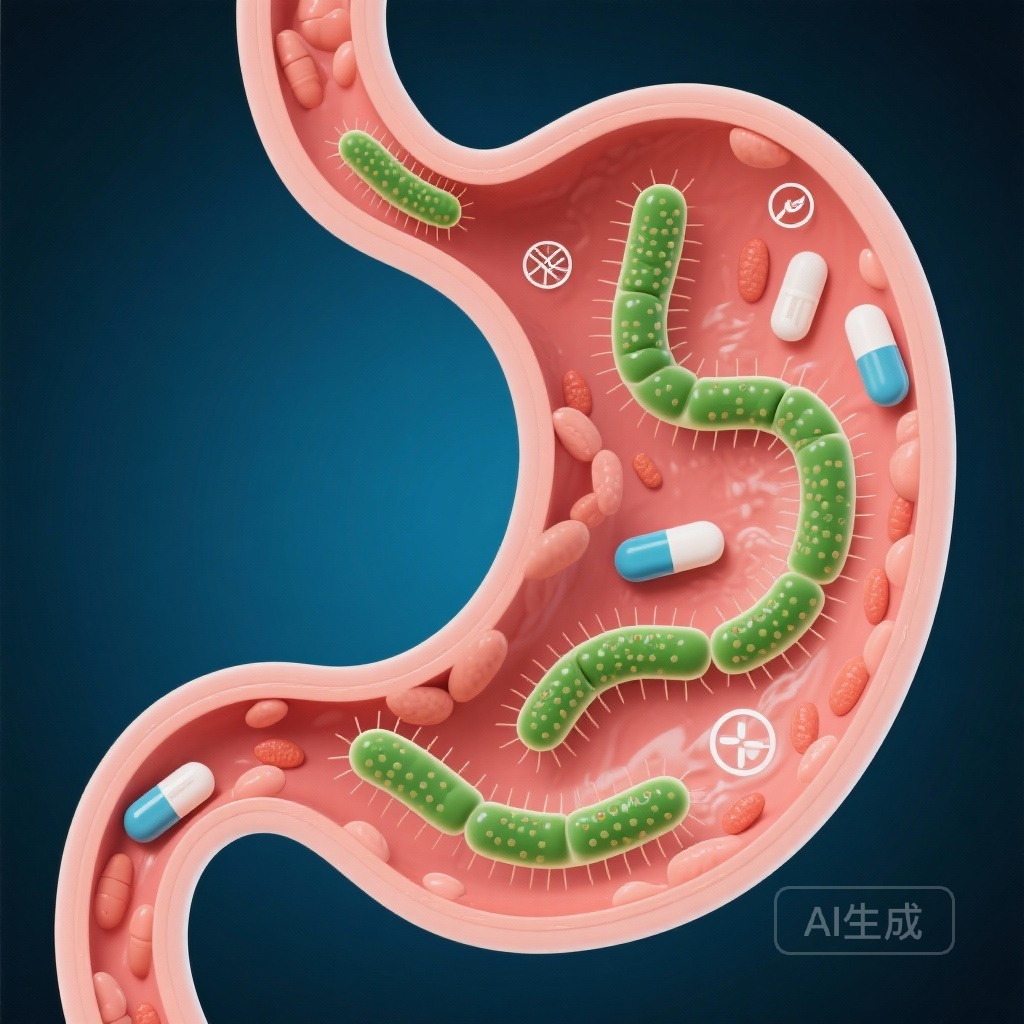
- Optimized Bismuth Quadruple Therapy (OBQT): Esomeprazole 40 mg, Amoxicillin 1 g, Metronidazole 500 mg, and Bismuth subsalicylate 369 mg. Crucially, all four components were administered three times a day (TID).
- Standard Triple Therapy (STT): Omeprazole 20 mg, Amoxicillin 1 g, and Clarithromycin 500 mg, all administered twice a day (BID).
Endpoints and Assessments
The primary outcome was successful H. pylori eradication, confirmed via a urea breath test or stool antigen test at least four weeks post-treatment. Secondary outcomes included the assessment of adverse events and treatment adherence. A significant strength of this study was the inclusion of baseline antimicrobial susceptibility testing for clarithromycin and the analysis of participants’ CYP2C19 genotypes to evaluate how PPI metabolism influenced success rates.
Key Findings and Results
The study enrolled 127 treatment-naïve participants, with 64 assigned to the STT group and 63 to the OBQT group. Baseline characteristics, including age, sex, and comorbidities, were well-balanced between the cohorts.
Eradication Success
The results demonstrated a clear and statistically significant superiority of the optimized quadruple regimen. In the intention-to-treat (ITT) analysis:
- OBQT: 95% eradication (60/63; 95% CI: 86%–99%)
- STT: 81% eradication (52/64; 95% CI: 70%–89%)
The p-value of 0.033 confirms that the OBQT regimen is significantly more effective than the current standard. These findings are particularly noteworthy as they align with the Maastricht VI/Florence consensus guidelines, which suggest that a first-line therapy should ideally achieve an eradication rate of over 90%.
Impact of Resistance and Genotype
The study found that the presence of clarithromycin resistance did not diminish the efficacy of the OBQT regimen. Furthermore, variations in the CYP2C19 gene—which can lead to rapid PPI metabolism and subsequent treatment failure in traditional BID regimens—did not significantly impact the OBQT group. This suggests that the high-dose, TID administration of esomeprazole in the optimized regimen provides more stable acid suppression, neutralizing the effect of genetic polymorphisms.
Safety and Tolerability
One of the primary concerns with quadruple therapies is the potential for increased toxicity due to the higher number of medications. However, this study found no significant difference in safety outcomes:
- OBQT Adverse Events: 67% (42/63)
- STT Adverse Events: 66% (42/64)
The p-value of 1.00 indicates that the optimized regimen was as well-tolerated as the triple therapy. Most adverse events were mild to moderate, and adherence remained high in both groups. This dispels the notion that more complex bismuth-based regimens necessarily lead to poorer patient compliance.
Expert Commentary and Clinical Implications
The results of this trial have profound implications for the management of H. pylori in regions with high clarithromycin resistance. The 95% eradication rate achieved by the OBQT regimen is exceptional and suggests that “optimizing” the regimen—specifically through TID dosing and the addition of bismuth—is the key to overcoming resistance.
By using bismuth subsalicylate, the regimen benefits from its synergistic antimicrobial effects and its ability to disrupt bacterial biofilms, which often shield H. pylori from antibiotics. Additionally, the use of high-dose esomeprazole (40 mg TID) ensures that the intragastric pH remains consistently elevated, which is vital for the stability and activity of amoxicillin and metronidazole.
While the sample size of 127 is relatively modest, the double-blind, randomized design provides high-level evidence. The findings suggest that clinicians should move away from clarithromycin-based triple therapy as an empiric first-line choice in Chile and similar high-resistance environments, adopting bismuth quadruple therapy as the new standard of care.
Conclusion
This randomized controlled trial confirms that optimized bismuth quadruple therapy is a highly effective, safe, and reliable first-line treatment for H. pylori eradication. With a 95% success rate and a safety profile comparable to standard therapy, OBQT offers a robust solution to the growing challenge of antibiotic resistance. Its implementation could significantly reduce the long-term burden of H. pylori-related gastric diseases, including peptic ulcers and gastric cancer.
Funding and Trial Registration
This study was supported by FONDECYT (1230504 AR), ANID-FONDAP (152220002 AR), the Horizon 2020 program of the European Union (825832 AR), and ANID-FONDAP (15130011). The trial is registered at clinicaltrials.gov under the number NCT05664685.
References
1. Medel-Jara PA, Latorre G, Fuentes-Lopez E, et al. Comparison between optimized bismuth quadruple therapy and standard clarithromycin-based triple therapy for first-line Helicobacter pylori eradication: a double-blind randomized controlled trial. Lancet Reg Health Am. 2025;53:101312. doi:10.1016/j.lana.2025.101312.
2. Malfertheiner P, Megraud F, Rokkas T, et al. Management of Helicobacter pylori infection: the Maastricht VI/Florence consensus report. Gut. 2022;71(9):1724-1762.
3. Hooi JKY, Lai WY, Ng WK, et al. Global Prevalence of Helicobacter pylori Infection: Systematic Review and Meta-Analysis. Gastroenterology. 2017;153(2):420-429.