

要点
- 左甲状腺素治疗对伴有亚临床甲状腺功能减退症(subclinical hypothyroidism,SCH)的老年人群脂质及心代谢生物标志物的总体影响较小。
- 在基线促甲状腺激素(thyroid-stimulating hormone,TSH)≥10 mIU/L的人群中,观察到脂质及脂蛋白谱可能获益的变化,仍需进一步研究。
- 随机对照试验和Meta分析提示,左甲状腺素的降脂作用在较年轻或病情较轻的SCH人群中更为明显。
- 八段锦等辅助性生活方式干预,可能通过改善血脂并降低老年SCH患者TSH,与药物治疗形成互补。
背景
亚临床甲状腺功能减退症(subclinical hypothyroidism,SCH)以促甲状腺激素(thyroid-stimulating hormone,TSH)升高而循环甲状腺激素水平正常为特征,在老年人中较为常见,患病率可高达10%~15%。该病常与血脂异常及心血管风险升高相关,其部分机制与甲状腺激素影响肝脏低密度脂蛋白受体表达及脂蛋白周转有关,从而改变脂质代谢。由于显性甲状腺功能减退症明确会增加心血管风险且可对左甲状腺素治疗产生反应,因此左甲状腺素在SCH中的作用仍是研究热点,尤其是在老年人群中,其获益-风险比尚未明确。
心代谢生物标志物,包括详细血脂谱及代谢组学特征,是评估心血管风险的敏感指标,也可能有助于发现超出传统临床终点(如心血管事件)的细微治疗反应。
核心内容
左甲状腺素对老年SCH患者心代谢生物标志物的影响
Ao等于2026年发表的具有里程碑意义的事后分析,基于两项双盲随机对照试验(randomized controlled trials,RCTs)数据,评估了286例年龄≥65岁的SCH成人对左甲状腺素治疗的心代谢生物标志物反应。研究采用核磁共振波谱技术,分析了7项核心脂质指标(ApoB、总胆固醇、非高密度脂蛋白胆固醇(non-HDL-C)、残余胆固醇、低密度脂蛋白胆固醇(LDL-C)、高密度脂蛋白胆固醇(HDL-C)、甘油三酯)以及167项代谢组标志物。
总体而言,左甲状腺素治疗在12个月时对ApoB(-0.03 g/L)、总胆固醇(-0.17 mmol/L)、non-HDL-C(-0.15 mmol/L)、残余胆固醇(-0.09 mmol/L)、LDL-C(-0.07 mmol/L)或甘油三酯(-0.07 mmol/L)均未带来统计学显著改善。值得注意的是,对基线TSH≥10 mIU/L的参与者(n=27)进行亚组分析后,除HDL-C外,几乎所有脂质参数均显示名义上显著的有利变化,同时Apolipoprotein B-containing lipoproteins、极低密度脂蛋白(very-low-density lipoprotein,VLDL)粒径及脂肪酸谱亦有所改善,但这些结果在多重检验校正后未能保留统计学显著性。这提示TSH升高可能存在阈值效应,即在甲状腺功能减退程度更明显的SCH中,左甲状腺素对纠正血脂异常的效果更佳。
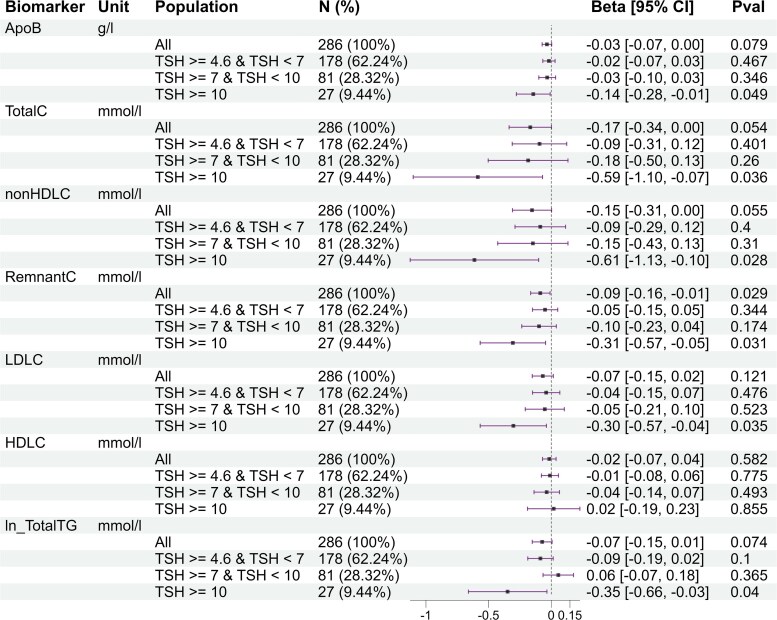
The effects of levothyroxine treatment on lipid-related biomarkers for all included participants and TSH-stratified groups. This figure shows the estimated effects (β and 95% confidence interval) based on the primary ANCOVA models for the corresponding metabolic biomarker in different population groups. The “Pval” column indicates the P-values of tests for the estimated associations in the corresponding population group.
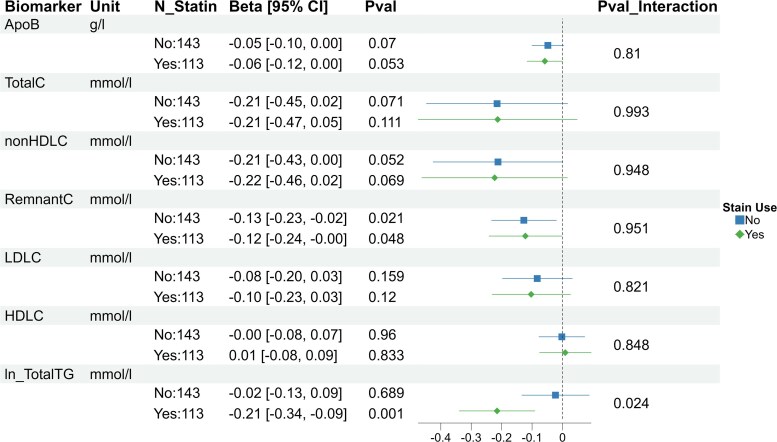
The effects of levothyroxine therapy on metabolic biomarkers in a subgroup stratified by baseline statin use. The “N_Statin” column shows the number of participants without (No) and with (Yes) taking statins at baseline. The “Beta [95% CI]” column indicates the estimated β and 95% confidence interval in subgroups not taking statins and those taking statins at baseline, respectively. The “Pval” column indicates the P-values of tests for the estimated associations in subgroups not taking statins and those taking statins at baseline, respectively. The “Pval_Interaction” column shows the results of the interaction tests between levothyroxine treatment and baseline statin use.
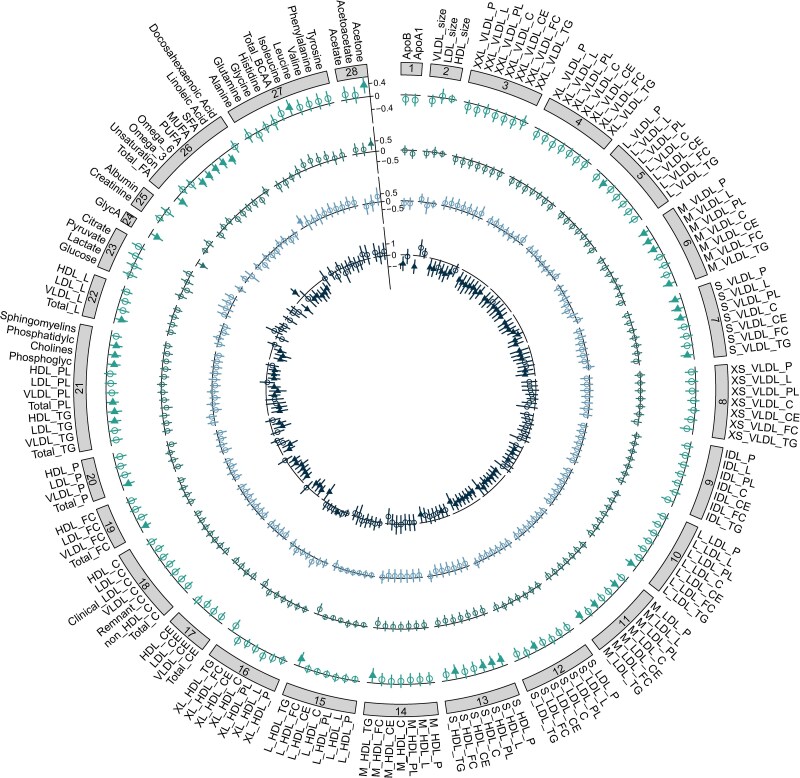
The effects of levothyroxine therapy on standardized metabolomic measurements for all included participants and TSH-stratified groups. From outer to inner circles, each circle represents the estimated β and 95% confidence interval based on the ANCOVA models for all participants (n = 228), participants with baseline TSH ≥ 4.6 and TSH < 7 mIU/L (n = 143), participants with baseline TSH ≥ 7 and TSH < 10 mIU/L (n = 62), participants with baseline TSH ≥ 10 mIU/L (n = 23), respectively. Hollow dots, solid triangles, and solid diamonds indicate estimates with P > .05, estimates with P < .05, and estimates with P < 1.79e-3, respectively. Numbers indicate groups: (1) Apolipoproteins; (2) Lipoprotein particle sizes; (3) Extremely large VLDL; (4) Very large VLDL; (5) Large VLDL; (6) Medium VLDL; (7) Small VLDL; (8) Very small VLDL; (9) IDL; (10) Large LDL; (11) Medium LDL; (12) Small LDL; (13) Small HDL; (14) Medium HDL; (15) Large HDL; (16) Very large HDL; (17) Cholesteryl esters; (18) Cholesterol; (19) Free cholesterol; (20) Lipoprotein particle concentrations; (21) Glycerides and phospholipids. (22) Total lipids; (23) Glycolysis-related metabolites; (24) Inflammation; (25) Fluid balance; (26) Fatty acids; (27) Amino acids; (28) Ketone bodies.
既往证据与比较研究
早期RCT和Meta分析提供了结果不尽相同但具有参考价值的证据:
- Rodondi等(2017)的Meta分析发现,SCH患者接受左甲状腺素治疗后,TSH下降66%,总胆固醇和LDL胆固醇分别下降约9%和14%,而其他脂质指标未见明显变化。这支持左甲状腺素具有适度降脂获益,尤其体现在LDL-C下降方面。
- 较年轻或中年成人的随机试验(如2001年巴塞尔甲状腺研究、Whickham队列)观察到,左甲状腺素替代治疗后LDL-C和总胆固醇明显下降,心血管症状也有所改善,且当TSH水平>8~10 mIU/L时尤为显著。
- TRUST试验及相关老年人研究显示,左甲状腺素治疗12个月并未显著降低心血管结局或脂质生物标志物,进一步印证了在TSH轻度升高的老年人群中,其血脂改善作用有限。
- 左甲状腺素与他汀治疗的比较研究提示,尽管他汀可显著改善SCH患者的血脂谱和内-中膜厚度(intima-media thickness,IMT),左甲状腺素对血脂的作用可能较弱,但其可能通过非脂质机制降低颈动脉IMT。
生活方式及辅助治疗
2025年一项RCT研究将八段锦纳入伴轻度SCH和轻度认知障碍的老年女性干预方案,结果显示,与单用左甲状腺素相比,该方案在改善血脂、血压和TSH水平方面获益更大,提示体力活动和生活方式调整可能与甲状腺激素治疗协同,以优化心代谢健康。
其他终点与器官系统
关于左甲状腺素对SCH患者非脂质性心代谢参数,如内皮功能、胰岛素抵抗、氧化应激及肾功能的影响,研究结果较为异质。例如,在合并SCH的糖尿病肾病患者中,L-thyroxine治疗可降低氧化应激标志物并减少蛋白尿,提示其可能具有肾脏保护潜力。
专家点评
Ao等及既往研究的细致结果强调了老年SCH管理的复杂性。尽管左甲状腺素能够有效使TSH恢复正常,但其改善脂质生物标志物谱的能力会随着年龄增长及TSH升高程度较轻而减弱。这可能与年龄相关的甲状腺激素敏感性改变、合并症对脂质代谢的混杂影响,或传统脂质指标对治疗效应捕捉能力不足有关。
亚组分析中TSH≥10 mIU/L患者出现脂质改善的趋势,与现有指南建议相一致:由于进展及并发症风险更高,TSH超过该阈值时可考虑治疗。然而,该亚组样本量较小,限制了结论的确定性,多重检验校正也降低了统计学可信度。
此外,左甲状腺素对HDL-C和甘油三酯作用有限,也符合其主要通过LDL受体介导促进LDL清除,而非全面调节脂质代谢的机制特点。
SCH患者脂质反应不一致,还可能与甲状腺自身免疫状态、肥胖程度以及影响脂蛋白(a)和其他致动脉粥样硬化颗粒的遗传易感性差异有关。
临床医生应权衡潜在的轻度降脂获益与过度治疗风险,尤其是在老年人中,如心房颤动和骨量丢失。基于TSH水平、症状表现及心血管风险状况进行个体化治疗更为稳妥。
最后,支持生活方式干预的新兴证据提示,在部分老年患者中,可考虑将非药物措施与左甲状腺素联合应用,或在适当情形下替代其使用。
结论
在总体人群层面,左甲状腺素治疗老年亚临床甲状腺功能减退症并不能显著改变心代谢生物标志物;但基线TSH较高(≥10 mIU/L)的患者可能获得一定程度的血脂改善。这些发现提示,老年SCH患者的治疗应采取谨慎、个体化策略,不应仅依据血脂指标,而应综合症状缓解及心血管风险因素进行评估。未来需要开展大样本、长随访期的RCT,并整合代谢组学生物标志物、按TSH严重程度分层,以进一步优化治疗指南并阐明左甲状腺素影响心代谢健康的机制路径。
参考文献
- Ao L, Noordam R, Trompet S, et al. Levothyroxine treatment response of cardiometabolic biomarkers in older adults with subclinical hypothyroidism. J Clin Endocrinol Metab. 2026;111(9):2445-2455. PMID:41965091
- Rodondi N, den Elzen WP, Bauer DC, et al. Subclinical hypothyroidism and the risk of coronary heart disease and mortality. J Clin Endocrinol Metab. 2010;95(4):1554-1563. PMID:20130033
- Razvi S, Weaver JU, Butler TJ, Pearce SH. Levothyroxine treatment of subclinical hypothyroidism and myocardial function (randomized controlled trial). J Clin Endocrinol Metab. 2012;97(7):2466-2475. PMID:22551843
- Van Vliet NA, Batterham RL, van Heemst D, Mooijaart SP. Cardiovascular risk and treatment of subclinical hypothyroidism in the elderly: reviewing the evidence. Curr Opin Endocrinol Diabetes Obes. 2015;22(5):395-402. PMID:26277555
- Chen YJ, Yu B, Miao Y, et al. Effects of levothyroxine on lipid profiles and carotid artery intima-media thickness in subclinical hypothyroidism: A meta-analysis of randomized controlled trials. Lipids Health Dis. 2019;18(1):131. PMID:31242342
- Zhou XY, Hu JM, Jiang H, et al. Effects of Baduanjin exercise on lipid profile and thyroid function in elderly women with subclinical hypothyroidism: A randomized controlled trial. Geriatr Nurs. 2025;64:103434. PMID:40582060
