Highlights
Unprecedented Survival Data
The combination of zanidatamab, tislelizumab, and CAPOX chemotherapy achieved a median overall survival (mOS) of 32.4 months, a significant milestone in the first-line treatment of HER2-positive advanced gastric cancer.
Robust Response Rates
Investigator-assessed confirmed objective response rate (cORR) reached 75.8%, with a median duration of response (mDoR) extending to nearly two years (23.3 months).
Manageable Safety Profile
While treatment-related adverse events were frequent, particularly diarrhea, the majority were manageable with standard supportive care, supporting the feasibility of this intensive triplet regimen.
Introduction: The Shifting Paradigm in HER2-Positive Gastric Cancer
Gastric and gastroesophageal junction adenocarcinoma (GC/GEJC) remains a global health challenge, characterized by high mortality and limited therapeutic options in the advanced stages. Approximately 15% to 20% of these tumors overexpress Human Epidermal Growth Factor Receptor 2 (HER2), a well-established oncogenic driver. For over a decade, the standard of care for HER2-positive (HER2+) advanced disease was limited to the combination of trastuzumab and chemotherapy, based on the landmark ToGA trial.
Recent years have seen the integration of immune checkpoint inhibitors, such as pembrolizumab, into this landscape following the KEYNOTE-811 study. However, there remains a critical unmet need for more potent HER2-targeted agents that can overcome resistance mechanisms and provide more durable clinical benefits. Enter zanidatamab, a novel, humanized, bispecific (biparatopic) antibody that targets two non-overlapping epitopes of the HER2 protein.
Zanidatamab: A Novel Biparatopic Approach to HER2 Inhibition
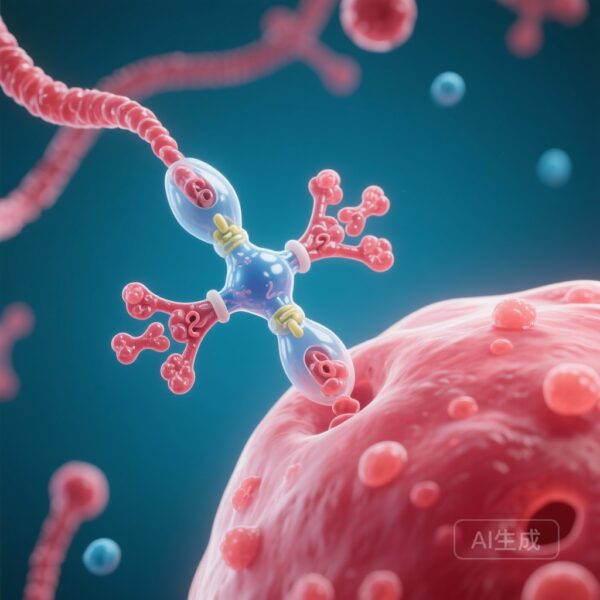
Unlike trastuzumab, which binds solely to the juxtamembrane domain (ECD4) of the HER2 receptor, zanidatamab is engineered to bind simultaneously to both ECD4 and the dimerization domain (ECD2). This dual binding, or biparatopic targeting, induces several unique mechanisms of action:
1. Enhanced Receptor Clustering: By cross-linking HER2 receptors, zanidatamab facilitates the formation of large receptor-antibody complexes on the cell surface.
2. Increased Receptor Internalization: These complexes are more efficiently internalized and degraded by the cell, leading to a more profound downregulation of HER2 signaling.
3. Potent Effector Function: The antibody is designed to enhance antibody-dependent cellular cytotoxicity (ADCC) and antibody-dependent cellular phagocytosis (ADCP), recruiting the patient’s immune system to destroy tumor cells.
By combining this potent HER2-targeted agent with tislelizumab (an anti-PD-1 monoclonal antibody) and standard chemotherapy (CAPOX), researchers aimed to leverage synergistic pathways to maximize tumor control.
Trial Architecture: The NCT04276493 Study Design
This phase 1b/2 multi-center study evaluated the safety, tolerability, and efficacy of the combination in treatment-naive patients with HER2+ GC/GEJC. The study was divided into two cohorts to explore different zanidatamab dosing strategies:
Patient Population
Adult patients with histologically confirmed, unresectable, locally advanced or metastatic HER2+ GC/GEJC. All patients had an ECOG performance status of 0 or 1 and had not received prior systemic therapy for advanced disease.
Intervention and Dosing
Patients received treatment in 21-day cycles (Q3W):
– Cohort A: Zanidatamab 30 mg/kg IV.
– Cohort B: Zanidatamab 1800 mg (weight < 70 kg) or 2400 mg (weight ≥ 70 kg) IV.
– Both Cohorts: Tislelizumab 200 mg IV plus standard CAPOX (capecitabine 1000 mg/m2 orally twice daily on days 1–14 and oxaliplatin 130 mg/m2 IV on day 1).
Endpoints
The primary endpoints were investigator-assessed cORR (per RECIST v1.1) and the frequency/severity of adverse events (AEs). Secondary endpoints included progression-free survival (PFS), duration of response (DoR), overall survival (OS), and pharmacokinetics (PK).
Clinical Efficacy: Deep and Durable Responses
As of the data cutoff in December 2023, 33 patients were evaluable for efficacy. The results demonstrate a high level of clinical activity that compares favorably with historical controls.
Objective Response and Durability
The confirmed objective response rate (cORR) was 75.8%, indicating that three out of four patients experienced a significant reduction in tumor burden. Perhaps more impressive was the durability of these responses. The median DoR was 23.3 months, suggesting that once a response is achieved, it is often maintained for nearly two years.
Survival Outcomes
The median PFS was recorded at 16.7 months. Most notably, the median OS reached 32.4 months. In the context of advanced gastric cancer, where median survival has historically hovered around 12 to 16 months with trastuzumab-based regimens, these figures represent a substantial step forward in extending the lives of patients with HER2+ disease.
Safety Analysis: Navigating the Toxicity Landscape
The intensification of therapy with a bispecific antibody, a PD-1 inhibitor, and doublet chemotherapy naturally raises concerns regarding toxicity. The safety profile observed in this study was generally consistent with the known effects of the individual components.
Common Adverse Events
The most frequent treatment-related adverse events (TRAEs) of any grade were:
– Diarrhea (100%)
– Nausea (63.6%)
– Decreased appetite (48.5%)
Severe Toxicities
Grade 3 or higher TRAEs occurred in 66.7% of patients. Diarrhea was the most frequent high-grade event, affecting 27.3% of the cohort. While the incidence of diarrhea was universal, researchers noted that it was typically manageable with prophylactic or reactive anti-diarrheal medications and dose modifications. No new safety signals were identified, and the toxicity profile did not preclude the continued development of the regimen.
Expert Perspective: Reshaping the First-Line Standard
The integration of zanidatamab into the first-line setting represents a sophisticated evolution of HER2-targeted therapy. Clinical experts suggest that the biparatopic nature of zanidatamab may provide a more complete blockade of the HER2 pathway, potentially delaying the onset of resistance compared to trastuzumab. Furthermore, the combination with tislelizumab may enhance the immune-mediated effects of zanidatamab, such as ADCC, by reinvigorating T-cells within the tumor microenvironment.
While the 100% incidence of diarrhea is a point of clinical focus, the survival benefit observed—specifically an OS exceeding 32 months—offers a compelling trade-off for many clinicians and patients. These results place zanidatamab as a highly competitive candidate in the HER2+ GC space, especially as the field moves toward more personalized, multi-targeted approaches.
Conclusion and Future Directions
The Phase 1b/2 study of zanidatamab in combination with tislelizumab and CAPOX has demonstrated clinically meaningful antitumor activity and a manageable safety profile in patients with HER2+ GC/GEJC. The high response rates and prolonged survival outcomes provide a strong rationale for the ongoing Phase 3 HERIZON-GEA-01 trial (NCT05152147), which is further evaluating this combination in a larger, randomized patient population.
If the Phase 3 data confirm these findings, this zanidatamab-based triplet could potentially replace the current standard of care, offering a new hope for patients facing this aggressive malignancy.
Funding and Clinical Registration
This study was funded by Zymeworks Inc. and BeiGene, Ltd. The trial is registered at ClinicalTrials.gov under the identifier NCT04276493. The ongoing Phase 3 confirmatory study is registered as NCT05152147.
References
1. Lee KW, Bai LY, Jung M, et al. Phase 1b/2 Study of Zanidatamab in Combination with Tislelizumab and Chemotherapy in First-Line HER2-Positive Gastric/Gastroesophageal Junction Adenocarcinoma. Clin Cancer Res. 2025 Dec 1. doi: 10.1158/1078-0432.CCR-24-4295.
2. Janjigian YY, Kawazoe A, Yañez P, et al. The KEYNOTE-811 trial of pembrolizumab plus trastuzumab and chemotherapy for HER2-positive gastric or gastro-oesophageal junction adenocarcinoma: interim results from a phase 3, randomised, double-blind, placebo-controlled study. Lancet. 2021;398(10311):1595-1606.
3. Meric-Bernstam F, Beeram M, Hamilton E, et al. Zanidatamab, a novel bispecific antibody, for the treatment of HER2-expressing solid tumors: results from a phase 1 study. Lancet Oncol. 2022;23(12):1558-1570.