Highlights
- Adjunctive use of Limosilactobacillus reuteri in periodontitis patients with diabetes does not provide additional clinical or microbiological improvements over standard subgingival instrumentation.
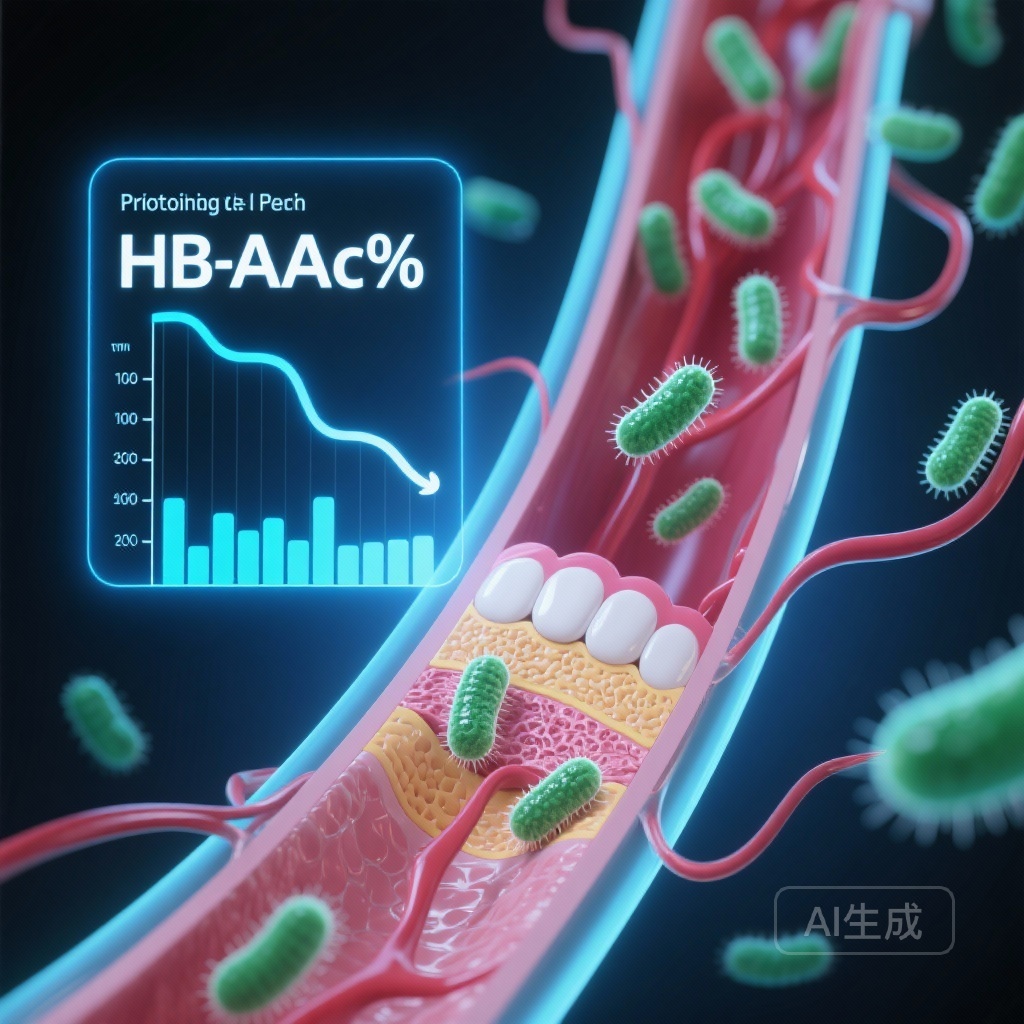
- The probiotic group demonstrated a statistically significant reduction in HbA1c levels (-0.6%) compared to the placebo group (-0.1%) at 6 months.
- The inter-group difference in HbA1c was -0.5% (p < 0.001), representing a clinically relevant systemic metabolic improvement.
- These findings suggest that oral probiotics may exert systemic anti-inflammatory effects that transcend localized dental outcomes.
Introduction: The Bi-directional Link Between Diabetes and Periodontal Disease
The relationship between diabetes mellitus and periodontitis is one of the most well-documented examples of the oral-systemic link in clinical medicine. This bidirectional relationship suggests that diabetes increases the risk and severity of periodontitis, while chronic periodontal inflammation complicates glycemic control by increasing systemic inflammatory mediators. For clinicians, the challenge has always been to find interventions that address both the local destruction of the periodontium and the systemic metabolic burden.
Subgingival instrumentation (SI), the gold standard for treating periodontitis, aims to reduce the bacterial load and inflammatory response. However, patients with diabetes often exhibit a suboptimal response to standard mechanical therapy due to impaired immune function and delayed wound healing. Recently, probiotics, specifically Limosilactobacillus reuteri, have gained attention as potential adjuncts. Known for their antimicrobial and immunomodulatory properties, these probiotics are hypothesized to shift the oral microbiome toward a symbiotic state and dampen the systemic pro-inflammatory cytokine cascade.
Study Methodology: A Triple-Blinded Randomized Controlled Trial
The study by Bujaldón et al. (2026) was designed as a 6-month, randomized, triple-blinded, placebo-controlled clinical trial. The researchers enrolled 40 patients diagnosed with both periodontitis and diabetes who had not received prior periodontal treatment. All participants underwent steps 1 and 2 of periodontal therapy, which included oral hygiene instruction and meticulous subgingival instrumentation.
Following the mechanical therapy, patients were randomized into two groups:
Experimental Group
Participants received oral tablets containing Limosilactobacillus reuteri (strains DSM 17938 and ATCC PTA 5289) to be taken twice daily for three months.
Control Group
Participants received a placebo tablet with the same appearance and taste, following the same administration schedule.
The primary outcome measure was the change in mean probing depth (PD). Secondary outcomes included clinical attachment level (CAL), bleeding on probing (BOP), microbiological profiles (analyzed via PCR), and systemic metabolic status measured by glycosylated hemoglobin (HbA1c) levels. Assessments were conducted at baseline, 3 months, and 6 months.
Clinical and Microbiological Outcomes: Parity Between Groups
The clinical results at the 6-month mark presented a nuanced picture. Both the probiotic and placebo groups achieved statistically significant improvements in periodontal parameters compared to their respective baselines. The mean probing depth reduction was 0.9 mm in the probiotic group and 0.8 mm in the placebo group. However, when comparing the two groups directly, no statistically significant differences were found in PD, CAL, or BOP.
Microbiologically, the study sought to identify changes in the prevalence of key periodontopathogens, such as Porphyromonas gingivalis and Aggregatibacter actinomycetemcomitans. While both groups saw a reduction in the total bacterial load following mechanical therapy, the addition of L. reuteri did not result in a superior microbiological shift compared to the placebo. This suggests that for the mechanical reduction of the oral biofilm, SI remains the primary driver of success, and the local ecological impact of L. reuteri may be limited in the presence of established diabetic complications.
Systemic Impact: Significant Reductions in Glycosylated Hemoglobin (HbA1c)
The most compelling finding of this trial was the impact on systemic health. Despite the lack of additional local clinical benefits, the probiotic group showed a much more pronounced reduction in HbA1c levels. Over the 6-month period, the probiotic group experienced a mean reduction of 0.6% in HbA1c, whereas the placebo group saw a negligible reduction of 0.1%.
The inter-group difference of -0.5% (95% CI [-1.0; 0.0]; p < 0.001) is particularly significant in a clinical context. In the management of diabetes, a 0.5% reduction in HbA1c is often considered the threshold for clinical relevance, as it is associated with a significant decrease in the risk of microvascular complications. This finding suggests that L. reuteri may have a systemic effect that is not strictly mediated by the local resolution of periodontal pockets.
Mechanistic Insights: How Probiotics Influence Systemic Inflammation
The disparity between the clinical periodontal results and the systemic metabolic results invites a deeper look into the mechanisms of action. Probiotics like L. reuteri are known to produce reuterin, a potent antimicrobial substance, but their more significant role in this context may be immunomodulation. It is hypothesized that these probiotics can reduce the production of pro-inflammatory cytokines such as Tumor Necrosis Factor-alpha (TNF-α) and Interleukin-6 (IL-6) in the gut and potentially the oral mucosa.
In patients with diabetes, systemic inflammation is a major contributor to insulin resistance. By modulating the host’s inflammatory response, L. reuteri may improve insulin sensitivity, thereby lowering HbA1c. This systemic benefit occurred even though the local periodontal improvement was similar in both groups, suggesting that the probiotic might be working through pathways independent of the mechanical closure of periodontal pockets.
Expert Commentary and Clinical Implications
From a clinical perspective, this study highlights the importance of looking beyond the tooth and gums when treating patients with systemic comorbidities. While the dental community often focuses on probing depths and attachment levels, the ultimate goal for a patient with diabetes is metabolic stability. The fact that a simple, non-invasive oral probiotic could contribute a 0.5% reduction in HbA1c is a finding that should interest both periodontists and endocrinologists.
However, limitations must be noted. The sample size of 40 patients is relatively small, and the 6-month duration, while standard for periodontal trials, may not capture the long-term sustainability of the HbA1c reduction. Furthermore, the lack of significant local clinical improvement suggests that probiotics should not be viewed as a substitute for thorough subgingival instrumentation but rather as a potential metabolic support tool.
Conclusion: A Shift Towards Holistic Management
The trial by Bujaldón et al. reinforces the concept that periodontal therapy is a component of systemic healthcare. While Limosilactobacillus reuteri did not provide a ‘magic bullet’ for deeper pocket reduction in diabetic patients, its systemic impact on glycemic control is undeniable and clinically valuable. Future research should focus on larger cohorts and explore whether the systemic benefits are maintained after the discontinuation of the probiotic regimen.
For now, clinicians may consider the adjunctive use of L. reuteri in diabetic patients not necessarily to speed up gum healing, but to support the patient’s overall metabolic health during their periodontal journey.
Funding and clinicaltrials.gov
The protocol for this study was approved by the Clinical Research Ethics Committee (CEIC) of Hospital Clínico de San Carlos (internal code 19/101-R_X). The trial was registered a priori at ClinicalTrials.gov under the identifier NCT04069611.
References
- Bujaldón R, Montero E, Gamonal JD, et al. Use of the Probiotic Limosilactobacillus reuteri as an Adjunct to Subgingival Instrumentation in the Treatment of Periodontitis Patients With Diabetes: A Randomised Clinical Trial. J Clin Periodontol. 2026;53(1):26-36.
- Sanz M, Ceriello A, Buysschaert M, et al. Scientific evidence on the links between periodontal diseases and diabetes: Consensus report and guidelines of the joint workshop on periodontal diseases and diabetes by the International Diabetes Federation and the European Federation of Periodontology. J Clin Periodontol. 2018;45(2):138-149.
- Chapple ILC, Genco R; on behalf of working group 2 of the joint EFP/AAP workshop. Diabetes and periodontal diseases: consensus report of the Joint EFP/AAP Workshop on Periodontitis and Systemic Diseases. J Periodontol. 2013;84(4 Suppl):S106-S112.