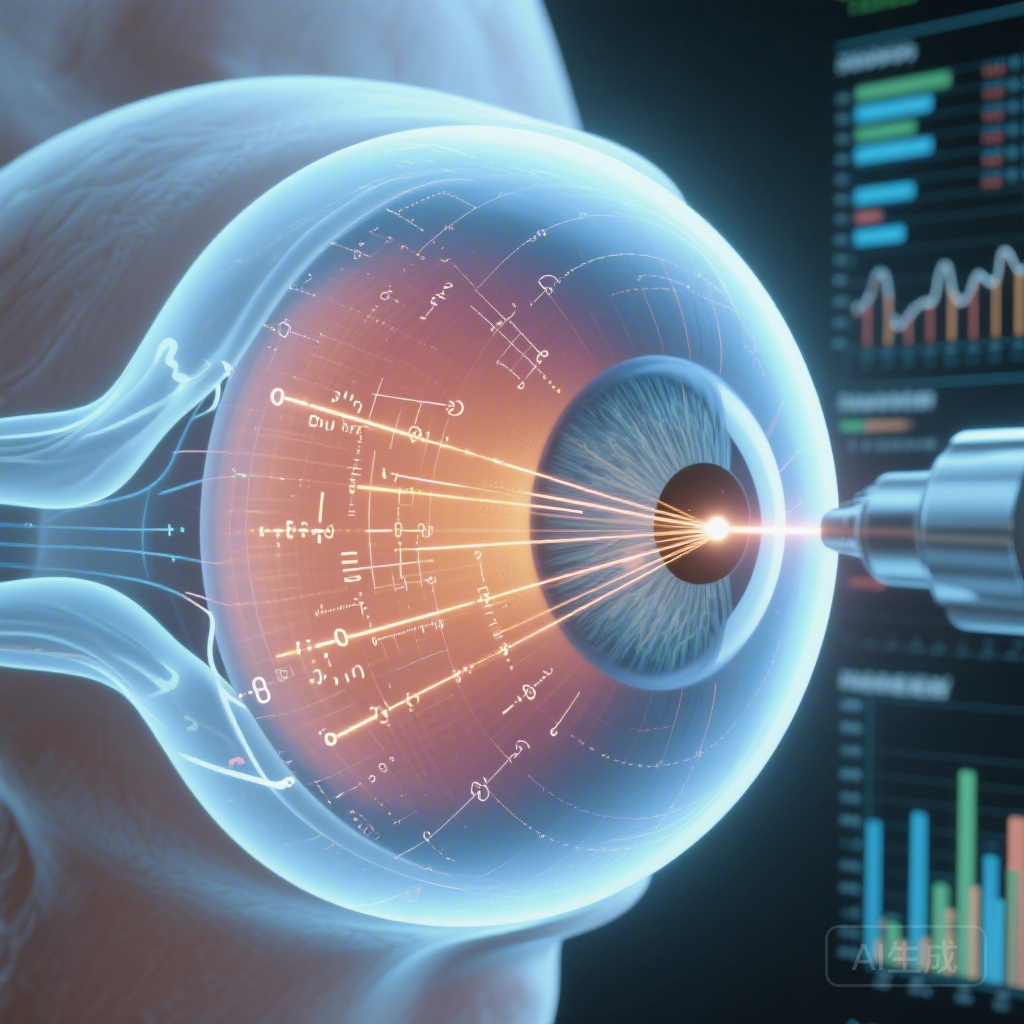
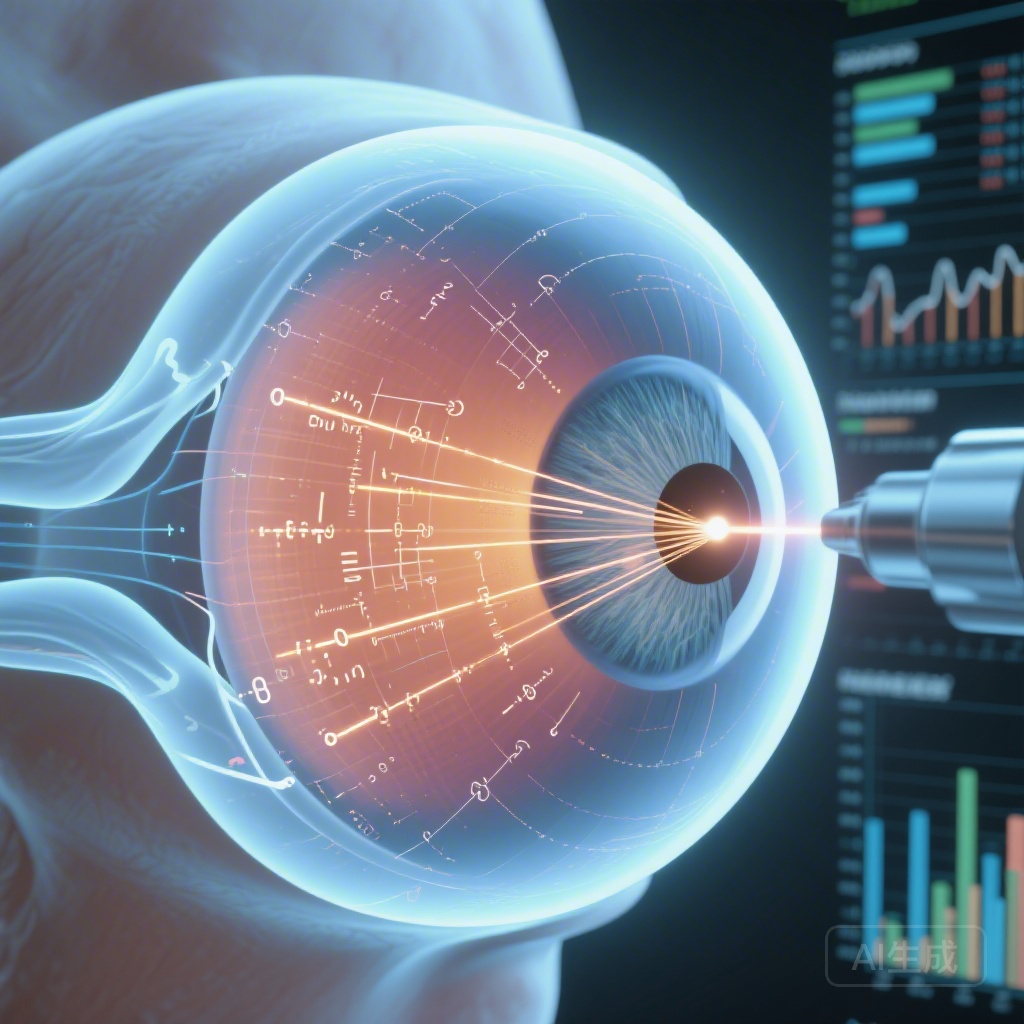
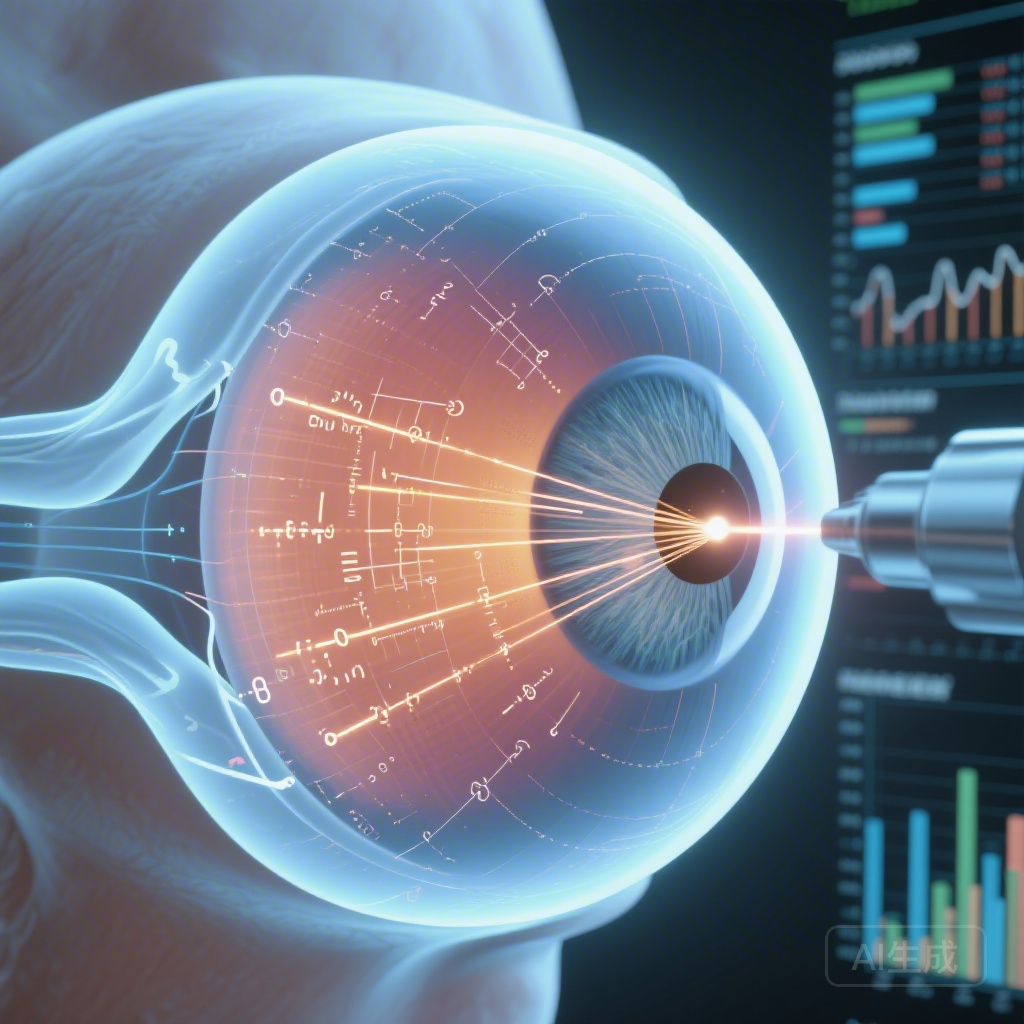
Introduction: The Growing Challenge of the Post-Refractive Eye
As the first generations of patients who underwent myopic corneal refractive surgery (MRS)—such as LASIK, PRK, and SMILE—reach the age of cataract development, ophthalmologists face a significant technical hurdle. Calculating the correct intraocular lens (IOL) power for these patients is notoriously difficult. Traditional IOL formulas often result in a hyperopic surprise, a disappointing outcome for patients who previously sought spectacle independence.
The inaccuracy in post-refractive eyes stems from three primary sources: the keratometric index error, the radius error, and the effective lens position (ELP) estimation error. Standard keratometry measures only the anterior corneal surface and assumes a fixed relationship with the posterior surface to calculate total corneal power. However, myopic refractive surgery alters the anterior surface while leaving the posterior surface largely unchanged, rendering standard keratometric indices invalid. Furthermore, many formulas use corneal power to estimate the ELP; when the cornea is flattened by surgery, the formula incorrectly predicts a shallower IOL position, leading to an underpowered lens.
Study Design: The Development and Validation of LISA MRS
In a recent study published in the American Journal of Ophthalmology, researchers developed and validated the LISA MRS formula to address these specific challenges. The study was structured in two phases: formula development and multi-center validation.
Formula Development
The development cohort included 134 patients who had undergone myopic refractive surgery (98 SMILE and 36 FS-LASIK). Researchers utilized a linear regression model to characterize the relationship between preoperative anterior corneal radius (ARC) and postoperative posterior corneal radius (PRC). This relationship is crucial for reconstructing the original corneal state to better estimate the ELP. The resulting LISA MRS formula is a thick-lens model that utilizes predicted preoperative ARC and, when available, actual PRC measurements to refine the calculation.
Multi-center Validation
The validation phase involved a retrospective analysis of 225 cataract patients with prior MRS across three different clinical centers. The performance of the LISA MRS formula (both with and without PRC data) was compared against five established formulas: Barrett True K, Emmetropia Verifying Optical (EVO), Haigis-L, Hoffer QST, and Shammas PL. The primary outcome measures were the arithmetic and absolute prediction errors, as well as the Formula Performance Index (FPI).
Key Findings: Superiority in Accuracy and Consistency
The results of the validation study suggest a significant advancement in IOL power prediction for this complex patient population. The LISA MRS formula demonstrated the highest overall performance among the tested models.
Formula Performance Index (FPI)
The FPI, a composite measure of formula accuracy, was highest for the LISA MRS formula (0.43). In comparison, the Hoffer QST achieved an FPI of 0.37, followed by EVO (0.32), and Barrett True K (0.26). This indicates that LISA MRS provides a more reliable prediction across a broad range of eye types.
Prediction Errors
LISA MRS-PRC and EVO-PRC yielded the lowest median absolute prediction error (MedAE) at 0.47 D. While both formulas performed well, a distinct advantage emerged when analyzing axial length (AL). In eyes with an AL less than 28 mm, the EVO-PRC formula performed relatively better. However, for eyes with an AL of 28 mm or greater—a common scenario in highly myopic patients—the LISA MRS-PRC formula maintained superior accuracy.
The Role of Posterior Corneal Radius (PRC)
One of the study’s most significant findings was the impact of incorporating actual posterior corneal radius measurements. The researchers found that including PRC data significantly improved the performance of the Barrett True K, LISA MRS, and Hoffer QST formulas (all P < 0.05). In the post-refractive eye, the posterior cornea remains the only stable anatomical reference for the original corneal curvature. By measuring the PRC rather than assuming it based on a population average, clinicians can drastically reduce the keratometric index error.
The study noted that postoperative posterior keratometry (PK) was a strong predictor of preoperative ARC, with an R-squared value of 0.82. This relationship allowed the LISA MRS formula to effectively ‘back-calculate’ the eye’s original state, leading to a more precise ELP estimation.
Clinical Implications and Expert Commentary
For clinical practice, these findings suggest that the LISA MRS formula should be considered a primary tool for IOL calculation in patients with a history of LASIK or SMILE, particularly those with high myopia and long axial lengths. The ability of the formula to maintain accuracy in eyes with AL ≥ 28 mm is a critical improvement, as these patients are often the most difficult to calculate for and have the highest expectations for visual outcomes.
Expert commentary highlights that while the EVO-PRC is a strong contender for standard-length eyes, the LISA MRS provides a specialized advantage for the high-myope demographic. Furthermore, the recommendation to use PRC data whenever available is becoming the new standard of care. Modern swept-source optical coherence tomography (SS-OCT) and Scheimpflug imaging devices now make obtaining PRC measurements routine, and this study provides the evidence-based justification for integrating that data into every post-refractive calculation.
Study Limitations
While the results are promising, the researchers noted that the study was retrospective in nature. Prospective studies across more diverse ethnic populations would further validate the formula’s generalizability. Additionally, while the formula performed well for both SMILE and FS-LASIK patients, the sample size for FS-LASIK in the development cohort was smaller than that for SMILE, though the changes in keratometry were comparable between the two procedures.
Conclusion
The LISA MRS formula represents a significant step forward in refractive surgery aftercare. By combining a thick-lens model with advanced regression for ELP estimation and incorporating posterior corneal data, it provides a high degree of precision for cataract patients who have previously undergone myopic correction. For surgeons, utilizing this formula—especially in highly myopic eyes—can reduce the risk of refractive surprises and improve patient satisfaction in the growing post-refractive cataract population.
References
1. Zhang J, Xie X, Yuan H, et al. Development and Validation of a new Formula for Intraocular Lens Power Calculation in Patients with Myopic Corneal Refractive Surgery. American Journal of Ophthalmology. 2026. PMID: 41819516.
2. Barrett GD. Intraocular lens calculation in eyes with prior refractive surgery. J Cataract Refract Surg. 2018;44(11):1353-1360.
3. Wang L, Koch DD. Comparison of intraocular lens power calculation methods in eyes with previous laser refractive surgery. Ophthalmology. 2021;128(11):e155-e164.